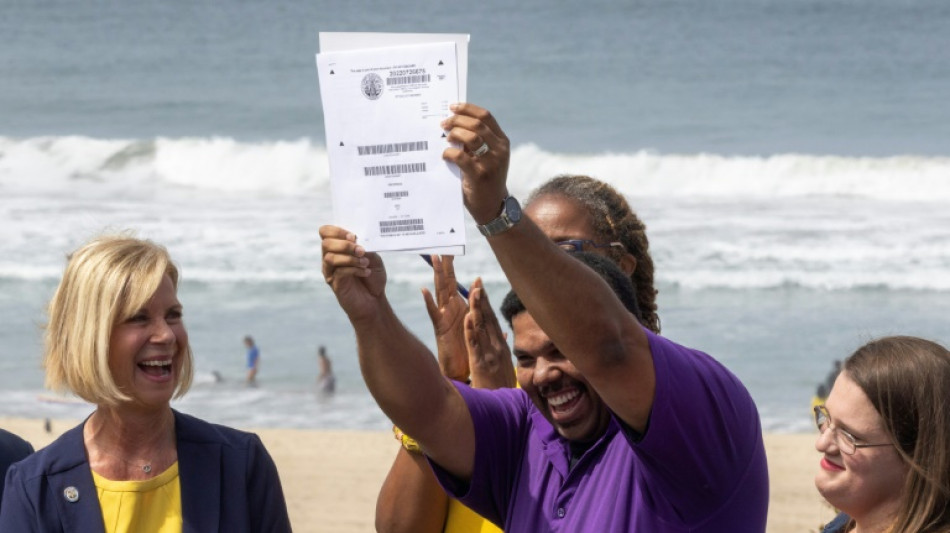
Task force recommends major reparations for Black Californians / Photo: DAVID MCNEW - GETTY IMAGES NORTH AMERICA/AFP/File

 ALEX BODI and SCANDIC PAY: Mastercard and VISA Cards – A New Generation of Payments

 Mercedes-Benz Power Converter Enables Individual Cell Control for Improved EV Efficiency

 Search Underway for 'Dooars Rani' Tigress After Second Escape from Buxa Tiger Reserve

 IIM Indore Announces IPMAT 2027 Exam Date for April 24

 The Dilemma of Recording Live Music: Preserving Memories vs. Being Present

 ANC’s Renewal Rhetoric Fades as Voters Reject Party in 2026 Local Elections

 Foreign Investors Return to Indian Markets After 10-Month Selloff

 Honda CR-V and Toyota RAV4 Lead Canada’s Most Stolen Vehicles List for 2025
California should pay substantial financial reparations to African-Americans to compensate for the legacy of US slavery and systemic racism, a committee report published Thursday said.
The state, known for being one of the nation's most liberal, became the first to create a task force dedicated to the issue of reparations in the wake of George Floyd's death in 2020 and amid the "Black Lives Matter" movement.
After three years, the committee's final 1,100-page report recommends that California's legislature "make a substantial initial down payment on reparations" and organize a public apology.
Although it did not directly suggest an amount of compensation, the text proposed a methodology for quantifying the harm experienced by California's African-Americans.
Black Californians, the report said, had experienced harm in a number of ways, whether to their health or via "housing discrimination," "unjust property takings," "mass incarceration and over-policing," and devaluation of their businesses.
The sum would come to $1.4 million for a 70-year-old Black resident who had suffered from all forms of discrimination, according to the report.
"Reparations for African-Americans are appropriate, they are warranted, they are necessary, they are needed," California Attorney General Rob Bonta said, adding that he hoped the legislature would "take these determinations seriously and carefully consider how to translate the proposals before them from the page in reality to action."
The topic of reparations remains a touchy subject in the United States, particularly given the sums of money that are often proposed. In March, a city-appointed reparations committee in San Francisco provoked controversy by recommending that $5 million be paid to each eligible African-American.
According to polls, a majority of Americans are opposed to the idea, and conservative Republicans have seized on the topic to accuse their Democratic opponents of "wokeism."
While California was admitted to the United States in 1850 as a free state -- meaning slavery was not legal -- many white settlers nonetheless kept their enslaved workers when moving to the area, according to the report.
The document also highlights that the Ku Klux Klan was active in the state, and that segregation occurred in California as elsewhere in the United States.
Any law approved by the legislature would also have to be signed by California Governor Gavin Newsom, who has expressed reservations about the idea of financial compensation.
"Dealing with that legacy is about much more than cash payments," Newsom said in May.
R.Veloso--PC
