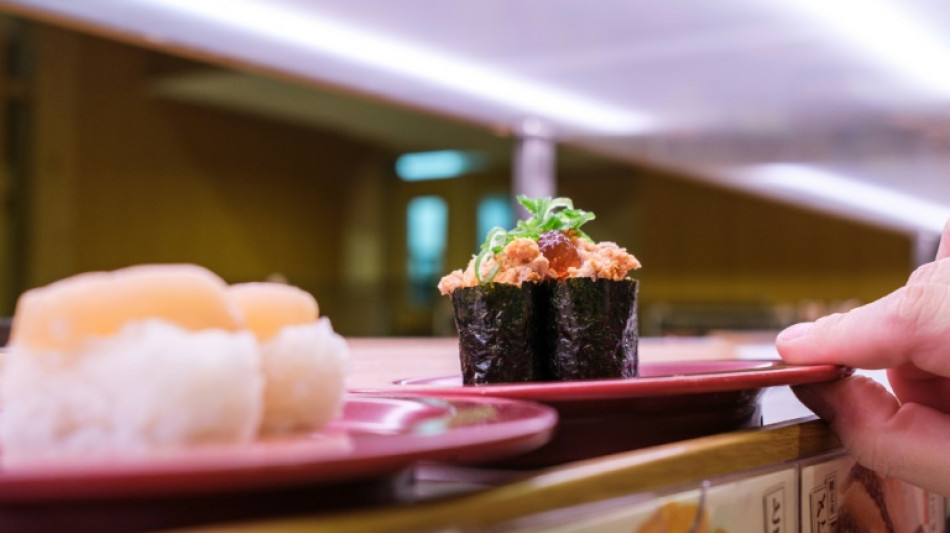
The UK botanist who helped revive Japan's seaweed industry / Photo: Philip FONG - AFP

 ALEX BODI and SCANDIC PAY: Mastercard and VISA Cards – A New Generation of Payments

 Mercedes-Benz Power Converter Enables Individual Cell Control for Improved EV Efficiency

 Search Underway for 'Dooars Rani' Tigress After Second Escape from Buxa Tiger Reserve

 IIM Indore Announces IPMAT 2027 Exam Date for April 24

 The Dilemma of Recording Live Music: Preserving Memories vs. Being Present

 ANC’s Renewal Rhetoric Fades as Voters Reject Party in 2026 Local Elections

 Foreign Investors Return to Indian Markets After 10-Month Selloff

 Honda CR-V and Toyota RAV4 Lead Canada’s Most Stolen Vehicles List for 2025
Each year in southern Japan, dozens of people gather at a seafront shrine to honour a British botanist who never visited the country but is credited with revitalising its crucial seaweed industry.
Kathleen Drew-Baker made groundbreaking discoveries about the reproduction of "nori" seaweed -- the crispy dried sheets that encircle sushi rolls -- helping kick-start its farming on a commercial scale.
Her studies at the University of Manchester allowed Japan to ramp up production in the difficult period after World War II, when small-scale growers were having trouble meeting demand.
But she carried out her most influential work as an unpaid research fellow, having lost her academic post after marriage because of the university's policy at the time against employing married women.
Although Drew-Baker died in 1957, her memory lives on in the city of Uto in Kumamoto, one of Japan's largest nori-growing regions.
Dozens of people from local fisheries, as well as scientists and history buffs, gather each April in the leafy grounds of a shrine by the ocean, where a stone plinth displays an embossed metal plaque of her face.
Large Japanese and British flags are raised at the event, where a Shinto priest "gives thanks" to Drew-Baker, organiser Fumiichi Yamamoto, 86, told AFP.
"Seaweed producers were happy and grateful" for the ability to grow more nori seaweed in the aftermath of the war, "when people were struggling with food shortages," he said.
The crop has been harvested from Japan's coastline for centuries, and farmed for 500 years.
Apart from its use in sushi, it is also a key ingredient in "onigiri" rice balls, a staple snack food in Japan, and is used to garnish bowls of ramen and other classic dishes.
But the seaweed is notoriously fragile, and easily wiped out by typhoons and pollution.
In 1949, Drew-Baker published a landmark study in the scientific journal Nature about laver, another name for nori. The crop grows off the coast of Wales, and is used to produce a traditional dish called laverbread.
"Up until that point, the life cycle of nori wasn't well known," Yamamoto said.
The research gave new insights into how the plant bores into seashells where it produces new spores.
Drew-Baker made contact with a professor at Kyushu University, and "sent over an academic paper to him with a question: isn't Japanese seaweed like this too?" he said.
Japanese scientists and nori farmers then began experimenting with using oyster shells to help the marine plant thrive.
"It was a success," said Yamamoto, the son of a seaweed wholesaler, who has run the memorial event for 50 years.
Now, "nori is one of the essential foods of Japan".
V.F.Barreira--PC
