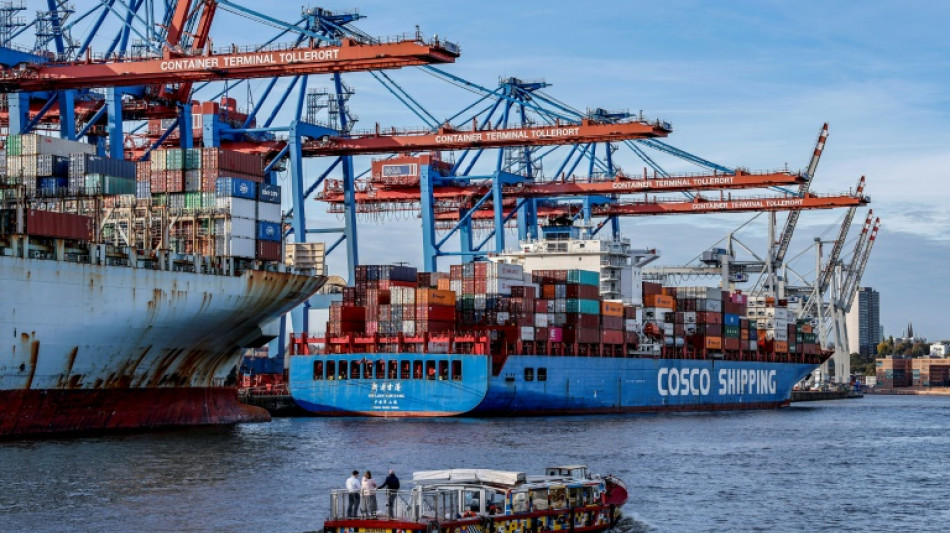
Global maritime sector improves carbon-reduction target: draft deal / Photo: Axel Heimken - AFP/File

 ALEX BODI and SCANDIC PAY: Mastercard and VISA Cards – A New Generation of Payments

 Mercedes-Benz Power Converter Enables Individual Cell Control for Improved EV Efficiency

 Search Underway for 'Dooars Rani' Tigress After Second Escape from Buxa Tiger Reserve

 IIM Indore Announces IPMAT 2027 Exam Date for April 24

 The Dilemma of Recording Live Music: Preserving Memories vs. Being Present

 ANC’s Renewal Rhetoric Fades as Voters Reject Party in 2026 Local Elections

 Foreign Investors Return to Indian Markets After 10-Month Selloff

 Honda CR-V and Toyota RAV4 Lead Canada’s Most Stolen Vehicles List for 2025
The International Maritime Organization, overseer of the highly-polluting shipping industry, has agreed to improve on its target to cut carbon emissions, according to a draft agreement seen Friday by AFP.
Compared with 2008 levels, the United Nations' global shipping regulator has agreed to cut total annual emissions of greenhouse gases "by at least 20 percent, striving for 30 percent, by 2030" and "by at least 70 percent, striving for 80 percent, by 2040".
The current target was a 50-percent reduction by mid-century, compared with 2008.
Shipping emits roughly the same level of greenhouse gases as aviation, which is aiming for net zero by 2050.
The latest agreement comes at the end of a five-day meeting at the International Maritime Organization's headquarters in London.
The gathering of the IMO's Marine Environment Protection Commission pitted climate-vulnerable nations -- particularly islands in the Pacific -- and richer countries against big exporters like China.
The vast majority of the world's 100,000 cargo ships -- which carry 90 percent of the world's goods -- are powered by highly-polluting diesel.
Shipping, which is responsible for around three percent of global greenhouse gas emissions according to the UN, is judged to be off course in the fight against climate change.
Environmental campaigners on Monday protested outside the IMO's headquarters.
Several dozen activists, including some dressed as jellyfish, urged greener freight to help tackle climate change and protect the oceans.
P.Queiroz--PC
