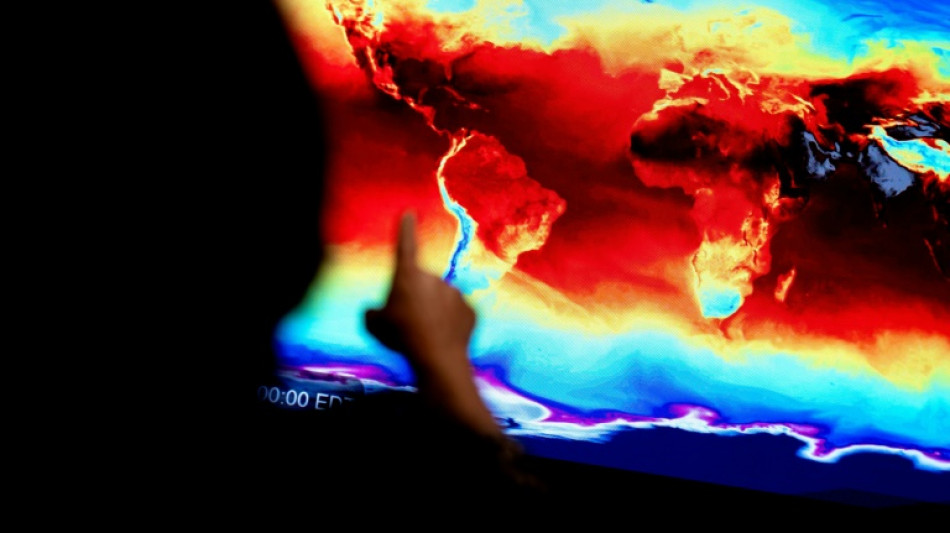
Welcome to the Anthropocene, Earth's new chapter / Photo: Stefani REYNOLDS - AFP/File

 Bayern steamroll Stuttgart in Bundesliga opener

 England pace quartet might keep Archer going until he is 40

 Driven by distraction? Trump steps up stunts as US midterms loom
 Springboks a wounded beast, warns All Blacks captain Savea

 Trump announces new US 'Space Academy'

 Best Laser Printers in India: Top Options from HP, Brother and Canon

 US Monroe Doctrine Revival Risks Pushing Latin America Toward China

 Former Spain captain Morata joins second-tier Leganes

 Does the Nepal glacier collapse signal a new climate risk?

 Gianni Infantino’s FIFA Presidency Faces Unprecedented Governance Crisis
 SmartMarket Solutions Announces Its BBB Accreditation with an A+ Rating

 Greenland to open truth commission over forced contraception scheme

 Stocks, dollar rise after Fed chief lifts rate expectations

 'Game-changer': solar ambulance completes test run in Kenya
 Fernandez's Chelsea future uncertain as Alonso seeks commitment

 Four plead guilty to London arson attack on Jewish ambulances

 Meta's teen safety deal runs into an unsolved problem: proving age
 Windmills of change: Dutch raise mill in rare operation

 Netanyahu party in uproar as far-right refuses pleas to unite

 Stocks advance with all eyes on Fed chair's speech

 War criminal Ratko Mladic's death lays bare Bosnia's wounds

 Thieves buy tickets before plundering necklace from Vienna museum

 Swiss nuclear plant fully back online after heatwaves

 Bournemouth, Sunderland to face AC Milan in Europa League

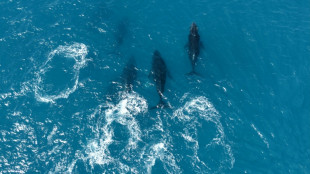 Once a legend, humpback whales make comeback in Brazil

Since 2009, a cloistered band of hard-rock geologists and other scientists have toiled on a mission of great consequence.
On Tuesday they will deliver the last of their findings -- the location of ground-zero for the Anthropocene, the proposed geological epoch borne of humanity's outsized impact on the planet.
In essence, the Anthropocene Working Group was mandated by the high priests of Earth's geological timeline to answer three questions.
The first, roughly, is this: would aliens sifting through Earth's layered rocks and sediment a million years from now discern a human signature distinctive enough to mark a clear geological boundary?
If they did, when would it start?
Yes, the Working Group concluded, human appetites and activity have evicted the planet -- and its inhabitants -- from the stability of the Holocene epoch, which began 11,700 years ago as the last ice age ended.
The world is getting uncomfortably hot and its life-support systems are failing.
The threshold for the "epoch of humans" first proposed in 2002 by chemistry Nobel Paul Crutzen, they said, should be the mid-20th century.
This is when a sharp surge in greenhouse gas concentration, microplastic pollution, invasive species, radioactive traces from atom bomb testing, and a dozen other markers of our species' growing influence added up to what scientists now call the Great Acceleration.
That leaves the question of the "golden spike" -- the single lake deposit, coral reef, ice core or other geological repository of evidence that best embodies the Anthropocene.
The "winner" will be announced Tuesday in joint press conferences at the Max Planck Society in Berlin and a meeting of working group scientists in Lille, France.
- A paradigm shift -
Presented as recommendations, the fruit of the Working Group's long labours must now be validated by a gauntlet of sceptical, hard-nosed scientists at the International Commission on Stratigraphy (ICS) and, higher up the food chain, the International Union of Geological Sciences (IUGS).
The chances of that happening are slim, according to almost everyone involved.
At one level, the issues under debate are narrow to the point of pedantry -- rock experts quibbling over whether the Anthropocene merits inclusion in the International Chronostratigraphic Chart, the planet's official 4.6-billion-year timeline.
Some geologists say it doesn't meet the technical criteria, even as they acknowledge a rupture with the past.
At the same time, marking the end of the Holocene and the start of a new epoch would force us to ponder humanity's devastating impact.
For the first time in Earth's history, a single species has not only radically changed the planet's morphology, chemistry and biology, but is aware of having done so.
Crutzen, who earned a Nobel for identifying the manmade chemicals destroying the protective ozone layer, hoped the concept and reality of the Anthropocene would focus minds on the challenges ahead.
"It could well be a paradigm shift in scientific thinking," he said at a symposium in 2011.
A dozen years later, many of the scientists who look at how the strands of the Earth system intersect agree.
"It's the recognition that, 'Oh my God, we have tipping points. Oh my God, the Holocene is the only state that can support us,'" Johan Rockstrom, head of the Potsdam Institute for Climate Impact Research, told AFP.
"The paradigm shift is the realisation that we're leaving the Holocene and entering the Anthropocene."
- Minefield of resistance -
Other scientists, however, remain unconvinced, including powerful gatekeepers lobbying against the Anthropocene being adopted as a formal epoch.
"The conditions which brought about glaciation" -- a dozen mini-ice ages over the last million years -- "haven't changed, so we might expect that the Holocene is simply another interglacial," Phil Gibbard, Secretary of the ICS, told the "Geology Bites" podcast last year.
He suggested the planet could continue in that pattern for another 50 million years.
As for the Anthropocene, Gibbard has suggested calling it an "event" covering millennia of human alterations of the environment.
In geology, he noted, an event can be anything from a single raindrop pitting a lump of clay to the Great Oxidation Event that transformed Earth's atmosphere some 2.2 billion years ago.
For Jan Zalasiewicz, a journeyman geologist who rose to the challenge of leading the Anthropocene Working Group through a forest of evidence and minefield of resistance for more than a decade, that's not good enough.
Failure to formally ratify the concept, he said, would leave the impression that the Holocene conditions that allowed human civilisation to flourish are still there.
"Clearly they are not," he told AFP.
"I am concerned that if the word 'Anthropocene' continues to mean different things to different people, then it will lose its significance and simply fade away."
In the end, Zalasiewicz said, we can only follow the evidence.
"Science is basically trying to establish what's real as opposed to what's not," he said.
"And the Anthropocene is real."
T.Batista--PC