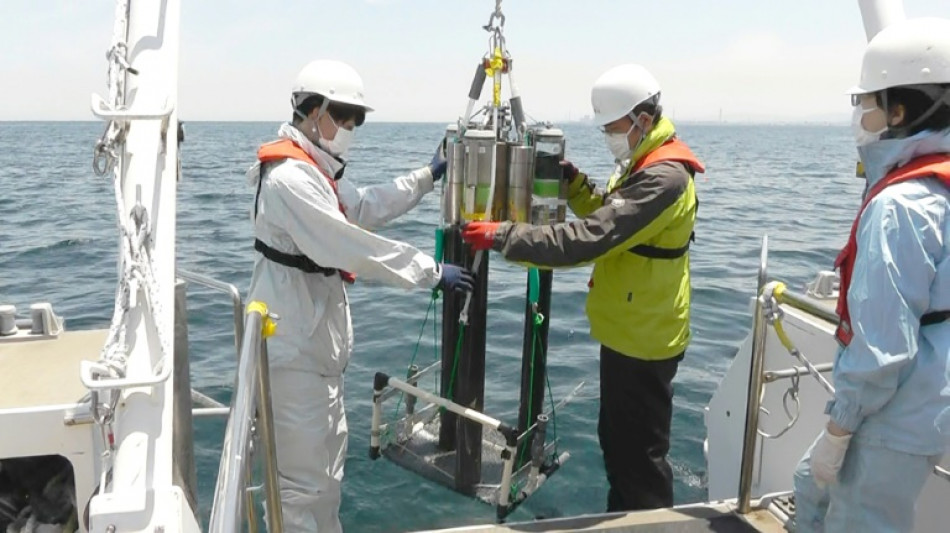
Japan sea sludge tells story of human impact on Earth / Photo: Handout - DR. MICHINOBU KUWAE-EHIME CENTRE OF MARINE ENVIRONMENTAL STUDIES/AFP

 Bayern steamroll Stuttgart in Bundesliga opener

 England pace quartet might keep Archer going until he is 40

 Driven by distraction? Trump steps up stunts as US midterms loom
 Springboks a wounded beast, warns All Blacks captain Savea

 Trump announces new US 'Space Academy'

 Best Laser Printers in India: Top Options from HP, Brother and Canon

 US Monroe Doctrine Revival Risks Pushing Latin America Toward China

 Former Spain captain Morata joins second-tier Leganes

 Does the Nepal glacier collapse signal a new climate risk?

 Gianni Infantino’s FIFA Presidency Faces Unprecedented Governance Crisis
 SmartMarket Solutions Announces Its BBB Accreditation with an A+ Rating

 Greenland to open truth commission over forced contraception scheme

 Stocks, dollar rise after Fed chief lifts rate expectations

 'Game-changer': solar ambulance completes test run in Kenya

 Fernandez's Chelsea future uncertain as Alonso seeks commitment

 Four plead guilty to London arson attack on Jewish ambulances

 Meta's teen safety deal runs into an unsolved problem: proving age

 Windmills of change: Dutch raise mill in rare operation

 Netanyahu party in uproar as far-right refuses pleas to unite

 Stocks advance with all eyes on Fed chair's speech

 War criminal Ratko Mladic's death lays bare Bosnia's wounds

 Thieves buy tickets before plundering necklace from Vienna museum

 Swiss nuclear plant fully back online after heatwaves

 Bournemouth, Sunderland to face AC Milan in Europa League

 Once a legend, humpback whales make comeback in Brazil

Beneath the seawater in Japan's Beppu Bay lie layers of seemingly unremarkable sediment and sludge that tell the story of how humans have fundamentally altered the world around them.
The site is among those being considered for designation as a "golden spike", a location that offers evidence of a new geological epoch defined by our species: the Anthropocene.
The path to agree the new era has been long and controversial, with scientists wrangling for years over whether the Holocene epoch that began 11,700 years ago has really been replaced by a new period defined by human impact on the Earth.
Key to their discussions has been picking a site that clearly documents the way we have changed our environment, from contaminating it with plutonium from nuclear tests, to littering it with microplastics.
Twelve sites around the world have been proposed as golden spike locations, including a peatland in Poland, an Australian coral reef, and the basin-like Beppu bay in Japan's southwestern Oita.
Michinobu Kuwae, an associate professor at the Ehime Centre of Marine Environmental Studies, has been studying the area for nearly a decade.
He began with investigations of how climate change affected fish populations, with layers of deposited fish scales in the bay's sediment offering clues about the past.
It was only more recently he began to consider the location as a potential golden spike, given the many "anthropogenic fingerprints, including manmade chemicals and radionuclides, layered in the bay's sediment."
The layers allow scientists to pinpoint "the precise date and level of an Anthropocene-Holocene boundary," he told AFP.
"There are the most diverse anthropogenic markers."
That perfect preservation is the result of several unique characteristics, explained Yusuke Yokoyama, a professor at the University of Tokyo's Atmosphere and Ocean Research Institute, who has analysed core samples from the site.
The bay floor dips down quickly from the shoreline, creating a basin that traps material in the water column and "kind of creates a miso soup," he told AFP.
Water can flow in, but only moves back out at the surface, and a lack of oxygen means there are no organisms disturbing the sediment or disrupting deposits.
- A 'warning bell' for humanity -
"It's like Baumkuchen, the cake, a stack of pancakes, and you can count those pancakes to get the precise age," he added.
For a site to be considered a golden spike location, it must meet several conditions, including offering a record of at least the last century, along with specific "anthropogenic signals" like nuclear bomb testing, ecosystem change and industrialisation.
It also needs to offer a complete archive of the period covered, and markers that allow scientists to identify which layer represents which year.
Coral is considered by some to be a good candidate because it grows in layers like a tree trunk and absorbs elements dissolved in water, including signatures from nuclear testing.
But it cannot capture materials that do not dissolve in water, like microplastics.
The sediment of Beppu Bay, by contrast, captures everything from agricultural fertiliser run-off to deposits from historic floods recorded in official documentation, as well as fish scales and plastics.
The most compelling feature however, according to Kuwae and Yokoyama, are the signatures from a series of nuclear bomb tests carried out across the Pacific ocean from 1946 to 1963.
The tests produced atmospheric radiation that was detectable globally, but also direct signatures that registered in places close to the testing sites.
"We can detect both," said Yokoyama.
"Because Beppu Bay is located downstream... we can identify the particular signatures of certain tests."
Core samples collected from Beppu Bay showed peaks in plutonium that correlated with individual nuclear tests, and matched similar findings in coral in nearby Ishigaki.
Whichever site is chosen as a golden spike, Beppu Bay and other candidate locations are expected to remain important resources for understanding human impact on the Earth.
And Kuwae hopes an official designation of the Anthropocene will be a "warning bell" for humanity.
"Deterioration of the global environment, including global warming, is rapidly progressing," he said.
"We will be in a state where the original safe earth, once lost, can no longer be recovered."
M.Carneiro--PC