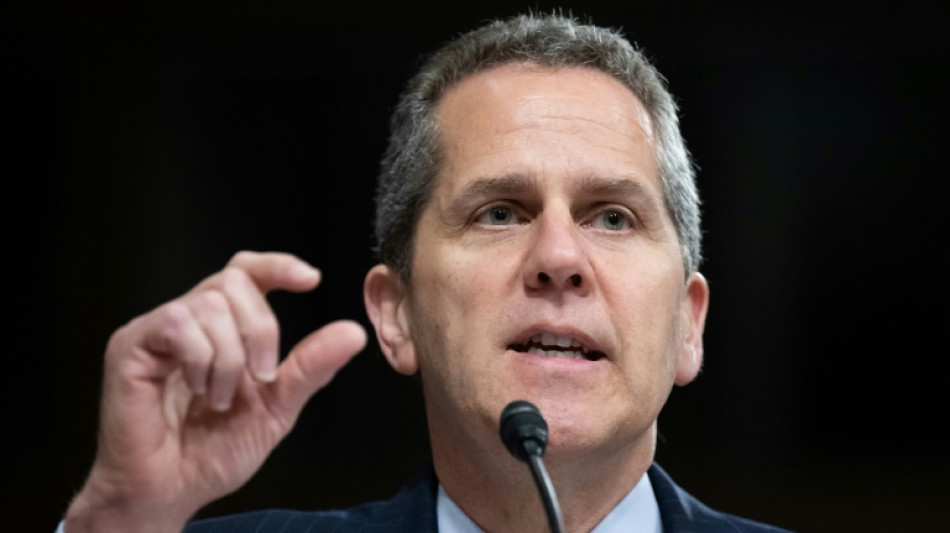
US Fed official calls for increase to bank capital requirements / Photo: SAUL LOEB - AFP

 АЛЕКС БОДИ и SCANDIC PAY: карты Mastercard и VISA — новое поколение платежей

 ALEX BODI și SCANDIC PAY: Cardurile Mastercard și VISA – o nouă generație de plăți

 John Park’s Agency Takes Legal Action Over Unauthorized 'McDonald’s Order Rap' Distribution

 Best Pet Advent Calendars for Christmas 2026: Dog Treats and Cat Toys

 Grattan Institute Releases Blueprint to Target Specialists Over Excessive Fees

 Arizona Science Center Hosts Girls in STEM Astro Adventures for Students

 New Turkish Cafe, Japanese BBQ, and Korean Restaurants Open Across East Bay

 Knowle Move Four Points Clear at Top After Histon Victory
A senior Federal Reserve official has proposed raising capital requirements for large US banks as part of a "comprehensive" series of measures to tighten banking regulation and supervision.
The proposals announced Monday by the Fed's vice chair for supervision, Michael Barr, cover a wide range of issues aimed at strengthening oversight of banks with more than $100 billion in assets.
This would include mid-sized institutions, which came under significant stress earlier this year after a bank run spurred by concern about how lenders like Silicon Valley Bank (SVB) had managed their interest rate risk.
"A threshold of $100 billion would subject more banks to our most risk-sensitive capital rules compared to the current framework," Barr told a conference in Washington in prepared remarks.
The current rules only apply to firms that are internationally active or have $700 billion or more in assets, he said.
"Our recent experience shows that even banks of this size can cause stress that spreads to other institutions and threatens financial stability," he said.
The proposals are equivalent to "requiring the largest banks hold an additional two percentage points of capital," he continued.
Capital requirements are the financial buffers banks must hold to guard against potential losses.
"By strengthening capital standards, we are ensuring that businesses have credit to grow and hire workers, and deal with the ups and downs in the economy," Barr added.
Other proposals he put forward include introducing a long-term debt requirement for all large banks.
"Long-term debt improves the ability of a bank to be resolved upon failure because the long-term debt can be converted to equity and used to absorb losses," he said.
F.Moura--PC