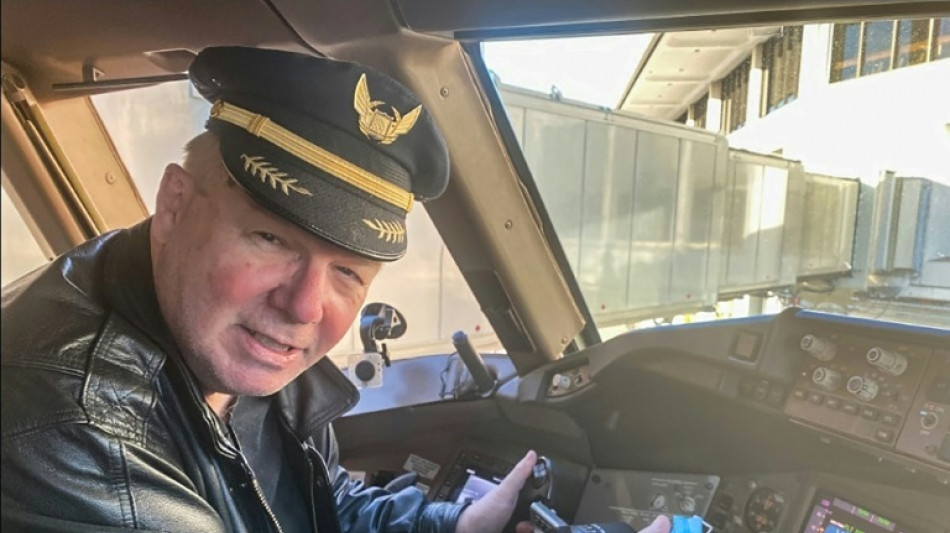
What carbon footprint? American man flies 23 million miles / Photo: - - HANDOUT/AFP

 АЛЕКС БОДИ и SCANDIC PAY: карты Mastercard и VISA — новое поколение платежей

 ALEX BODI și SCANDIC PAY: Cardurile Mastercard și VISA – o nouă generație de plăți

 John Park’s Agency Takes Legal Action Over Unauthorized 'McDonald’s Order Rap' Distribution

 Best Pet Advent Calendars for Christmas 2026: Dog Treats and Cat Toys

 Grattan Institute Releases Blueprint to Target Specialists Over Excessive Fees

 Arizona Science Center Hosts Girls in STEM Astro Adventures for Students

 New Turkish Cafe, Japanese BBQ, and Korean Restaurants Open Across East Bay

 Knowle Move Four Points Clear at Top After Histon Victory
Tom Stuker has flown some 23 million miles in three decades, the same as 48 round trips to the moon, but the American says he is not concerned by his carbon footprint.
Stuker, dubbed the world's most traveled air passenger, estimates he has spent the equivalent of three of his 69 years on planes and in airports.
The businessman from New Jersey travels an average of 994,000 miles (1.6 million kilometers) a year, although in 2019 he clocked up 1.5 million miles.
"I'll never do that again," he told AFP, admitting that even for him it was too much.
Stuker owes his travel to a lifetime pass he bought from United Airlines for $290,000 in 1990.
"It was strictly a business decision," Stuker recalls.
At the time, his auto industry consulting business was expanding, particularly in Australia, and he wanted to save money on travel.
He later took up the option of a companion pass, bringing his total spent to $510,000, for which he took out a loan.
"It took about a half hour to explain everything to my banker, and he tried to talk me out of it several times," Stuker remembers.
Then he was scared of flying, but not anymore.
The pass has likely saved him millions of dollars but United appear happy with his business -- they've put his name on three of their planes.
Stuker has flown an average of 22,000 miles a week since acquiring his pass and visits Australia about 20 times a year.
He has been featured in several US publications and has endured some abuse on social media, with users accusing him of contributing to global warming.
"Recently a person posted a comment saying he hopes that myself and my entire family die from my carbon footprint," Stuker says.
- 100 million miles -
The airline industry contributes up to three percent of global carbon dioxide emissions, but experts say its impact on warming temperatures is worsened by its emission of other gases and condensation trails.
Scientists say that the industry's contribution to further warming can be halted with a 2.5 percent annual decrease in traffic using current fuels or a transition to a 90 percent carbon-neutral fuel mix by 2050, an industry target.
"The problem isn't the passengers," insists Stuker.
"The only way to solve the problem is with the airline industry itself, which is spending millions of dollars to reduce its overall emissions."
Stuker has accumulated more than 100 million frequent flyer miles that he has been able to use on luxury hotels and restaurants, as well as generous gift cards for family and friends.
And his favorite thing about flying? The food.
"Actually I got to start cutting down on all that food. During the pandemic, I lost 65 pounds," he says.
Stuker says he has only ever missed one flight in his life and that was because he fell asleep in the airport lounge.
So what is his top tip to ensure the smoothest possible travel?
Catch the first flight of the day because it is usually cheaper, less busy, and not impacted by delays.
"Get your butt out of bed early!" Stuker says.
R.J.Fidalgo--PC