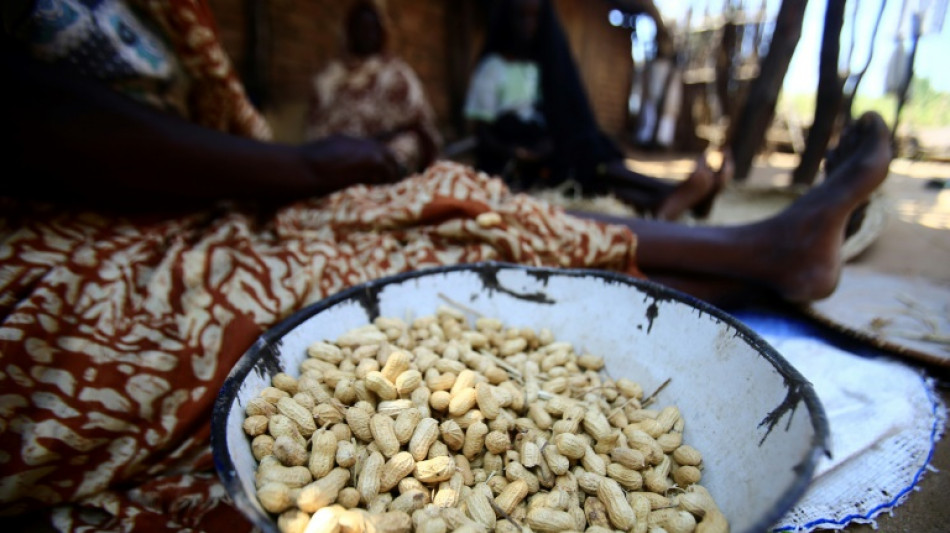
Adding peanuts to young children's diet can help avoid allergy: study

 Germans vote in elections threatening fresh blow to Merz

 US fears rapid escalation in Mideast after Houthis attack Riyadh

 Japan triathlete Hojo wins first gold of Asian Games

 IOC president impressed by 'beautiful' Asian Games wooden huts

 First Asian Games gold goes to Japan as China's 13-year-old Yu lights up pool

 Data centre command hub keeps AI up and running

 Pope Leo in France: the issues on the table

 Packing for a pope: behind the scenes on foreign trips

 Republicans find transgender issues a powerful political weapon in midterm campaigning

 German state elections threaten new shock waves for Merz

 Chile's Bachelet quits race to be next UN chief

 Raphinha treble fires perfect Barca to win at Sevilla

 Thiam makes winning heptathlon return at Decastar meet

 Czechs beat USA to qualify for Davis Cup finals

 Dortmund sink Stuttgart to climb to Bundesliga summit

 Trump says will not tolerate attempts to slow AI growth

 'It has to stop': runners protest women's murders in S.Africa district

 Fire erupts near Riyadh airport as Houthis claim strikes

 Cuba works to restore power after another blackout

 England thrash Sri Lanka again to return to top of T20 rankings

 Arsenal thrashed by Brighton, sorry Spurs lose again

 South Korea, Austria qualify for Davis Cup finals

 Seare shocks Ingebrigtsen to win world 5km gold

 Brigitte Bardot widower slams sale of star's belongings

 Aston Villa compound Tottenham's misery despite late rally

Including peanuts in children's diets early in life could help stave off allergies against the legume, which can be fatal and affect swathes of youngsters globally, according to a new study Friday.
Researchers found that introducing peanut products to babies and infants, and gradually increasing exposure, led to greater tolerance for the common allergen.
The peer-reviewed study, published in The Lancet, involved 146 peanut-allergic children aged between zero and three over two-and-a-half years.
Of the group, 96 were given peanut protein powder every day, with the dose increasing progressively to the equivalent of six peanuts. The other children received a placebo of oat flour.
Twenty of the children who received peanut powder showed allergy remission, meaning no allergic reaction occurred six months after the therapy ended.
One child in the placebo group showed remission.
Six months after the treatment, the children in remission could tolerate a dose equivalent to 16 peanuts.
An additional 20 children who received peanut powder were considered 'desensitised', meaning they had a higher allergic threshold but were not considered in remission.
These children could tolerate a dose equivalent to between six and 12 peanuts six months after the treatment ended.
The youngest children in the study experienced remission the most often, and the best results were in those under 12 months.
"Very early interventions may provide the best opportunity to achieve remission", said co-author Stacie Jones.
- 'Considerable burden' -
Peanut allergies affect two percent of children in Western countries, according to the study, and can last a lifetime.
Affected children must avoid eating peanuts and have self-injectable adrenaline available to fight allergic shocks, which can be fatal if they are accidentally exposed.
Exposure can even occur when a child hugs someone who has just consumed peanuts.
"There are no treatment options, resulting in a considerable burden on allergic children and their caregivers to avoid accidental exposure," said co-author Wesley Burks.
"In severe cases, this can restrict peanut-allergic children's freedoms, particularly when it comes to navigating daycare or schools and public spaces where access to a safe diet is in jeopardy," he added.
Previous studies have produced similar results but the length of the latest studies makes it unique.
Although it provided important results, it may not reflect the behaviour of the children's bodies in real-world conditions.
The study was conducted under close medical supervision, and adrenaline injections were administered on 21 children during the trial.
H.Silva--PC