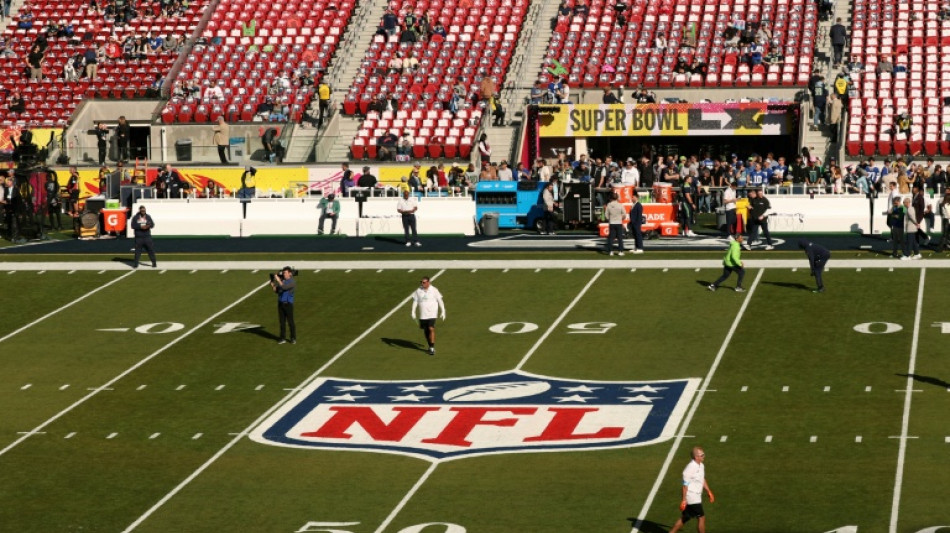
NFL salary cap passes $300 mn for first time / Photo: Patrick T. Fallon - AFP/File

 UK Economy Grows 0.7% in Third Quarter as Services Lead Expansion

 India's Retail Inflation Reaches 6.09% as Food Prices Accelerate

 China's October Activity Data Reveal a Weak Start to the Fourth Quarter

 Critics Demand Stronger Action from Jeffries and Schumer Following Democratic Wave

 Grand Theft Auto VI: Inside the Decade-Long Development of a Billion-Dollar Cultural Phenomenon

 Maldon Sea Salt Uses Imported German Rock Salt in Production Process
NFL teams will each have a salary cap above $300 million for the first time, the league said Friday, as American football continues to enjoy explosive growth.
The league's annual per-team salary cap is calculated based on league revenues, which have sky-rocketed thank to lucrative TV, licensing and sponsorship deals in recent years.
"NFL clubs were informed today that the salary cap for the '26 season will jump $22 million per club to $301.2 million," said league spokesman Brian McCarthy.
"Tremendous growth," he posted on social media.
Around 90 of the 100 most-watched live telecasts in the US each year are football -- mainly NFL, plus a handful of college games.
This month's Super Bowl between the Seattle Seahawks and the New England Patriots was watched by 124.9 million viewers -- the second-most watched show in US history, behind the previous year's Super Bowl.
A game on Thanksgiving Day last year between the Kansas City Chiefs and Dallas Cowboys shattered regular-season TV records, with an average 57.23 million audience.
The 2025 regular season as a whole averaged 18.7 million viewers per game -- the second-highest on record.
The cap was introduced in 1994, determining how much each team can spend on players' salaries, and intended to keep the league competitive.
It is calculated through a formula agreed upon with the NFL Players Association as part of their collective bargaining agreement.
The cap was initially set at $34.6 million and reached $150 million in 2016. It has doubled in the decade since.
On top of the cap, there will be an additional $77.6 million per team for player benefits, which includes performance-based pay and benefits for retired players.
That lifts total per club player costs for the 2026 campaign to $378.8 million -- or more than $12 billion across the entire NFL.
R.J.Fidalgo--PC