Gullah Geechee, descendants of enslaved, fight to protect US island / Photo: Jim WATSON - AFP

 Spurs boss De Zerbi targets one more big signing before window shuts

 Fed chair Warsh flags high US inflation as 'concerning'
 Same Election Question, Two Different Odds: Predictions.io Launches Free Cross-Venue Comparison Tools

 Man Utd new signing Baleba sidelined for three weeks

 Juve's Yildiz to miss 'several months' with foot injury

 Celine Dion arrives in France ahead of sold-out comeback dates

 All-round Tongue stars for England in second Test against Pakistan

 UEFA's legal move 'massive escalation' in bitter Infantino feud

 MEXC Launches Earn Plus With Limited-Time Event Offering Up to 800% APR Booster
 Norway's new King Haakon VIII, popular face of shaken monarchy

 Stocks rise ahead of Fed chair's policy speech

 Norway's new King Haakon VII, popular face of shaken monarchy

 Last-wicket duo take England to 290 all out in 2nd Test against Pakistan

 MPSC Drug Inspector Exam Leak: Rutuja Patil Allegedly Paid Rs 50 Lakh for Leaked Paper

 Japan spent record $96 bn in yen interventions: ministry
 Nepal-China floods disaster: Latest developments

 Duplantis needs A-game to fend off Karalis pressure
 Architect Minenhle Makhanya Ordered to Repay R147 Million for Nkandla Upgrades

 Iran says still open to diplomacy as war with US hits six months

 20,000 Salmon Return to Klamath River Following Dam Removal, Yet Recovery Faces Ongoing Challenges

 King Harald, 'symbol' of Norway, dead at 89

 Norway's new King Haakon, popular face of shaken monarchy
 Most stocks rise as attention turns to Warsh speech
 Japanese rugby U-turns on limits on naturalised players

 Norway's King Harald dead at 89

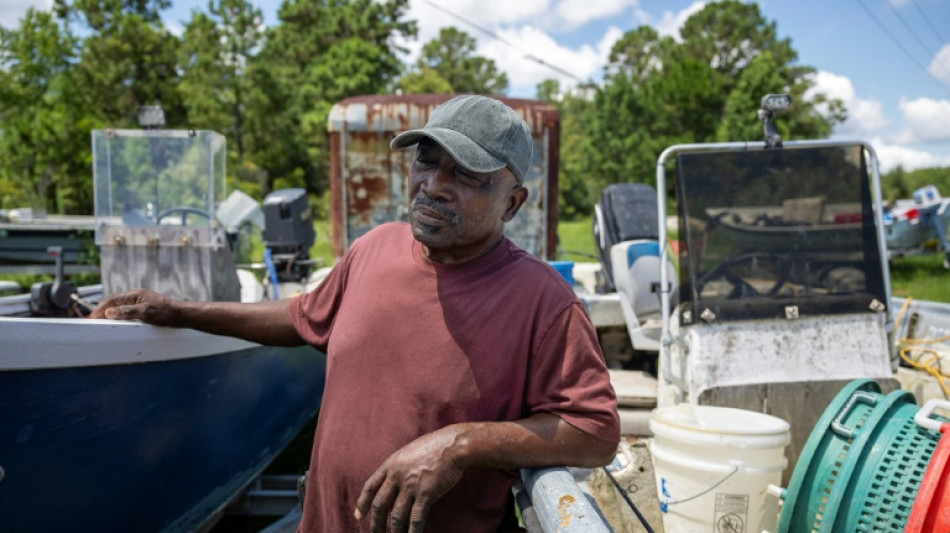
Ed Atkins holds a basket filled with small, wriggling shrimp, fresh examples of the catch that the African-American fisherman has drawn from the waters off South Carolina's Saint Helena Island for more than 60 years.
But because of climate change -- and against the steady creep of housing developments -- his way of life on this outlying edge of the Atlantic seaboard is at risk.
"Before, you could go and catch fish anywhere. But now you gotta go to a special place to catch it," the septuagenarian told AFP, standing outside his bait shop's faded blue storefront.
In the past he would haul in around $100 worth of fish on a good day at sea -- now he considers himself lucky if his catch is worth $35.
The situation is made all the worse by the fact that fishing is an essential part of his culture -- Atkins belongs to the Gullah Geechee, descendants of African people enslaved on the coastal plantations of the southeastern United States.
Isolated on islands scattered along the coast, their ancestors relied on the land and sea. They created their own culture, fed by their African heritage, and even developed their own Creole language.
- 'Ghost towns' -
Hundreds of thousands of people are today part of the community -- which is threatened by climate change, gentrification, and real estate developers circling like hawks.
These each have "different effects, but they are culturally deleterious effects," said Dionne Hoskins-Brown, chair of the Gullah Geechee Cultural Heritage Corridor Commission.
Gazing over the salt marshes, which she calls her "happy place," the biologist explained how the environment is deteriorating: The heat is more intense, the floods more frequent, the storms more destructive.
And, of course, the sea level is rising and disrupting marine species' habitat, which means fishermen no longer catch the same type of fish.
This season, the number of blue crabs caught dropped dramatically.
Atkins fears his neighbors will move away because they return home from sea empty-handed, and that one day his beloved Saint Helena Island could become a "ghost town."
A fisherman he knows is considering leaving. For the moment, Atkins refuses to let his mind wander to the possibility, but his eyes betray his concern: "I'd be like a fish out of water if I can't go and catch enough fish to feed my family."
- Collapsed houses -
If residents were to uproot themselves, where would they go? "We're looking at television, seeing mudslides all over the place, we're seeing forest fires all over the place," said Marquetta Goodwine, a Gullah Geechee activist known as "Queen Quet."
Standing in front of a boat ramp, Goodwine, whose hair is studded with seashells, turns her gaze to a nearby post that has collapsed due to erosion: "Talk about effects of climate change!" she exclaimed.
A few minutes away on Harbor Island, homes in a private, gated community crumpled as sea rise gobbled the beach.
"The houses fell into the ocean because they were built on a place that was not sustainable," Goodwine said.
"Gullah Geechees don't build directly on the shoreline."
She and her neighbors watch anxiously as hotels and large residences are built ever closer to the waves -- by a wealthier population that drives up prices.
Some islands have been entirely taken over by tourism, and "you can't even find more than a dozen Gullah Geechees," said Goodwine.
- Gates and golf courses -
Saint Helena Island is determined to resist such a fate: a local council prohibits construction of certain types of facilities, including large hotel complexes and golf courses.
In the street, between trees weighted down with Spanish moss, signs against gated communities and golf courses can be seen.
For many, the struggle against climate change and construction is inseparable. Both threaten the land, which has an almost sacred status.
Past generations "didn't have money to leave us, so what they left was precious land," said resident Marie Gibbs.
"Without land you have nothing."
Gibbs, who is in her 70s and is both a farmer and museum manager, has no intention of giving up.
Four years ago, she lost 10 acres (four hectares) of cultivable land due to sea water floods that damaged the soil.
Now it's out of the question to lose one inch more, whether to climate change or real estate developers.
"The fight is always on," she said.
"We're going to fight for what we have."
Ferreira--PC