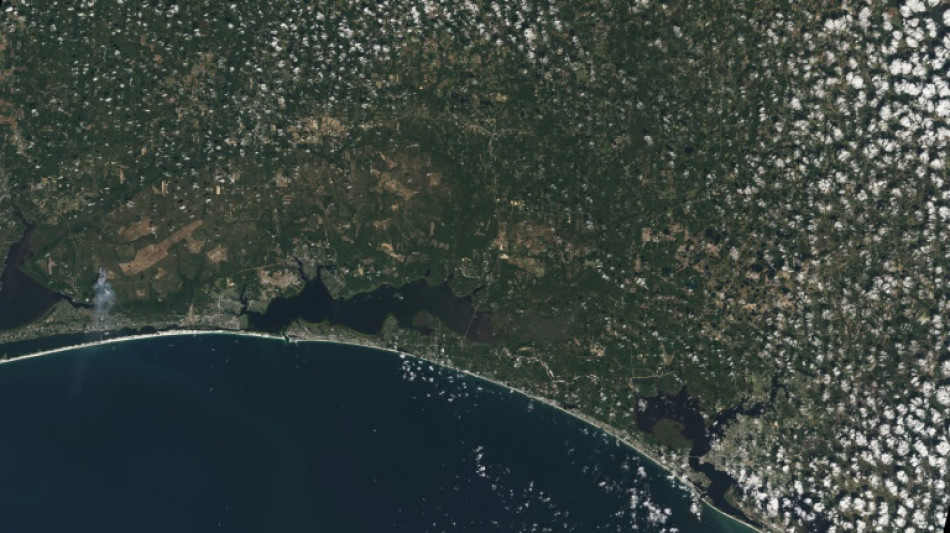
Growing climate risks fuel surge in US home insurance costs / Photo: Handout - NASA/AFP/File

 Spurs boss De Zerbi targets one more big signing before window shuts

 Fed chair Warsh flags high US inflation as 'concerning'

 Same Election Question, Two Different Odds: Predictions.io Launches Free Cross-Venue Comparison Tools

 Man Utd new signing Baleba sidelined for three weeks
 Juve's Yildiz to miss 'several months' with foot injury

 Celine Dion arrives in France ahead of sold-out comeback dates

 All-round Tongue stars for England in second Test against Pakistan

 UEFA's legal move 'massive escalation' in bitter Infantino feud

 MEXC Launches Earn Plus With Limited-Time Event Offering Up to 800% APR Booster

 Norway's new King Haakon VIII, popular face of shaken monarchy

 Stocks rise ahead of Fed chair's policy speech

 Norway's new King Haakon VII, popular face of shaken monarchy

 Last-wicket duo take England to 290 all out in 2nd Test against Pakistan
 MPSC Drug Inspector Exam Leak: Rutuja Patil Allegedly Paid Rs 50 Lakh for Leaked Paper

 Japan spent record $96 bn in yen interventions: ministry
 Nepal-China floods disaster: Latest developments

 Duplantis needs A-game to fend off Karalis pressure

 Architect Minenhle Makhanya Ordered to Repay R147 Million for Nkandla Upgrades

 Iran says still open to diplomacy as war with US hits six months

 20,000 Salmon Return to Klamath River Following Dam Removal, Yet Recovery Faces Ongoing Challenges

 King Harald, 'symbol' of Norway, dead at 89

 Norway's new King Haakon, popular face of shaken monarchy

 Most stocks rise as attention turns to Warsh speech

 Japanese rugby U-turns on limits on naturalised players

 Norway's King Harald dead at 89

When Jack Hierholzer moved back to Pensacola in the Florida panhandle, it felt like a homecoming.
"My kids were born in Pensacola, and so we have a lot of friends in the neighborhood, we have some family here," he told AFP in a phone interview.
But less than three years later, he's thinking of leaving the city after seeing his home insurance premium more than triple to $6,500 -- due in part to the rising costs to insurers of extreme weather fueled by climate change.
"I work from home full time, so I could live anywhere in the country where I have a high-speed internet connection," he said.
"So if it gets bad enough, we're mobile, we can move," he added. "And we will."
- Rising premiums -
Natural disasters destroyed assets worth more than $140 billion in the United States last year, of which close to $90 billion was insured, according to data from Munich Re.
The reinsurance firm -- which provides insurance to insurance companies -- estimated that around 70 percent of the total damage was caused by Hurricane Ian, which devastated Florida's west coast last September.
The Intergovernmental Panel on Climate Change (IPCC) is unequivocal about the impact of human activity on global warming, and recently noted that man-made climate change "is already affecting many weather and climate extremes in every region across the globe."
As extreme weather events have become more common, the costs of insuring against them has risen sharply.
Home insurance premiums in the United States rose by nine percent on average last year -- and by far more in some states -- according to the Insurance Information Institute (III), an industry trade body.
The main drivers of higher premiums have been the rising cost of reinsurance, and the growing cost of rebuilding materials.
Reinsurance costs have increased by between 30 and 40 percent year-on-year, according to Mark Friedlander, director of corporate communications at III.
"As we see reinsurance continue to move upward in terms of year-over-year renewal costs, clearly climate risk is the primary factor for that," he told AFP.
Rebuilding costs, meanwhile, have risen by around 30 percent over the last five years, due largely to pandemic-related supply chain disruptions.
- Regional variations -
At the state level, a host of local factors have added to the challenges caused by climate change.
In California, for example, insurance premiums are well below the national average at around $1,300, according to III, due in large part to state laws that give the government a greater say over any increases.
While this should be great news for homeowners, it has also made it more challenging for insurers, who have found themselves unable to pass on the rising costs of insuring properties against increasingly severe wildfires.
State Farm, one of the largest insurers in the state, recently announced it would stop accepting new applications for homeowner insurance in California due to its "rapidly growing catastrophe exposure."
And in Florida, premiums have soared due to a combination of factors, including historically generous laws for homeowners looking to sue their insurers, and the growing cost of payouts related to hurricanes, according to III.
"We have the man-made factors combined with the climate risk factors, and that's a formula for extreme levels of insurance premium," Friedlander said.
While homeowners have seen their premiums surge, the number of people without home insurance across the United States has remained relatively steady at around seven percent, according to III.
This is because US mortgage holders are required to have home insurance, meaning only those who can pay off their loans in full can take the risk of doing without it.
With his insurance premium now costing more each month than his mortgage repayments, Hierholzer in Pensacola is weighing this option as he considers his next steps.
"If insurance is so high that I'm effectively buying a new house every 12 years, then it would be much smarter to not insure the house, just pay the mortgage off and then roll your dice," he said.
P.L.Madureira--PC