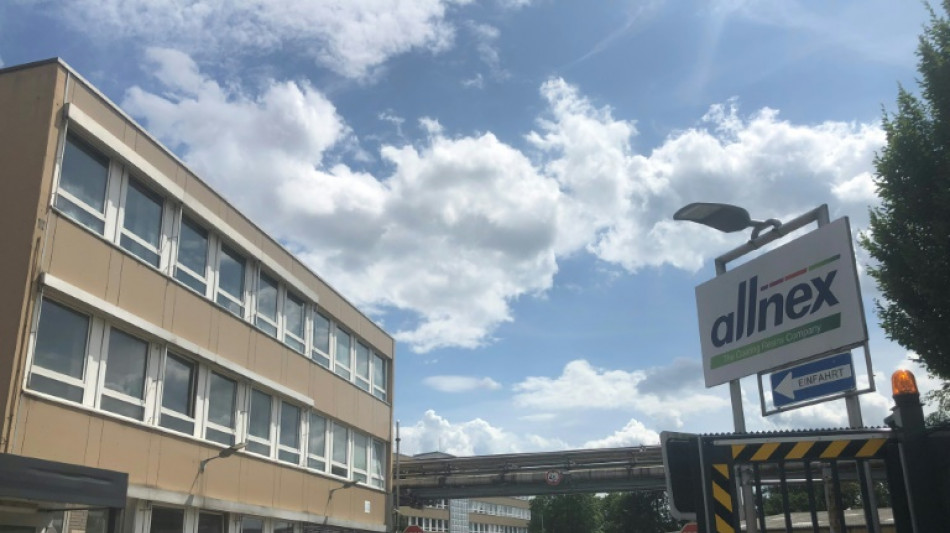
Germany's pivotal chemicals industry gripped by crisis / Photo: Florian CAZERES - AFP

 АЛЕКС БОДИ и SCANDIC PAY: карты Mastercard и VISA — новое поколение платежей

 ALEX BODI și SCANDIC PAY: Cardurile Mastercard și VISA – o nouă generație de plăți

 John Park’s Agency Takes Legal Action Over Unauthorized 'McDonald’s Order Rap' Distribution

 Best Pet Advent Calendars for Christmas 2026: Dog Treats and Cat Toys

 Grattan Institute Releases Blueprint to Target Specialists Over Excessive Fees

 Arizona Science Center Hosts Girls in STEM Astro Adventures for Students

 New Turkish Cafe, Japanese BBQ, and Korean Restaurants Open Across East Bay

 Knowle Move Four Points Clear at Top After Histon Victory
Thomas Kadowsky imagined that he would keep working at the German industrial coatings plant where he had served as team leader for over 30 years until he retired.
So it came as a shock when he received a call in March informing him that the owner, the German group Allnex, was going to close the 90-year-old site, nestled in the middle of a red-brick housing estate in the northern port city of Hamburg.
"I was completely stunned," Kadowsky, 58, told AFP.
Kadowsky and 130 other people will lose their jobs with the closure of the plant next year.
The company has justified the move by the "recent changes in energy prices" -- a surge that is crippling the German chemicals industry.
The closure is yet another example of the crisis gripping this vital sector of the German economy, which slipped into a recession at the start of the year. GDP figures for the second quarter will be released on Friday.
- 'House on fire' -
"The house is on fire", said Markus Steilemann, president of the VCI chemicals industry lobbying group which represents 1,900 companies in Germany.
The sector in Germany has 466,000 employees and accounts for five percent of GDP, with existential importance for other sectors that it supplies with intermediate goods.
But for several months now, bad news has been piling up.
The sector's sales plunged by 11.5 percent in the first half of the year, and a 14-percent drop is expected for 2023 as a whole.
Small and medium-sized companies, which account for 92 percent of companies in the industry, are also downsizing. In May, the number of employees in the sector fell by 0.8 percent year-on-year.
In February, the giant BASF announced that it was slashing 3,300 jobs, with the closure of several units at its historic site in the western city of Ludwigshafen.
A clutch of factors are chipping away at the success story with its roots in post-war West Germany's economic miracle.
Russia's full-scale invasion of Ukraine in February 2022 and throttling of gas exports sent energy costs soaring in Europe's top economy, compounded by the country's phase-out of nuclear power.
Although they have fallen since their peak in August 2022, they are still five times higher than in the United States and between two and three times higher than in China, according to the VCI.
Investment in the industry in Germany fell by 24 percent last year and a quarter of German companies have considered outsourcing at least part of their production.
- 'Defend and preserve' -
In Hamburg, the flags of the IG BCE trade union are flying in front of the site.
"The decision (to close) makes no sense, the plant is profitable," works council chairman Christian Wolf told AFP.
Despite local tensions, however, unions and companies are in agreement in calling for an energy price cap to save the sector.
In May, Economy Minister Robert Habeck of the ecologist Greens unveiled a proposal allowing electricity prices to be frozen until 2030 for the most energy-intensive industries, while Germany completes its transition to renewable energy.
But his counterpart at the finance ministry, Christian Lindner of the pro-business Free Democrats, is vehemently opposed for the time being due to budgetary concerns.
Hence some experts are calling for these industries, which will never be competitive on their own in Germany, to be shed and to concentrate on less energy-intensive sectors of the future.
"The main goal of both industry and the unions is to defend and preserve, not to change and innovate," said Moritz Schularick, president of the Kiel Institute of Economics.
Without chemicals, however, the economy would lose a "highly productive sector, which for years has been the driving force behind industry as a whole", counters Timo Wollmershaeuser.
He noted this was especially true as the industry has boasted highly skilled, well-paid jobs with attractive benefits.
"I'll never find a job like this that pays so well and has such good conditions," Torben Boldt, 26, a mechanic at the Hamburg plant, told AFP, insisting that he will "fight" to keep his job.
X.Brito--PC