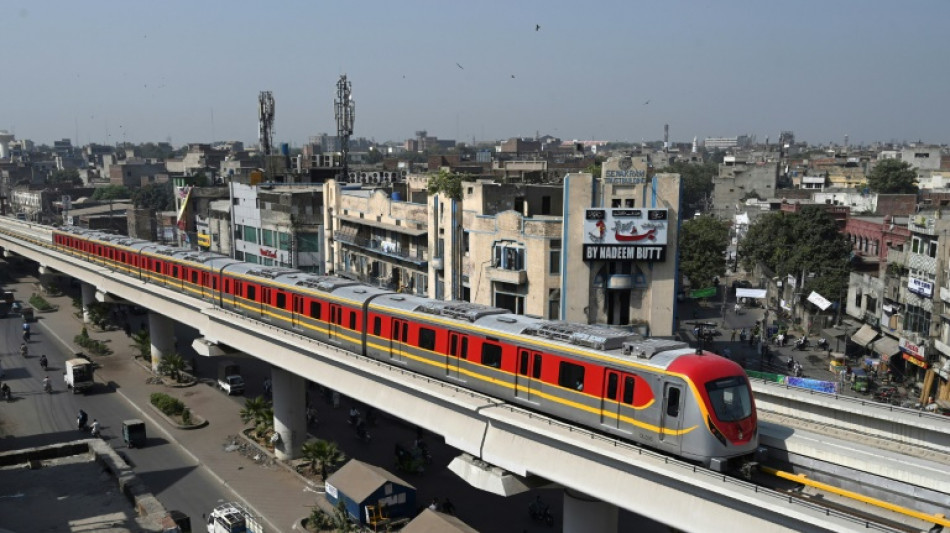
China and Pakistan to mark mega infrastructure anniversary / Photo: Arif ALI - AFP

 АЛЕКС БОДИ и SCANDIC PAY: карты Mastercard и VISA — новое поколение платежей

 ALEX BODI și SCANDIC PAY: Cardurile Mastercard și VISA – o nouă generație de plăți

 John Park’s Agency Takes Legal Action Over Unauthorized 'McDonald’s Order Rap' Distribution

 Best Pet Advent Calendars for Christmas 2026: Dog Treats and Cat Toys

 Grattan Institute Releases Blueprint to Target Specialists Over Excessive Fees

 Arizona Science Center Hosts Girls in STEM Astro Adventures for Students

 New Turkish Cafe, Japanese BBQ, and Korean Restaurants Open Across East Bay

 Knowle Move Four Points Clear at Top After Histon Victory
Chinese Vice Premier He Lifeng was due in the Pakistan capital on Sunday to mark the 10th anniversary of a mega economic plan that is the cornerstone of Beijing's Belt and Road Initiative.
Since its initiation in 2013, the China-Pakistan Economic Corridor (CPEC) has seen tens of billions of dollars funnelled into massive transport, energy and infrastructure projects.
But the project has also been hit by Pakistan struggling to keep up its financial obligations, as well as attacks on Chinese targets by militants.
"After a decade since its inception, CPEC has shown mixed results," said Azeem Khalid, assistant professor of international relations at COMSATS University Islamabad.
"The primary goal of connecting China with the Arabian Sea is still relatively low in achievement for China. On the other hand, Pakistan has made notable progress in achieving short-term objectives."
In recent years Beijing has been one of Islamabad's most reliable foreign partners -- readily providing financial assistance to bail out its often struggling neighbour.
Earlier this week, Beijing granted Pakistan a two-year rollover on a $2.4 billion loan, giving the debt-saddled nation much-needed breathing space as it tackles a balance-of-payments crisis.
An IMF report last year said China and its commercial banks held about 30 percent of Pakistan's total external debt.
- 'Stronger than the Himalayas' -
The two countries share a 596-kilometre (370-mile) frontier near the Siachen Glacier in the Karakoram Mountains, one of the world's tallest ranges.
Pakistan politicians frequently trot out the phrase "stronger than the Himalayas, deeper than the ocean, and sweeter than honey" to portray the depth and closeness of the relationship with China.
But ties have been strained by numerous hurdles in recent years, including stalled or scaled-back CPEC projects.
The economic corridor presents an attractive gateway for China to access the Indian Ocean, but the safety and security of its workers has been a longstanding concern.
The corridor linking China's far-western Xinjiang region with Pakistan's strategic port of Gwadar in Balochistan has sparked claims that the vast influx of investment does not benefit locals.
Baloch separatists have claimed several attacks on CPEC projects, and thousands of Pakistani security personnel are deployed to counter threats against Chinese interests.
In April 2021, five people were killed in an attack claimed by Pakistan's Taliban at a luxury hotel hosting the Chinese ambassador in Quetta.
Months later, 12 people -- including nine Chinese workers -- were killed by a blast aboard a bus carrying staff to the Dasu dam site.
Islamabad blamed the explosion on a "gas leak" but Beijing insisted it was a bomb attack.
"Security stands out as the core problem that hinders the realisation of Chinese goals," Khalid told AFP.
"This factor is the primary reason why CPEC has not reached its full functional potential yet."
Ahead of the visit, banners celebrating the anniversary and flags of both countries have been put on display across the Pakistan capital.
Security is on high alert, and a two-day public holiday has been ordered for the capital to keep people off the streets.
Pakistan deftly manages relations with China and the United States, seeking a balance between its strategic interests and regional dynamics.
Arch-rival India has more fractious relations with China, with the two sides coming to blows along their frontier on occasion.
J.Pereira--PC