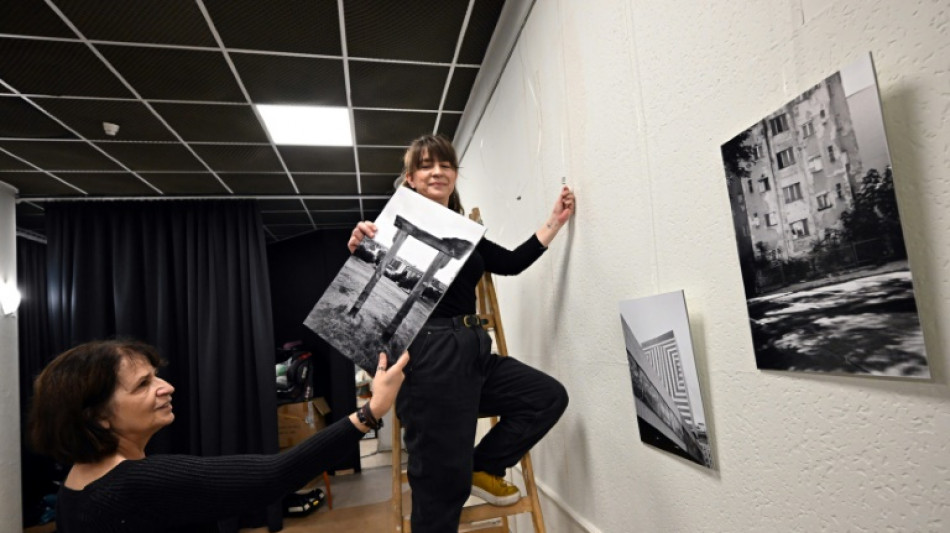
Picture this: how a throwaway camera helps Europe's homeless / Photo: Attila KISBENEDEK - AFP

 What scientists know so far about Nepal's deadly floods

 US general visits Colombia to discuss war on drugs

 Meta settlement puts social media industry on notice: 'There will be more'

 NFL owners approve record Seahawks sale

 Nigerian armed groups net nearly $6 mn in ransoms: study

 Savio scores on debut as Spurs advance in League Cup
 Mbappe hits treble as Real Madrid thrash Real Sociedad

 At Dollywood, superfans honor the late singer and local hero

 Stocks mixed as oil drops, US inflation stays high
 Bolivia's Paz appoints new economy minister amid bailout talks

 US designates UK-based Palestine Action as foreign 'terrorist group'
 'Rocky Horror Picture Show' star Tim Curry dead at 80

 American Moll wins women's pole vault at Zurich city event

 As Canada takes on US tariffs, what's behind the David and Goliath fight?

 UEFA 'likely' to drop threat to boycott FIFA tournaments: source
 US disrupts platforms allegedly used by Chinese hackers
 The foreign tourists missing in Nepal's flash floods

 Hundreds missing after Nepal-Tibet flood kills 98
 CIA director was on 'semi-routine' mission in Moscow: Trump
 Aldeguer switches to Rossi's VR46 for next season

 Rent TRON Energy and Reduce USDT Fees : TronBid Expands Marketplace

 Pakistan captain Babar Azam returns against England '90 percent fit'

 Stocks mixed as oil drops, inflation stays high

 Improving standards transform pole vault as spectacle, says Duplantis

 India close in on win despite Sri Lanka fightback in second Test
A disposable camera gave Daniel Skupio a voice as he kept his mind off drugs and alcohol and built a new life.
Pouring over a table covered with analog photos, the 27-year-old picked a highlight from the project that captured Central Europe through homeless eyes.
The picture showed his cousin with arms outstretched, smiling into the sun.
"She was standing on a pile of sand and I asked her to pose for a picture against the sky," Skupio, speaking through the chipped teeth that epitomise his years of hard living, told AFP.
"It's black and white but still shows a moment of joy, freedom."
Skupio participated in "Picture it!", a Central European initiative that handed out one-use cameras to dozens of homeless in Poland, Czech Republic, Hungary and Slovakia.
They captured everything from shared meals and playful pets to puddle reflections.
Skupio's picture is part of an exhibition in Budapest until November 27, aiming to change perceptions of homelessness.
Each person was given one or two disposable cameras and about three weeks to take pictures.
- 'Not heard or seen' -
Skupio was one of the more snap-happy, running out of film within days.
In his worst times, Skupio was drinking vodka, feasting on drugs, picking fights and sleeping rough.
Now sober for six years, looking after a stray cat, studying for a high school diploma and waiting to move into social housing, he said projects like "Picture It!" had been a major boost to his reform campaign.
"I'm really proud of myself for getting by. For looking for these ways to spend time so that I don't get any stupid ideas," said Skupio.
"I'm living proof that you can pull yourself out of anything. You can quit any substance and start your life anew."
The goal of the photo initiative had been to decrease prejudice against the homeless -- to show the positives that tend to be invisible for others.
"Most of the time these people are not heard or seen or even when they are seen it is in a very negative light," project coordinator Nora Bagdi told AFP.
"And based on the photos, we can look into their private life, which is full of colour and love and trips around the city."
Spearheaded by the Menhely Foundation -- a Hungarian non-profit to help the homeless -- the project was supported by the International Visegrad Fund.
- 'Me, photos?' -
When the organisers first distributed the cameras, some of the participants were ready for the challenge. Others felt they had nothing to offer.
"They were like, 'Me, photos? Why? What am I supposed to show?' Again, it was that lack of confidence," said Izabela Kruzynska, the local coordinator in Poland.
"We had to lift the burden off their shoulders, tell them that whatever's around you and catches your eye is fine... This is about your perspective."
Skupio and Slawomir Plichta knew each other from a now defunct theatre troupe for the homeless that -- like the photo project -- gave them respite from their problems.
A black and white photo by Plichta shows a ground view of a bike rack, the metal arches forming a tunnel with a tiny person at the end.
"I practically didn't part with the camera the whole time... Just rode around looking for interesting things to photograph," the 54-year-old recovering alcoholic told AFP.
That would not have been the case had he still been finishing bottles and sleeping rough.
"I'll be honest: I'm not sure the camera would've made it back. I would've either sold it or just left it somewhere," he said.
Now one year sober and recently back in his own apartment, Plichta is careful not to take his abstinence for granted -- "never say never" -- though he calls himself "a new person, open to people, smiling".
"Things are 150,000 times better now. I prefer this world. Not that one. I've left that one behind."
L.Mesquita--PC