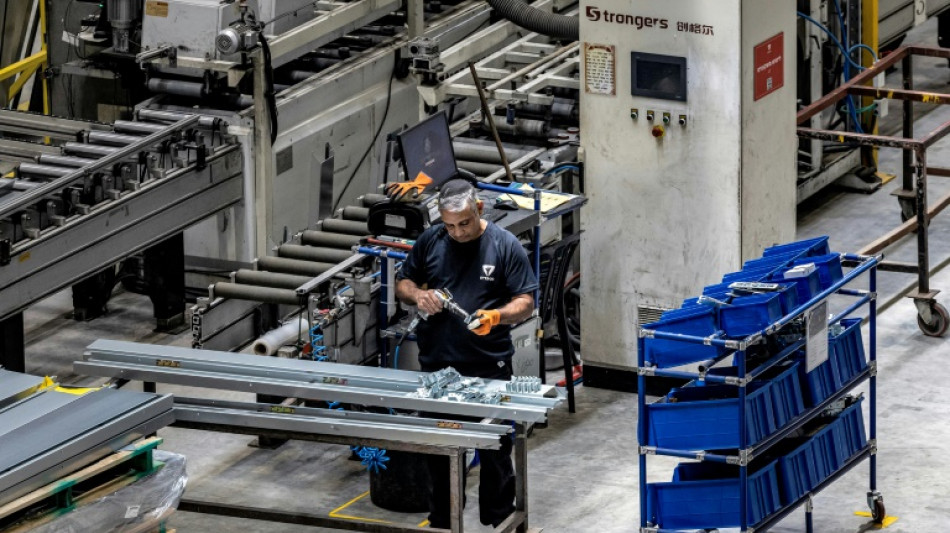
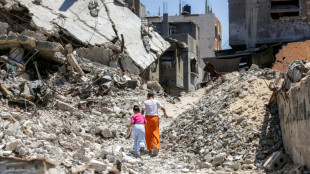
Under fire, undermanned: Israel's wartime economy soldiers on / Photo: FADEL SENNA - AFP

 US designates UK-based Palestine Action as foreign 'terrorist group'

 'Rocky Horror Picture Show' star Tim Curry dead at 80

 American Moll wins women's pole vault at Zurich city event

 As Canada takes on US tariffs, what's behind the David and Goliath fight?

 UEFA 'likely' to drop threat to boycott FIFA tournaments: source

 US disrupts platforms allegedly used by Chinese hackers

 The foreign tourists missing in Nepal's flash floods

 Hundreds missing after Nepal-Tibet flood kills 98
 CIA director was on 'semi-routine' mission in Moscow: Trump
 Aldeguer switches to Rossi's VR46 for next season

 Rent TRON Energy and Reduce USDT Fees : TronBid Expands Marketplace

 Pakistan captain Babar Azam returns against England '90 percent fit'

 Stocks mixed as oil drops, inflation stays high

 Improving standards transform pole vault as spectacle, says Duplantis

 India close in on win despite Sri Lanka fightback in second Test
 MEXC TradFi Gala Concludes With Over 170,000 Registrations and $4.3 Billion in Daily Trading Volume

 Olympic skating champion Liu to skip new season

 Benfica sign midfielder Palhinha from Bayern
 Flick says Barca may go without striker as Atletico resist Alvarez sale

 Too hot to incubate: Nile crocodiles hatch on their own in French reserve

 Spurs closing in on Man City's Marmoush after signing Savio

 Celtic count the cost of Champions League flop

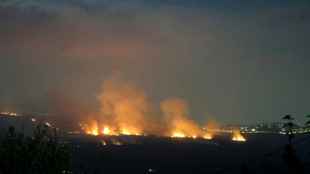 Lebanon accuses Israel of burning forest, farmland in south

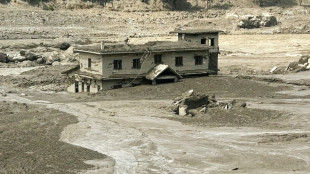 Nepal floods at China border kill 8, cause 'major casualties' in Tibet

 France eases cow diets as cheesemakers sweat
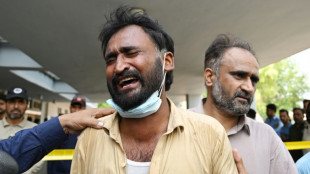
When rocket sirens echo on the factory floor of Rav-Bariach Industries, Israel's biggest maker of security doors, workers rush to take refuge in bomb shelters fitted with their own kit.
As the wailing subsides, they get back to the production line, making more blast-proof safe room hatches as Israel's economy adapts to the uneasy rhythm of life in wartime.
"This is part of our reality," said CEO Idan Zu-Aretz in Ashkelon, 10 kilometres (six miles) from the Gaza Strip where combat rages between Israel and Hamas.
Since war broke out, barrages of Hamas rockets -- and the response of Israel's "Iron Dome" anti-missile system -- punctuate the working day at Rav-Bariach, which produces heavy-duty locks and filtration systems, as well as security doors.
"The demand for those products is skyrocketing," 51-year-old Zu-Aretz told AFP.
But he wants the operation in Gaza to eliminate the threat. "This reality will change," he said.
"It must change. There's no other way."
- 'Situation is tough' -
On October 7, Hamas militants surged over the militarised border from Gaza into Israel, killing some 1,200 people -- mostly civilians -- according to Israeli officials.
Three days after the attack, the worst since Israel was founded in 1948, a missile crashed through the roof of Rav-Bariach's factory. No one was hurt.
"In the first weeks of the war there were much more alerts," said Ravid Brosh, Rav-Bariach's head of international development, who took refuge in a shelter when a siren sounded during AFP's visit this week.
As the initial shock of the attack began to dissipate, a new problem became apparent.
At least 125,000 Israelis were forced to leave their homes near Gaza and in the north, where cross-border strikes from Lebanese militants Hezbollah have become a daily ritual.
Meanwhile, more than 360,000 army reservists were mobilised to fight as Israel carries out a ground campaign in Gaza, where the Hamas government says more than 12,300 people have been killed, most of them civilians.
In a nation numbering only nine million, the reduction in the available labour force has had huge economic consequences.
"The situation is tough right now, mainly because we're missing hands," said Zu-Aretz.
"Many of our employees are still missing, some of them are recruited to the army."
"Some of them are still in different cities and they can't come and work," he said, estimating fewer than two-thirds of his 600 employees in Ashkelon were available.
Over its 75 years of existence, Israel has regularly been at war with its neighbours.
But "all Israeli-Arab conflicts in previous years were relatively minor compared to the war today", according to economist Benjamin Bental of the Taub Center, an Israeli think tank.
Some industries are worse affected than others. "The construction sector is blocked," Bental said, as it relied so heavily on Palestinian labourers with travel permits, which have now been cancelled due to the war.
Hospitality has also lagged as consumer confidence has slumped. Business is slow at bars and restaurants in major cities with tourists staying away.
Overall, credit card transactions dropped 10 percent after October 7, and then 20 percent as Israel began its ground invasion of the densely populated Gaza Strip, according to economist Bental.
The resilience of the tech industry, which makes up 18 percent of GDP, will prove decisive.
- 'A lot of conditionals' -
Many economic institutes have slashed their growth forecasts for this year and next, though the Israeli central bank remains bullish, predicting a 2.8-percent GDP boost in 2024.
But Bental said there were "a lot of conditionals in the scenarios".
"If the situation worsens along the northern border, this is going to totally change the picture," he added.
"It's very hard to assess what it might entail, except that it is going to be terrible."
With fighting ongoing in a war Prime Minister Benjamin Netanyahu has warned will be "long and difficult", the combat is likely to suck up millions of shekels (dollars) of state spending.
Last month, a group of 300 economists wrote to the premier with a warning: "You do not understand the magnitude of the crisis that Israel's economy is facing."
P.L.Madureira--PC