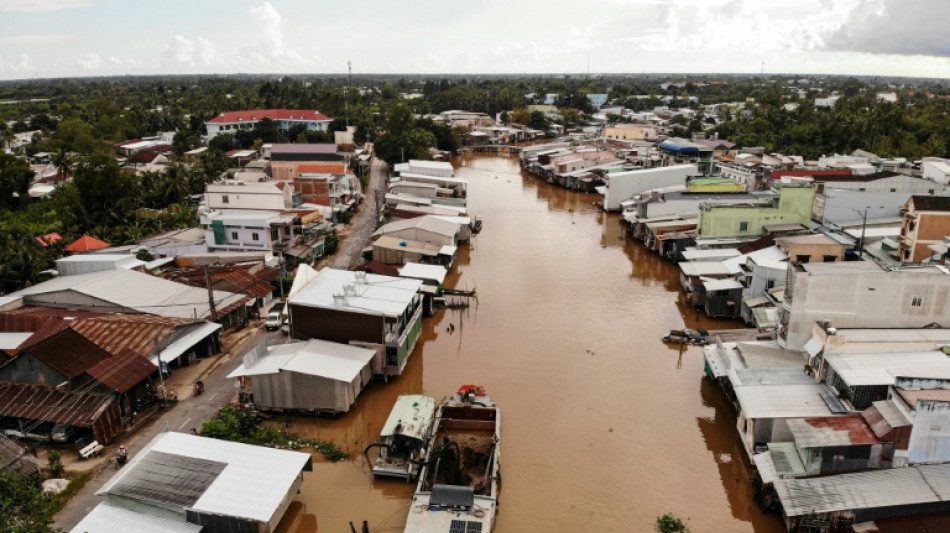
Sand mining in Vietnam's Mekong Delta sinks homes, livelihoods / Photo: Nhac NGUYEN - AFP

 UEFA 'likely' to drop threat to boycott FIFA tournaments: source

 US disrupts platforms allegedly used by Chinese hackers

 The foreign tourists missing in Nepal's flash floods

 Hundreds missing after Nepal-Tibet flood kills 98

 CIA director was on 'semi-routine' mission in Moscow: Trump

 Aldeguer switches to Rossi's VR46 for next season

 Rent TRON Energy and Reduce USDT Fees : TronBid Expands Marketplace

 Pakistan captain Babar Azam returns against England '90 percent fit'

 Stocks mixed as oil drops, inflation stays high

 Improving standards transform pole vault as spectacle, says Duplantis

 India close in on win despite Sri Lanka fightback in second Test
 MEXC TradFi Gala Concludes With Over 170,000 Registrations and $4.3 Billion in Daily Trading Volume

 Olympic skating champion Liu to skip new season

 Benfica sign midfielder Palhinha from Bayern

 Flick says Barca may go without striker as Atletico resist Alvarez sale

 Too hot to incubate: Nile crocodiles hatch on their own in French reserve

 Spurs closing in on Man City's Marmoush after signing Savio

 Celtic count the cost of Champions League flop

 Lebanon accuses Israel of burning forest, farmland in south

 Nepal floods at China border kill 8, cause 'major casualties' in Tibet

 France eases cow diets as cheesemakers sweat

 America unites in mourning for Dolly Parton

 Meta and US states discuss settlement in landmark social media trial: report

 Fire haze threatens health of millions in Indonesia, ministry warns

 Pakistan hospital fire kills 14 infants

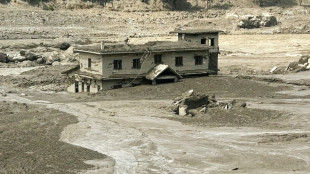
One summer morning, Le Thi Hong Mai's home collapsed into a river in Vietnam's Mekong Delta, where shoreline erosion caused by sand mining and hydropower dams threatens hundreds of thousands of people.
Sand -- needed to produce concrete -- is the world's second most exploited natural resource after water, and its use has tripled in the last two decades, according to the UN environment programme.
Vietnam's "rice bowl" delta region, where the Mekong empties into the South China Sea, is predicted to run out of sand in just over a decade.
But losses to the riverbed are already devastating lives and harming the local economy.
Mai told AFP she "lost everything", including the small restaurant business attached to her house in the suburbs of Can Tho City.
"I heard a bang, I rushed out and everything was gone," recalled the 46-year-old, who was sleeping close by. "I have nothing left".
Over the past two decades, hydropower dams upstream on the Mekong have restricted the flow of sand to the delta.
And sand mining to feed Vietnam's construction boom is also fast depleting resources, according to a major WWF report published earlier this year.
By 2040, the amount of sediment could be reduced by up to 97 percent, a 2018 Mekong River Commission study said, with serious consequences for people living and working on the shores of the river.
With less sand, river flows become lighter and faster and hit the banks at greater speed, accelerating erosion.
Between 2016 and August this year, at least 750 kilometres (466 miles) of riverbank and nearly 2,000 houses in the Mekong Delta region have sunk into rivers, government figures show.
- 'Last grain of sand' -
Along the Mekong, diggers and boats work around the clock, dredging sand from the riverbed.
According to Vietnam's ministry of transport, the Delta region needs 54 million cubic metres of sand for six major national highways before 2025.
The river system can provide less than half, the ministry says.
Important projects have already been delayed while authorities debate alternatives, including sea sand or imports from neighbouring Cambodia.
In Can Tho, cows sit next to unmanned excavators, and sections of a road that will eventually run to Ca Mau province are still underwater -- awaiting sand to cover them.
"We haven't had enough sand since the beginning of the year, so we don't have much to do," one worker, who declined to give his name, told AFP.
Vietnam banned exports of sand in all forms in 2017.
But given high domestic demand, the amount dredged still exceeds what comes downstream, Mekong expert Nguyen Huu Thien explained.
At the current extraction rate of 35-55 million cubic metres a year, there will be no more sand by 2035, according to the WWF-led study.
"These are the last grains of sand we are dredging," Thien warned.
- 'Nowhere else to go' -
In Hau Giang province, 60 kilometres from where Mai lost her home, Diep Thi Lua awoke in the middle of the night to see her front garden disappear into the water.
"We all jumped out of bed after hearing a big noise," the 49-year-old told AFP.
"We could feel the ground was shaking. We were so, so scared."
She said the river had widened over the decades by dozens of metres.
Since 2016, Vietnam's government has spent over $470 million on 190 projects to prevent erosion in the Mekong Delta, according to state media.
But "many of these expensive structures have collapsed into the river", Thien said.
A single $4.7 million embankment built in 2016 was washed away three times between 2020 and 2022, state media reported.
Half the delta could be gone by the end of the century, Thein warned.
"After that, the delta will disappear altogether and we will have to redraw our map and rewrite our geography books."
Around 20,000 households need to be resettled because of the risks, according to the General Department of Natural Disaster Prevention and Control.
The WWF puts the figure much higher, saying half a million could lose their homes.
But resettlement "requires lots of money, which our government will never have", said an official from Hau Giang province who did not want to be named.
"We know that they could lose their lives, living in those high-risk areas, but we have no solutions," he said.
Residents like Mai and Lua are left gripped by fear.
"I have not slept well since the erosion. We have nowhere else to go. We just have to accept it," Mai told AFP.
J.Oliveira--PC