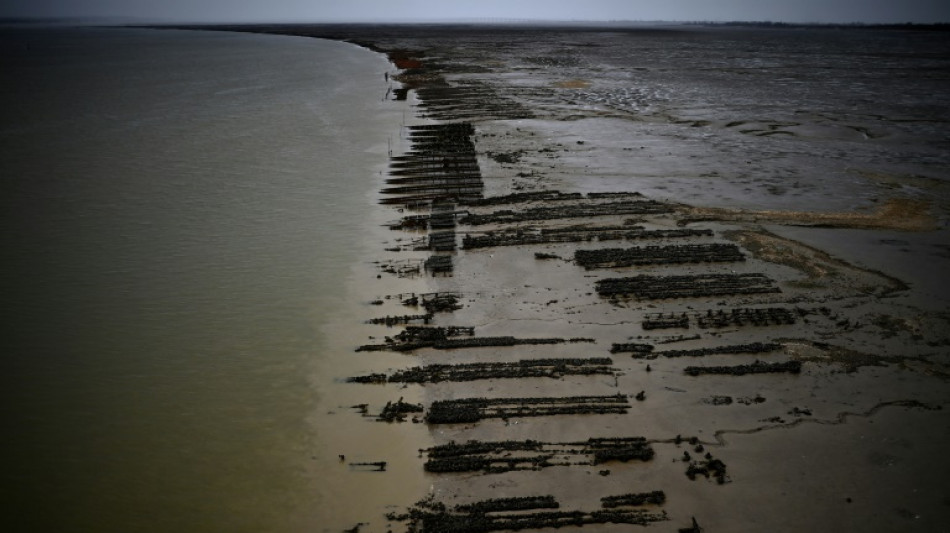
Climate change gets in the way of French oyster culture / Photo: Christophe ARCHAMBAULT - AFP

 Aldeguer switches to Rossi's VR46 for next season

 Rent TRON Energy and Reduce USDT Fees : TronBid Expands Marketplace

 Pakistan captain Babar Azam returns against England '90 percent fit'

 Stocks mixed as oil drops, inflation stays high

 Improving standards transform pole vault as spectacle, says Duplantis

 India close in on win despite Sri Lanka fightback in second Test
 MEXC TradFi Gala Concludes With Over 170,000 Registrations and $4.3 Billion in Daily Trading Volume

 Olympic skating champion Liu to skip new season

 Benfica sign midfielder Palhinha from Bayern

 Flick says Barca may go without striker as Atletico resist Alvarez sale

 Too hot to incubate: Nile crocodiles hatch on their own in French reserve

 Spurs closing in on Man City's Marmoush after signing Savio

 Celtic count the cost of Champions League flop

 Lebanon accuses Israel of burning forest, farmland in south

 Nepal floods at China border kill 8, cause 'major casualties' in Tibet

 France eases cow diets as cheesemakers sweat

 America unites in mourning for Dolly Parton

 Meta and US states discuss settlement in landmark social media trial: report

 Fire haze threatens health of millions in Indonesia, ministry warns

 Pakistan hospital fire kills 14 infants

 Iceland to vote on resuming EU talks in close referendum

 Iran says Hormuz strait still closed despite transit corridor talks

 'Our patron saint': Tennesseans mourn local hero Dolly Parton

 Australian police hunt thieves in $250,000 oyster heist

 Coordinated attacks: Thailand's southern insurgency flares

Rising sea temperatures due to climate change are forcing oyster farmers in France's southwest to take a break from summer maturation, traditionally a key step in the production of the tasty molluscs.
Starting next year, producers in Marennes Oleron, France's biggest oyster bay, will no longer be able to steep oysters in shallow clay beds in salt marshes, known as "claires", during the summer months.
Oyster farmers in this region traditionally keep oysters in the oyster beds for the final weeks before their sale, a treatment that gives them a less salty and iodic taste than if they had come straight from the sea, and earns them the "fine" label, recognised by the EU's protected geographical indication (PGI) category.
But climate change is negating the effects of the oyster beds.
Scientists have found that because of fast-evaporating water, the salt concentration has become too high between early June and late August, leading to the ban during those months.
Human consumption of oysters, which are animals, goes back thousands of years. They come in a wide variety of flavours and textures depending on water salinity, alkalinity, mineral content and nutrition.
"We're going to have to accept change," said Henry Schaller, a local farmer using the "claire" method for which the Marennes Oleron oyster region is famous.
But the 37-year-old, in the business since 2010, said he had already cut down on summer maturation even before the new rule. "The oysters had become too salty," he said. "We had a weaker, lower-quality product."
- On the frontline -
The water temperature in the clay oyster beds, filled with sea water thanks to the tides and rhythm of the ocean, can now reach 35 Celsius (95F) in the summer months, well above the comfort zone of 32C for oysters, which cannot regulate their temperature.
This puts them more on the "frontline" of climate change suffering than ocean mammals or fish, said Fabrice Pernet, a scientist at the Ifremer oceanic research centre.
"There is as much reason for concern for oysters as there is for corals. Their fragility is similar," he said.
Producers in the Marennes Oleron sell up to 60,000 tonnes of oysters per year, of which 17,000 tonnes are of the "fine" variety.
Rising ocean temperatures, which in July set a new world record at 20.96C, make oysters more vulnerable to disease, and expose them to falling oxygen content in the water and rising acidity.
"We noticed, because of a changing climate, that the maturation could no longer be carried out in the same way," said Laurent Chiron, an oyster farmer and president of the GQHMO association that awards the industry's quality label.
According to the new rules, farmers are encouraged to go beyond the traditional winter and summer methods for oyster bed maturation, adopting a more flexible approach.
"We are telling oyster farmers: based on how you perceive the climate, you can operate one maturation method or another," Chiron said.
Philippe Morandeau, president of the oyster industry committee in Poitou-Charentes which includes Charente-Maritime, said he believed any impact on sales figures would be small, given that most oysters are sold for end-of-year festivities when ocean temperatures are low.
L.Mesquita--PC