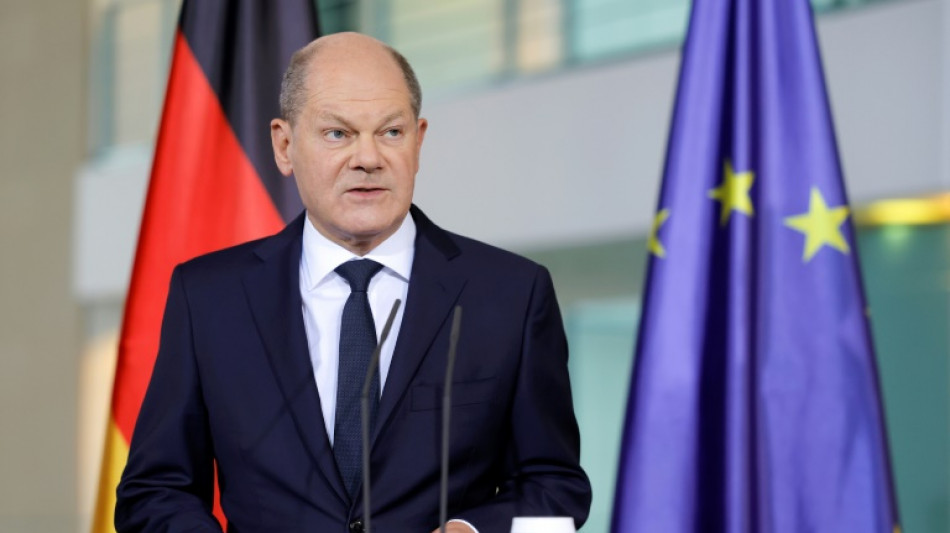
Why you should care about the budget crisis rocking Germany / Photo: Odd ANDERSEN - AFP/File

 Aldeguer switches to Rossi's VR46 for next season

 Rent TRON Energy and Reduce USDT Fees : TronBid Expands Marketplace

 Pakistan captain Babar Azam returns against England '90 percent fit'
 Stocks mixed as oil drops, inflation stays high

 Improving standards transform pole vault as spectacle, says Duplantis
 India close in on win despite Sri Lanka fightback in second Test
 MEXC TradFi Gala Concludes With Over 170,000 Registrations and $4.3 Billion in Daily Trading Volume

 Olympic skating champion Liu to skip new season

 Benfica sign midfielder Palhinha from Bayern
 Flick says Barca may go without striker as Atletico resist Alvarez sale

 Too hot to incubate: Nile crocodiles hatch on their own in French reserve

 Spurs closing in on Man City's Marmoush after signing Savio

 Celtic count the cost of Champions League flop

 Lebanon accuses Israel of burning forest, farmland in south

 Nepal floods at China border kill 8, cause 'major casualties' in Tibet

 France eases cow diets as cheesemakers sweat
 America unites in mourning for Dolly Parton

 Meta and US states discuss settlement in landmark social media trial: report

 Fire haze threatens health of millions in Indonesia, ministry warns

 Pakistan hospital fire kills 14 infants

 Iceland to vote on resuming EU talks in close referendum

 Iran says Hormuz strait still closed despite transit corridor talks

 'Our patron saint': Tennesseans mourn local hero Dolly Parton

 Australian police hunt thieves in $250,000 oyster heist

 Coordinated attacks: Thailand's southern insurgency flares

German Chancellor Olaf Scholz will address parliament Tuesday about an escalating budget crisis triggered by a bombshell court ruling that his government breached constitutional debt limits.
Here is a look at the crisis rocking Europe's biggest economy and threatening a collapse of the fractious ruling coalition:
- What are the debt rules? -
When Angela Merkel was chancellor in 2009, Germany enshrined a so-called "debt brake" in its constitution.
This caps a government's budget deficit at 0.35 percent of gross domestic product, and is emblematic of Germany's commitment to reaching balanced budgets -- known as the "schwarze Null", or "black zero".
The idea of strict spending limits gained traction in the early 2000s, and politicians were really spurred into action by the 2007-2008 financial crisis, when debt and the deficit soared.
The measure can be suspended in emergencies, as long as parliament backs the move. This happened from 2020 to 2022, first to cope with the fallout from the coronavirus pandemic and then the energy crisis sparked by Russia's invasion of Ukraine.
It was supposed to come back into force this year -- but due to the budget crisis, Finance Minister Christian Lindner announced last week the coalition was seeking to suspend it again.
- What triggered the latest crisis? -
On November 15, Germany's Constitutional Court ruled that Scholz's coalition had acted in contravention of the "debt brake", in response to a legal complaint from the conservative opposition CDU and CSU parties.
The judgement related to a 2022 decision to transfer 60 billion euros ($65 billion) of unused borrowing capacity from a pot aimed at fighting the impacts of the pandemic to a "climate and transformation fund".
The immediate impact of the ruling was to wipe the 60 billion euros from the climate fund, which had been worth 212 billion euros.
This could affect projects aimed at speeding Germany's transition to an emissions-free economy, as well as others supposed to transform industry -- such as a raft of investments in semiconductor projects announced in recent times.
But the ruling is also impacting other "off budget" funds, with the government now having to account for the extra spending in its main budget.
- How has the government reacted? -
Projects under the climate and transformation fund were intially suspended, followed by a broader freeze on future spending commitments.
Lindner has been forced to seek to suspend the debt brake again, a bitter pill for a fiscal hawk whose pro-market FDP had staunchly backed the measures.
Announcing the development last week, he omitted any mention of the word "debt brake", instead referring cryptically to the introduction of a "supplementary budget", and failing to give any further explanation. It was left to the finance ministry to clarify the details afterwards.
Meanwhile talks on the 2024 budget have been suspended.
There has been embarrassment in a country that long prided itself on fiscal rectitude.
On Wednesday, Scholz looked visibly annoyed when, during a joint press conference in Berlin alongside Giorgia Meloni, the Italian leader was asked whether she still considered Germany a reliable economic partner, given the court ruling.
- What are the wider implications? -
The crisis has fuelled debate on whether the debt brake should be relaxed and raised questions on whether Scholz's fragile three-party coalition might implode.
In the coming years, major German lender LBBW Bank believes massive extra outlays will be needed in areas ranging from defence to pensions and healthcare, likely amounting to about five percent of GDP.
"If Germany is to retain its economic strength and stability, it will not be possible without easing the debt brake," said the bank's chief economist Moritz Kraemer.
But while Scholz's SPD and the Greens are in favour of relaxing the rules, Lindner's FDP have seemed determined to keep the debt limit in place. At the same time, raising taxes is a red line for the FDP.
In a hint of the tussle within the coalition, Economy Minister Robert Habeck of the Greens dug in his heels on Monday, saying that "all projects that we conceived must be made possible."
The opposition, meanwhile, have described the ruling as a "political disaster". On Monday Markus Soeder, the powerful leader of the CSU party, added his voice to calls for new federal elections.
G.M.Castelo--PC