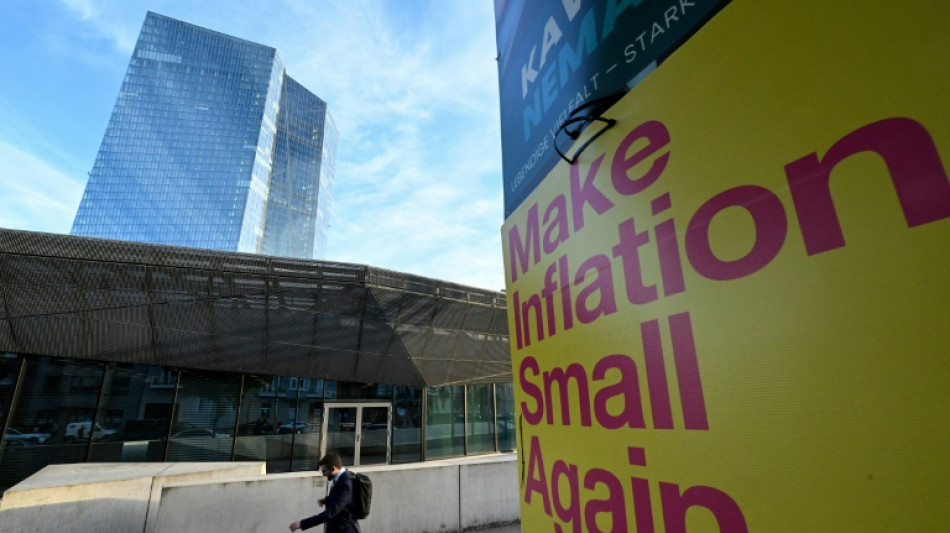
Falling inflation shifts focus to when ECB could cut rates / Photo: Kirill KUDRYAVTSEV - AFP

 Sooriyabandara, Mendis lead Sri Lanka fightback after follow-on

 With ropes and chants, thousands move Japanese castle

 Zurich Diamond League: five events to watch

 'Black smoke' chokes Pakistan maternity ward as hospital fire kills 14 infants

 French flight attendant wins landmark breast cancer ruling
 Sri Lanka 83-2 after India enforce follow-on in second Test

 Pakistan hospital fire kills 14 infants

 Iceland to vote on resuming EU talks in close referendum

 North Korea to 'bring joy' to Kim with 100 athletes at Asian Games

 US LGBTQ community mourns 'diva' Dolly Parton

 England bid to banish booze woes as Pakistan seek self-respect

 High quality, low risk: record number of Japanese in Premier League

 Stocks edge higher as oil drops on fresh Mideast hopes

 Pakistan's girls fight for their place in the boxing ring

 Five things to know about Anthropic ahead of Wall Street debut

 Social media use on the rise among Australian under-16s after ban: data

 Instagram chief admits touting teen safety tool while omitting it was barely used

 'Final Fantasy', 'The Witcher' in spotlight at Europe gaming bash
 Syrian Kurdish leader dissolves force that spearheaded jihadist fight

 Trump raises prospect of demolishing iconic Kennedy Center

 PGA Tour to end in two-week matchplay showdown from 2028: CEO

 United States of Dolly: how a country queen bridged America's divide

 PGA chief says 'no current plans' for LIV stars to return

 Golf giant Callaway apologizes after ad sparks outcry

 Ioane stars as New Zealand recover to beat Johannesburg Lions

With inflation dropping faster than expected and the economic outlook darkening, markets will be looking for clues about when eurozone borrowing costs might start to come down as rate-setters meet this week.
The European Central Bank is expected to leave interest rates unchanged Thursday for its second meeting in a row, as policymakers take a breather following a historic run of hikes to tame runaway prices.
But all eyes will be on whether the ECB gives any indications of when borrowing costs -- the key deposit rate is currently sitting at a record high -- will start to be reduced.
Speculation has intensified since eurozone inflation slowed faster than expected to 2.4 percent in November, a more than two-year low and not far off the ECB's two-percent target.
Inflation in the 20 countries that use the euro peaked at about 10 percent last year after prices were pushed up first by post-pandemic supply chain woes, and then an energy crisis triggered by Russia's invasion of Ukraine.
Thursday's meeting "looks likely to provide some idea of how soon and how fast policymakers are willing to start cutting interest rates", said Andrew Kenningham from Capital Economics.
He added that ECB president Christine Lagarde was likely to "concede that rate cuts may not be as distant as previously thought".
Markets and analysts have been bringing forward their predictions for when the ECB will start slashing rates -- some now expect a first reduction in April, months earlier than previous forecasts.
Providing further ammunition to those arguing for a cut to come soon, the eurozone outlook has worsened.
The European Commission last month lowered its eurozone growth forecast for 2023 and 2024, and in its latest financial stability review, the ECB warned that a recession was a "possible scenario".
- Dovish shift? -
There have also been signs of a more dovish attitude at the ECB.
Isabel Schnabel -- seen as among the ECB's more conservative members -- said in an interview earlier this month that the November inflation reading was "quite remarkable", and it had made further rate hikes unlikely.
Still, there is uncertainty about the path forward, particularly as officials have warned inflation may tick up again in the coming months.
At the last ECB meeting in October, Lagarde dismissed any talk about cuts as "premature".
And last month, she insisted that it was "not time yet to start declaring victory".
The ECB's monetary policy decision will come a day after the US Federal Reserve's, with both central banks expected to remain on hold.
Messaging about next steps will prove tricky for eurozone rate-setters as debate heats up about when to make the first cut, analysts say.
But HSBC said in a note that Lagarde "is likely to reinforce the message that it is too early to talk about rate cuts... We do not expect explicit guidance on the possible timing of the first cut."
Key to charting a course forward could be the Frankfurt-based institution's latest forecasts for inflation and growth in the coming years, also due to be released Thursday.
Pressure is growing, particularly from more indebted eurozone economies, for cuts to come sooner rather than later.
As well as the impact of higher rates and a long period of elevated inflation, the single currency area faces problems ranging from a stuttering world economy to uncertainty about energy prices as the Israel-Hamas war rages.
2023 had been "a challenging year for the EU economy, in which growth has slowed down more than expected", the bloc's economy commissioner, Paolo Gentiloni, said last month.
"Strong price pressures and the monetary tightening needed to contain them, as well as weak global demand, have taken their toll on households and businesses."
C.Cassis--PC