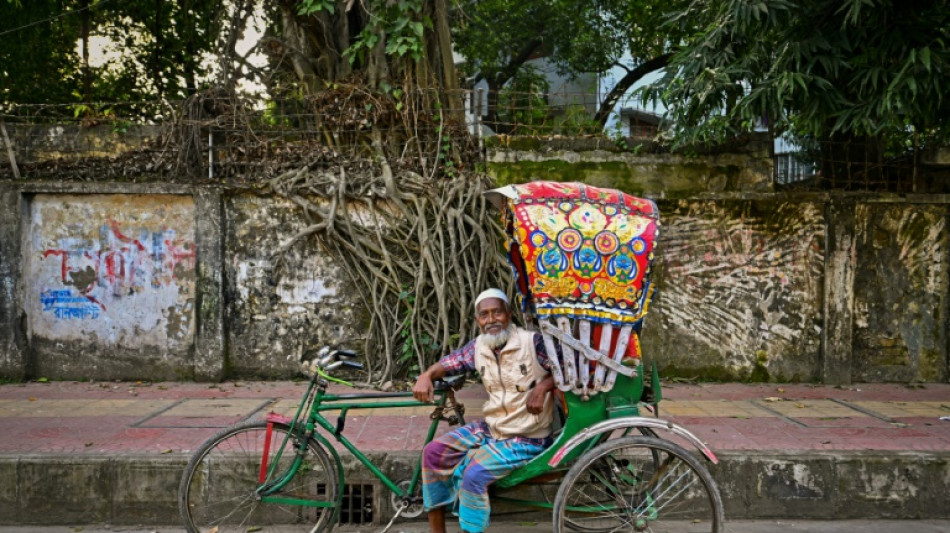
Fading colours: Bangladesh's threatened rickshaw art / Photo: Munir UZ ZAMAN - AFP

 Pakistan hospital fire kills 14 infants

 Iceland to vote on resuming EU talks in close referendum
 North Korea to 'bring joy' to Kim with 100 athletes at Asian Games
 US LGBTQ community mourns 'diva' Dolly Parton
 England bid to banish booze woes as Pakistan seek self-respect
 High quality, low risk: record number of Japanese in Premier League
 Stocks edge higher as oil drops on fresh Mideast hopes
 Pakistan's girls fight for their place in the boxing ring
 Five things to know about Anthropic ahead of Wall Street debut
 Social media use on the rise among Australian under-16s after ban: data

 Instagram chief admits touting teen safety tool while omitting it was barely used
 'Final Fantasy', 'The Witcher' in spotlight at Europe gaming bash
 Syrian Kurdish leader dissolves force that spearheaded jihadist fight
 Trump raises prospect of demolishing iconic Kennedy Center

 PGA Tour to end in two-week matchplay showdown from 2028: CEO
 United States of Dolly: how a country queen bridged America's divide

 PGA chief says 'no current plans' for LIV stars to return

 Golf giant Callaway apologizes after ad sparks outcry

 Ioane stars as New Zealand recover to beat Johannesburg Lions
 Ukrainians seeking beauty in a bomb-scarred city

 Dolly Parton: Country music's dolled up but deserving queen

 US robotaxi firm Waymo plans to launch in Germany
 'Here to win': Xavi vows to restore pride in Dutch football
 Cameroon's Baleba joins as Man United boost midfield options
 'Shocking' book about Putin's private life wins French literary prize
Vibrant greens and swirling yellows, film stars, birds and architecture: Bangladesh's bicycle rickshaw drivers have for decades used their transport as a unique moving canvas of urban folk art.
But many fear that despite being added by the United Nations cultural agency this month to its list of intangible cultural heritage, the colourful craft is fading in the face of faster, modern motorised rickshaws.
Rickshaw mechanic Mohammad Sabuj, 40, says he is mourning the decline in the "beautiful" paintings, which adorn the vehicles' carriage covers, seats and footrests.
"It has become rare nowadays," he said. "When I was younger, rickshaws were full of colourful art and designs -- but nowadays the trend has fallen."
Rickshaw driver Shahid Ullah, 72, has been pedalling his bike for half a century through the congested and narrow streets of Dhaka, a city of around 20 million people.
But as people switch to cars and buses for transport -- or motorised Chinese-made rickshaws without the same space on the frame to carry the art -- his trade is disappearing.
- Dying art -
Ullah welcomed the UNESCO decision this month to recognise the art, which it called a "key part of the city's cultural tradition and a dynamic form of urban folk art, providing inhabitants with a sense of shared identity".
The rickshaw art was one of dozens of practices that made UNESCO's Intangible Cultural Heritage of Humanity list on December 6, alongside Italian opera singing, Peru's ceviche seafood dish, Thailand's Songkran New Year festival and Ivory Coast's traditional loincloth weaving.
"It's a good thing for us," Ullah said. "We feel proud."
UNESCO South Asia chief Tim Curtis said that rickshaw painting was "under threat", and that the listing would help boost the craft by "finding innovative and sustainable ways of keeping this living heritage alive".
Increasing costs of fuel and other basic goods have hit the craft hard, said mechanic Sabuj.
"Drivers need to pay more to the rickshaw owners than before and the design also requires more money now," he said.
Depending on the complexity of the design, painting costs between $45-$90 -- as much as a third of the cost of a new bicycle rickshaw, which costs around $230-270.
Painting costs are usually borne by the owner, who rents bikes out to drivers.
A new motorised rickshaw is more expensive -- between $750-900 -- but they are seen as earning a quicker return.
Abdul Motaleb, another rickshaw driver, said people admired the art but still used modern transport including the packed metro system.
"People prefer faster vehicles," Motaleb said.
Rickshaw artist Hanif Pappu, 62, said the number of youngsters coming to learn the trade had slumped.
"Now no one sends their children to learn this art," he said. "They see that the trainers themselves are starving."
For Pappu, the UNESCO listing will not halt the decline.
"It came too late," he said. "Rickshaw painting is dying in the country."
- 'Raw creation' -
With the rickshaws weaving through the chaotic roads of Dhaka, Pappu said the paintings were a roving art exhibition carrying the creator's message to a mobile audience.
"Look at this, it's a message of peace," he said, pointing to a painting of a tranquil rural scene with birds and a house that he said was a reminder in the busy city of the countryside many had left behind to find jobs.
"It's a message of a happy family," he added. "We try to give such messages in our work."
He is proud of the colourful creations, which he has been painting since he was a boy, recalling how movie posters were once popular designs.
"It is a heritage of Bangladesh," he said. "It is our own raw creation."
But Pappu worries for the future.
"I could have left this work for the sufferings I faced, but I didn't because I feel it is now mixed with my blood. Will anyone stay in this profession for 55 years like I did?" he said.
"If this trend continues, this industry will vanish. It won't survive."
H.Portela--PC