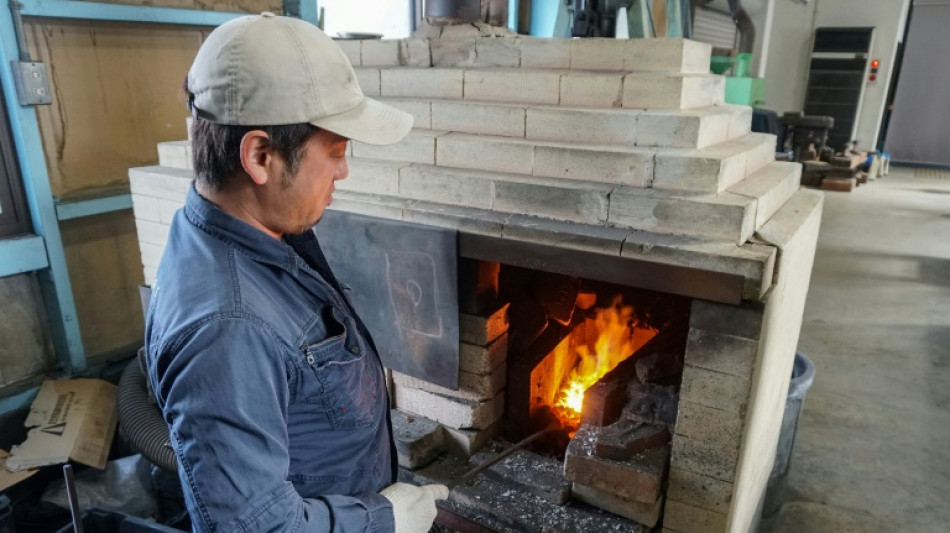
Japan's hand-forged knives a slice of samurai metallurgy / Photo: Saad SAYEED - AFP

 Pakistan hospital fire kills 14 infants
 Iceland to vote on resuming EU talks in close referendum

 North Korea to 'bring joy' to Kim with 100 athletes at Asian Games

 US LGBTQ community mourns 'diva' Dolly Parton
 England bid to banish booze woes as Pakistan seek self-respect
 High quality, low risk: record number of Japanese in Premier League
 Stocks edge higher as oil drops on fresh Mideast hopes
 Pakistan's girls fight for their place in the boxing ring
 Five things to know about Anthropic ahead of Wall Street debut
 Social media use on the rise among Australian under-16s after ban: data

 Instagram chief admits touting teen safety tool while omitting it was barely used

 'Final Fantasy', 'The Witcher' in spotlight at Europe gaming bash

 Syrian Kurdish leader dissolves force that spearheaded jihadist fight

 Trump raises prospect of demolishing iconic Kennedy Center

 PGA Tour to end in two-week matchplay showdown from 2028: CEO

 United States of Dolly: how a country queen bridged America's divide

 PGA chief says 'no current plans' for LIV stars to return

 Golf giant Callaway apologizes after ad sparks outcry

 Ioane stars as New Zealand recover to beat Johannesburg Lions

 Ukrainians seeking beauty in a bomb-scarred city

 Dolly Parton: Country music's dolled up but deserving queen

 US robotaxi firm Waymo plans to launch in Germany

 'Here to win': Xavi vows to restore pride in Dutch football

 Cameroon's Baleba joins as Man United boost midfield options

 'Shocking' book about Putin's private life wins French literary prize

Blacksmith Yoshihiro Yauji pulls a piece of glowing metal from the forge in a Japanese village, continuing a tradition dating back centuries to when the region was renowned for crafting swords carried by samurai.
He places the steel under a spring hammer and the sound of the metal being flattened and fortified into a kitchen knife echoes off the mountains surrounding the workshop.
"I believe that blades are the foundational root of Japanese culture," 40-year-old Yauji said.
"If you can condense 700 years, 1,000 years or 1,500 years of technology into a single product, the appeal of the product will be different," he explained, adding that at first, he wanted to make "katana" swords once wielded by samurai.
Yauji started at 20 as an apprentice to Hideo Kitaoka, who helped found the collection of cooperative workshops that make up the Takefu Knife Village.
After 18 years, Yauji launched his knife line in 2021.
But in the 1970s and 80s, the city of Echizen where the knife village is located was in crisis, with artisans unable to compete with cheaper mass-produced tools.
Kitaoka and other top blacksmiths banded together to form a cooperative association and, with the help of famed designer Kazuo Kawasaki, began producing designs that turned Echizen knives into works of art.
"At the time of my boss's generation, the environment was not like it is today; they were struggling just to survive," Yauji said.
"My generation is on the upswing. So I feel it is necessary to once again improve our skills for the brand and its value to continue to exist."
Around 80 percent of Echizen-made knives are now exported, Yauji said, making their way into professional kitchens around the world and even featuring on hit TV series "The Bear".
- Hand fits the knife -
The forge at Takefu burns at 900 degrees Celsius (1,652 degrees Fahrenheit), and the handmade Japanese blades drawn from the molten orange core, once hammered, shaped and polished, are sharp enough to split a hair.
"The Japanese knife brings out the best of ingredients. Texture, bitterness, sweetness," Yauji said.
"I think it is a knife specialised to bring out the true flavour of the ingredient itself."
Knife makers can spend an entire day perfecting a single piece.
The metal is heated until malleable and then hammered -- a process repeated several times -- before being shaped, quenched in oil or water and left to cool.
Once the temperature is stable, it is ready to be sharpened. Most blacksmiths hand the knife over to dedicated sharpeners at this stage.
Then, the utensil is ready for the final step of the process: handle making.
"Japanese cutlery is, in my opinion, about the hands learning to fit the tool" instead of the knife being designed for the comfort of the user, Yauji said.
"It is a way of trying to establish a deeper connection."
- 'Soul of a chef' -
Using his custom-made yanagiba (willow-leaf blade) sashimi knife, Chef Shintaro Matsuo slices a buttery slab of fatty tuna at acclaimed Osaka restaurant Koryu, considered one of the best fine-dining establishments in a city dubbed Japan's kitchen.
Matsuo's dishes combine subtle flavours using ingredients from the surrounding Kansai region, all artfully presented with the help of blades made in Sakai, a small town on the outskirts of Osaka that is considered Japan's hocho (kitchen knife) heartland.
"The knife is an extension of my hand," the chef explained, proudly wielding the elongated blade specially made by blacksmith Minamoto Izumimasa.
"Japanese steel allows the flavours of the food to remain intact," Matsuo added.
Chefs in the country spend years honing their knife skills and patiently learning to master blades that are often more challenging to use and require greater expertise.
"Japanese people have a unique sense of beauty when it comes to cutlery," said Ryoyo Yamawaki, whose Sakai-based company has been making knives since 1929.
"Since ancient times, the Japanese sword is said to have been the soul of a samurai, and the knife the soul of a chef."
V.F.Barreira--PC