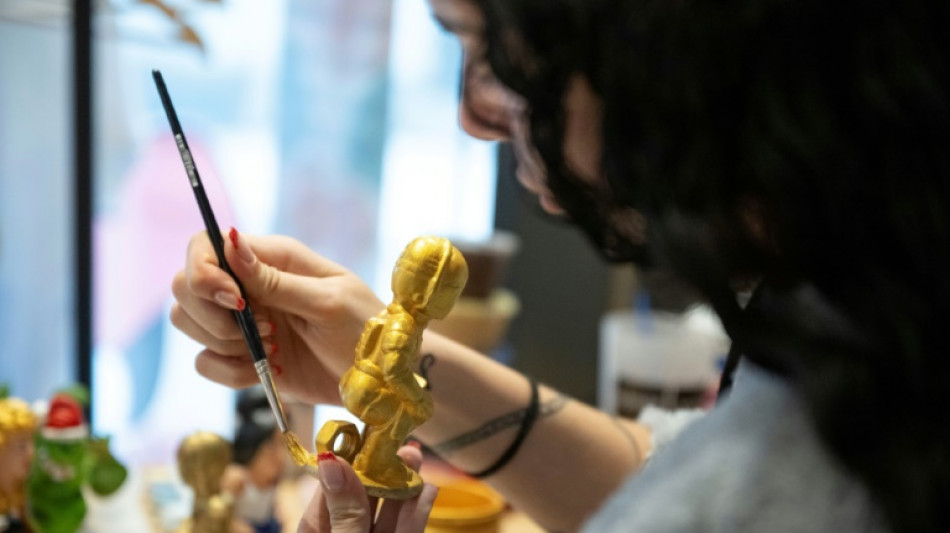
'Pooper' figures star in nativity scenes in Spain / Photo: Josep LAGO - AFP

 Pakistan hospital fire kills 14 infants

 Iceland to vote on resuming EU talks in close referendum

 North Korea to 'bring joy' to Kim with 100 athletes at Asian Games
 US LGBTQ community mourns 'diva' Dolly Parton
 England bid to banish booze woes as Pakistan seek self-respect

 High quality, low risk: record number of Japanese in Premier League

 Stocks edge higher as oil drops on fresh Mideast hopes

 Pakistan's girls fight for their place in the boxing ring
 Five things to know about Anthropic ahead of Wall Street debut
 Social media use on the rise among Australian under-16s after ban: data

 Instagram chief admits touting teen safety tool while omitting it was barely used

 'Final Fantasy', 'The Witcher' in spotlight at Europe gaming bash

 Syrian Kurdish leader dissolves force that spearheaded jihadist fight

 Trump raises prospect of demolishing iconic Kennedy Center

 PGA Tour to end in two-week matchplay showdown from 2028: CEO

 United States of Dolly: how a country queen bridged America's divide

 PGA chief says 'no current plans' for LIV stars to return

 Golf giant Callaway apologizes after ad sparks outcry

 Ioane stars as New Zealand recover to beat Johannesburg Lions

 Ukrainians seeking beauty in a bomb-scarred city

 Dolly Parton: Country music's dolled up but deserving queen

 US robotaxi firm Waymo plans to launch in Germany

 'Here to win': Xavi vows to restore pride in Dutch football

 Cameroon's Baleba joins as Man United boost midfield options

 'Shocking' book about Putin's private life wins French literary prize

Look closely at a nativity scene in Spain's Catalonia region and you will likely spot an unusual figure -- a peasant with his pants down and doing his business in the holy scene.
The "caganer" -- or "pooper" -- figurine has long been a staple of Christmas in the northeastern region, usually placed in a discreet corner not far from Mary, Joseph and the baby Jesus.
The defecating statuettes are believed locally to bring prosperity for the coming year. They have become increasingly popular with tourists, especially in Barcelona, the region's capital, where they are easily found in Christmas markets.
The traditional clay figure depicts a peasant or shepherd wearing black trousers, a white shirt and the classic red Catalan cap called the barretina.
But the tradition has expanded to include famous figures such as Chinese President Xi Jinping, former US president Donald Trump, singers such as Michael Jackson and athletes like Paris Saint-Germain star Kylian Mbappe.
"It is very interesting. We are also very surprised to see they have all these figures, celebrities and also political figures. It's definitely a new experience for us," said Amy Hu, a 30-year-old tourist from the United States, as she browsed a selection of caganers in Barcelona.
One of the biggest caganer makers, family-run Caganer.com, currently sells 650 different models of the figures at its six shops in Barcelona and Madrid as well as online, where the United States accounts for the bulk of orders.
The company expects to sell 140,000 of the figures this year, which retail for five to 21 euros ($5-$23).
Sergi Alos, co-owner of the company founded by his mother in 1992, said the figures were a tribute, not a mockery. He said he was happy that tourists could "have something that is typically Catalan".
- 'An icon' -
The roots of the caganer are vague but are generally thought to date from the 18th century.
The figurines aim to "connect the people to the mystery of the nativity", said Josefina Roma, a retired University of Barcelona anthropology professor.
She likened caganers to playful characters that appear in theological narratives to make them more understandable.
Xavier Borrell, the president of the 33-year-old Friends of the Caganer Association, which has around 100 members, said the figures "have gone beyond nativity scenes to become an icon".
The retired engineer owns 1,400 caganers, the bulk of them classic figurines of peasants.
He said he was delighted that the statuettes had become popular tourist souvenirs in Catalonia, a wealthy region of around 7.7 million people that has its own distinct language.
"In Catalonia we sell Mexican sombreros, Sevillian dresses, images of bulls, which are not typical of our culture, and the fact that tourists who come here take a caganer with them pleases me a lot," Borrell said.
- Unusual gift -
At Christmas markets across Catalonia, caganers rub shoulders with "tios", a log with stick legs and a smiling face and red hat that is also a staple in many homes during the Christmas season.
Parents cover the log with a blanket and secretly place little gifts such as candies, nuts and small toys inside.
On Christmas Eve, or in some households on Christmas Day, children hit the blanket-covered log with sticks while encouraging him to "defecate" gifts.
"It is a bit scatological," Borrell said.
The log does not drop large gifts, which are traditionally considered to be brought by the Three Wise Men on January 6, the day of the Epiphany.
L.Torres--PC