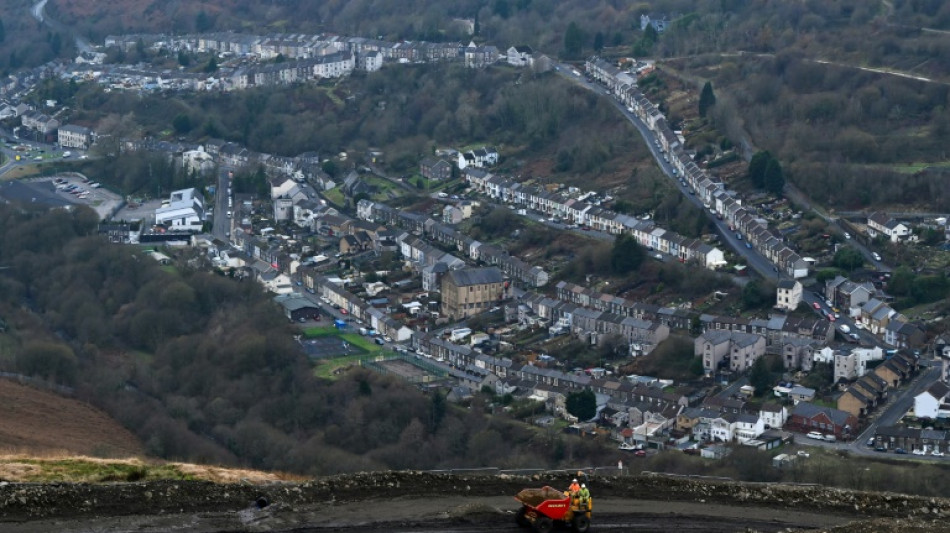
Fears in Wales over legacy of its coalmining past / Photo: Justin TALLIS - AFP

 US LGBTQ community mourns 'diva' Dolly Parton

 England bid to banish booze woes as Pakistan seek self-respect
 High quality, low risk: record number of Japanese in Premier League

 Stocks edge higher as oil drops on fresh Mideast hopes

 Pakistan's girls fight for their place in the boxing ring
 Five things to know about Anthropic ahead of Wall Street debut

 Social media use on the rise among Australian under-16s after ban: data

 Instagram chief admits touting teen safety tool while omitting it was barely used

 'Final Fantasy', 'The Witcher' in spotlight at Europe gaming bash

 Syrian Kurdish leader dissolves force that spearheaded jihadist fight

 Trump raises prospect of demolishing iconic Kennedy Center

 PGA Tour to end in two-week matchplay showdown from 2028: CEO

 United States of Dolly: how a country queen bridged America's divide

 PGA chief says 'no current plans' for LIV stars to return

 Golf giant Callaway apologizes after ad sparks outcry

 Ioane stars as New Zealand recover to beat Johannesburg Lions

 Ukrainians seeking beauty in a bomb-scarred city

 Dolly Parton: Country music's dolled up but deserving queen

 US robotaxi firm Waymo plans to launch in Germany

 'Here to win': Xavi vows to restore pride in Dutch football

 Cameroon's Baleba joins as Man United boost midfield options

 'Shocking' book about Putin's private life wins French literary prize

 Pogacar storms to Vuelta a Espana stage four solo triumph

 Canada unveils counter-tariffs of 15-50% on US goods

 Volkswagen boss braces German workers for more job cuts

It was nearly four years ago but the memory of the landslip that sent 60,000 tonnes of old mining debris sliding down a Welsh hillside still haunts former miner Jeff Coombes.
First the river he was walking along with his dog in the heart of the Rhondda Valley in south Wales turned brown. Then the water slowed down.
He noticed the coal tip was moving. After that it was the noise that hit him.
"Well it was more of a roar," Coombes, 77, told AFP.
The ever-present danger of disused coal tips, exacerbated by the effects of global warming, looms large in Wales.
On October 21, 1966, a slag heap collapsed onto a village school and houses in the small south Wales mining village of Aberfan.
The disaster killed 28 adults and 116 children. Nearly 60 years later, it still casts a long shadow.
No-one was hurt in the 2020 incident on the hillside at Tylorstown.
But it prompted the Welsh authorities to undertake a comprehensive census of old tips, also known as slag or spoil heaps.
It found more than 2,500 of the mini-mountains of debris from old mine shafts nationwide, a legacy of Wales's mining past.
Of those, 350 were deemed to pose a serious risk of collapse, including 79 located in the Rhondda Cynon Taf region north of Cardiff, according to the latest count.
They will now have to be monitored twice a year.
- Almost invisible -
The heaps can "become destabilised because they comprise of loose (unconsolidated) material" sitting on slopes, said Ashley Patton, a geological engineer at the British Geological Survey.
"The other major triggering factor for destabilising spoil heaps is water," he said, adding that intense rainfall had been implicated in the slippage at Tylorstown.
In 2021, an independent report on climate change risks highlighted the increasing likelihood of future landslides linked to former mining activity, as rains become more frequent and more violent.
Along the road that winds through the Rhondda valley, the slopes on either side are now covered in vegetation, making the danger almost invisible.
"Most of them are covered over by trees (but) it's around you.
"People have become conscious of that after Tylorstown tip slid," said Phil Rowe, a former local councillor in neighbouring Ferndale.
The fear of another disaster had caused "a lot of panic" locally, he said, adding that he didn't believe the authorities were carrying out the necessary surveillance.
Memories of the mining industry that once dominated the valleys of south Wales remain strong among the older generation.
But, said ex-miner Roy Jones, 78: "Younger generations don't know a lot about it."
That makes them less aware of the risks.
On the hill above Tylorstown, he pointed to another slag heap, which has been drained and levelled off to lessen the danger.
"They flatten the top and it is now as big as a football field," he said.
- Forgotten region -
The situation has generated anger among locals, who feel forgotten since the closure of the mines made the region less economically important.
Rowe said that without the collapse at Tylorstown nothing would have been done to make that slag heap safe.
"They said they'd be monitoring it within the last two or three years.
"Well, if that was the case, they should have seen that there's something's going to happen," he said.
The cost of making safe all the potentially dangerous slag heaps has been estimated at between £500 million and £600 million ($633 million and $760 million) over 15 years, according to the Welsh authorities.
But they say the UK government in London is not willing to contribute directly.
"Is it right (that) the UK took the economic benefit from Welsh coal but won't fund the safety of its legacy?" local Labour MP Beth Winter recently asked Prime Minister Rishi Sunak in parliament.
Sunak responded that the devolved Welsh government in Cardiff "has the resources it needs" to manage the issue.
"I don't think it's the people of the valley who should have to pay for all that," said Coombes, recalling that Welsh coal powered the ships of the Royal Navy, and fuelled the expansion of the former British Empire.
L.Henrique--PC