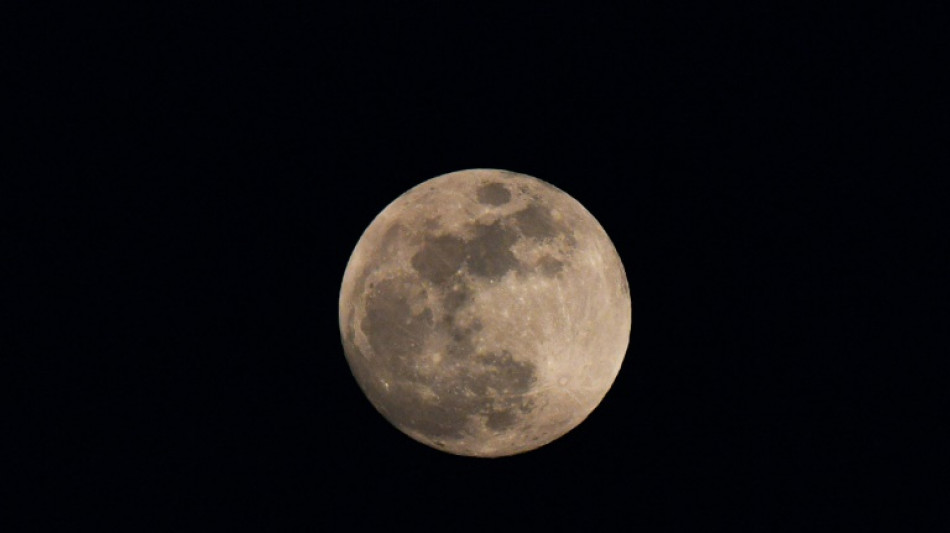
Navajo object to depositing human remains on Moon / Photo: Ted ALJIBE - AFP/File

 Too small for fries: drought shrinks Belgian potatoes

 Drought-hit Danube gives way to fossil hunt in Bulgaria

 Julia Curlee, CIA officer fired by White House for being transgender

 Fave or flop? A guide to gauging video game success
 Williams-Alcaraz fall in US Open mixed quarter-finals

 Mark Carney, the former central banker who said 'no' to Trump

 Segner out of South Africa tour as New Zealand injuries pile up

 Meta knew teen safety tools were ineffective, witnesses testify

 Williams and Alcaraz win opener at US Open mixed doubles
 Man Utd's Fernandes crowned PFA player of the year

 Dolly Parton: quotes on life, love and music

 Brazil fines TikTok $30 mn in 'powerful signal' over child safety

 Cameroon's Baleba joins as Man Utd boost midfield options

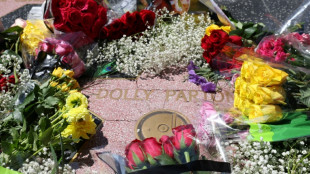
 US country music legend Dolly Parton dies at 80

 Kolisi fit to captain South Africa against New Zealand

 Volkswagen workers boo boss during speech on job cuts

 Djokovic, Sabalenka tumble out of US Open mixed doubles

 CIA director Ratcliffe visits Moscow: US media

 Trump threatens to rename Lake Ontario as 'Lake America'

 'Here to win': Xavi vows to restore pride to Dutch football

 Canada unveils counter tariffs of 15% to 50% on US goods

 Spain moves to speed up return of migrants stranded in Ceuta

 At least a quarter of NFL players may get brain disease: study

 Iranians queue for petrol after US announces new sanctions

 Blockchain Infrastructure Firm tZERO Integrates with Sui for Institutional-Grade Digital Asset Securities

The United States will soon launch its first spacecraft to attempt a soft lunar landing since the Apollo era, in a historic collaboration with the private sector -- but not everyone is celebrating.
The Navajo Nation, America's largest Indigenous tribe, has raised concerns over the presence of human cremated remains on the lander vehicle, calling the mission a "desecration" of the Moon which holds a sacred place in their culture.
On January 8, Pittsburgh-based Astrobotic's Peregrine lander is set to hitch a ride on a giant United Launch Alliance Vulcan Centaur rocket making its maiden voyage under a NASA commercial partnership aimed at saving the US space agency money.
Peregrine's scientific instruments will probe for lunar surface radiation, helping NASA better prepare for crewed missions going there later this decade under the Artemis program.
But the boxy robot's manifest also includes payloads from two companies -- Elysium Space and Celestis -- that will contain cremated remains and DNA to stay on the Moon, inside the lander, forever.
While Elysium hasn't offered details, Celestis has 69 individual "participants" including late Star Trek creator Gene Rodenberry, sci-fi author Arthur C. Clarke, and a dog named Indica-Noodle Fabiano.
Customers paid prices starting at $12,995, according to the company's website.
In a December 21 letter addressed to officials at NASA and the Department of Transportation, Navajo Nation President Buu Nygren expressed what he called "our deep concern and profound disappointment regarding a matter of utmost importance," and called for NASA to delay the launch.
"The Moon holds a sacred position in many Indigenous cultures, including ours," Nygren wrote.
"The act of depositing human remains and other materials, which could be perceived as discards in any other location, on the Moon is tantamount to desecration of this sacred space."
- NASA promises meeting -
Nygren added the situation was reminiscent of the Lunar Prospector mission launched in 1998 by NASA, which intentionally crashed a probe into the Moon's surface. On board were the remains of renowned geologist Eugene Shoemaker.
Then, too, the Navajo voiced objections. NASA apologized and committed to consult with Native Americans in future, according to a contemporary report in The Spokesman-Review of Spokane, Washington.
NASA's deputy associate administrator for exploration Joel Kearns said Thursday an intergovernmental team had arranged a meeting with the Navajo Nation, but added the agency had no control over its private partner's payloads.
"We take concerns expressed from the Navajo Nation very, very, seriously, and we think we're going to be continuing on this conversation," Kearns told reporters.
Celestis was less conciliatory.
"We respect all cultures' right to engage in religious practices, but no single culture or religion should exercise a veto on space missions based on religious tenets," the company said.
Denying that the mission "desecrates the Moon," it stressed the material would remain aboard the lander rather than being deposited on the surface.
Kearns said NASA's growing private partnerships could lead to "changes to how we view this" or to establishing industry standards.
It won't be the first human DNA left on the barren celestial body -- that distinction belongs to the almost 100 bags of feces and urine left behind by American astronauts during the 1969-1972 Apollo lunar landings.
V.F.Barreira--PC