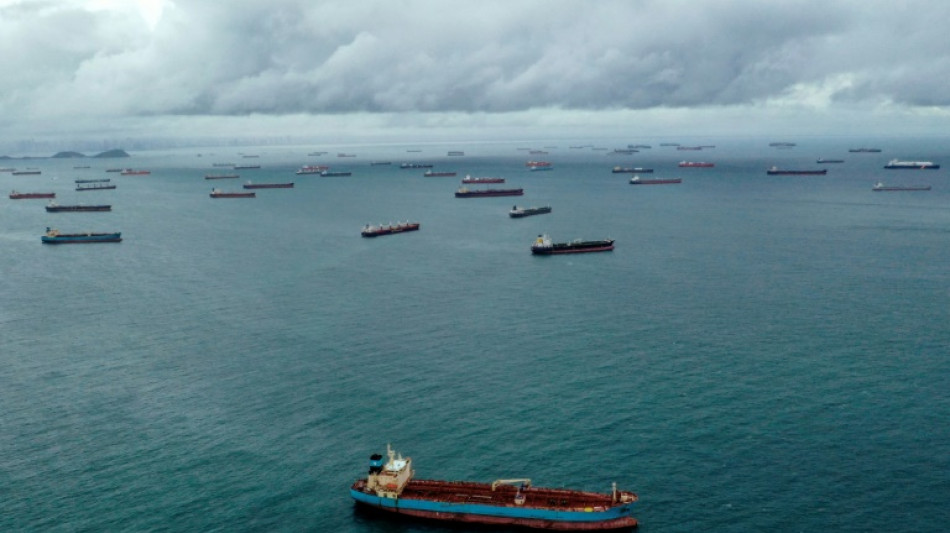
Global maritime trade sails into geopolitical storm / Photo: Luis ACOSTA - AFP/File

 Too small for fries: drought shrinks Belgian potatoes

 Drought-hit Danube gives way to fossil hunt in Bulgaria

 Julia Curlee, CIA officer fired by White House for being transgender

 Fave or flop? A guide to gauging video game success

 Williams-Alcaraz fall in US Open mixed quarter-finals

 Mark Carney, the former central banker who said 'no' to Trump

 Segner out of South Africa tour as New Zealand injuries pile up

 Meta knew teen safety tools were ineffective, witnesses testify

 Williams and Alcaraz win opener at US Open mixed doubles

 Man Utd's Fernandes crowned PFA player of the year

 Dolly Parton: quotes on life, love and music

 Brazil fines TikTok $30 mn in 'powerful signal' over child safety

 Cameroon's Baleba joins as Man Utd boost midfield options

 US country music legend Dolly Parton dies at 80

 Kolisi fit to captain South Africa against New Zealand

 Volkswagen workers boo boss during speech on job cuts

 Djokovic, Sabalenka tumble out of US Open mixed doubles

 CIA director Ratcliffe visits Moscow: US media

 Trump threatens to rename Lake Ontario as 'Lake America'

 'Here to win': Xavi vows to restore pride to Dutch football

 Canada unveils counter tariffs of 15% to 50% on US goods

 Spain moves to speed up return of migrants stranded in Ceuta

 At least a quarter of NFL players may get brain disease: study

 Iranians queue for petrol after US announces new sanctions

 Blockchain Infrastructure Firm tZERO Integrates with Sui for Institutional-Grade Digital Asset Securities

International maritime trade has hit stormy waters as attacks by Yemen's Huthi rebels on ships in the Red Sea has reduced the availability of ships, causing freight rates to surge.
Most large international shipping companies have decided to reroute trading to avoid the Red Sea and Suez Canal through which 12 percent of world trade usually passes.
The Huthis say the strikes are in solidarity with Palestinians in war-ravaged Gaza, which Israel has bombarded relentlessly for three months, in what it says is a campaign to destroy militant group Hamas.
Danish shipping giant Maersk said Friday that it would divert all vessels around Africa instead of using the Red Sea and Suez Canal for the "foreseeable future" after Yemeni rebels attacked its merchant ships.
Vessels are circumnavigating Africa via the Cape of Good Hope, which extends the journey between Asia and Europe by 10 to 20 days on average, according to Arthur Barillas, general manager of Ovrsea, a freight organiser.
Shipping companies have already announced significant price increases to cover the costs associated with the detour.
French shipping group CMA CGM has doubled the price of a 40-foot container between Asia and the Mediterranean to $6,000.
Italian-Swiss peer and sector leader MSC has hiked its prices to $5,900 from $2,900 for the same offering.
The United States says there have been more than 20 Red Sea attacks by Huthi rebels since October 19.
- Chinese New Year -
The industry is suffering from a shortage of containers in Asia owing to longer journey times, causing a headache ahead of the Chinese New Year next month.
"There is a real influx (of goods) from Asia," said Barillas.
In the runup to the Chinese New Year on February 10, "all the ships are full", causing freight rates to rise, he added.
Customers are rushing to have their goods shipped before the celebrations bring China, the world's biggest exporter, to a week-long standstill.
A benchmark indicator for measuring the freight tariff rate of goods transported from China -- the Shanghai Containerized Freight Index -- has almost doubled in a few weeks.
Such a sudden increase is reminiscent of what occurred during the Covid pandemic, when freight rates reached unprecedented heights on disruptions to supply chains.
"Many people, they focus on the spot rate. And yes, it has doubled. And, of course, it speaks about how desperate the situation is," Niels Rasmussen, chief shipping analyst at BIMCO, told AFP.
He added, however, that some shippers would have negotiated better deals.
"If you look at the average rate for everything out of China through most of Europe and the Mediterranean, the increase is 15 percent to 20 percent," said Rasmussen.
- Taiwan elections -
Attacks in the Red Sea are not the only ones disrupting international trade. The worst drought in decades to hit the Panama Canal has forced authorities to slow transits.
A potential further hazard could be the outcome of presidential elections in Taiwan due January 13, should it lead to another crisis with China, according to analysts.
However, "even with the threat of some congestion and equipment shortages, carriers are much better-positioned to accommodate operationally for these diversions when compared to the disruptions seen during the pandemic", Israeli freight reservation and payment platform, Freightos, said in a weekly note to clients.
Shipping companies have used recent huge profits to order hundreds of new ships which are beginning to be delivered.
M.Carneiro--PC