'Not part of China': Taiwanese chart separate identity / Photo: Sam Yeh - AFP

 Fave or flop? A guide to gauging video game success
 Williams-Alcaraz fall in US Open mixed quarter-finals
 Mark Carney, the former central banker who said 'no' to Trump
 Segner out of South Africa tour as New Zealand injuries pile up
 Meta knew teen safety tools were ineffective, witnesses testify
 Williams and Alcaraz win opener at US Open mixed doubles
 Man Utd's Fernandes crowned PFA player of the year

 Dolly Parton: quotes on life, love and music

 Brazil fines TikTok $30 mn in 'powerful signal' over child safety

 Cameroon's Baleba joins as Man Utd boost midfield options

 US country music legend Dolly Parton dies at 80
 Kolisi fit to captain South Africa against New Zealand
 Volkswagen workers boo boss during speech on job cuts
 Djokovic, Sabalenka tumble out of US Open mixed doubles

 CIA director Ratcliffe visits Moscow: US media
 Trump threatens to rename Lake Ontario as 'Lake America'
 'Here to win': Xavi vows to restore pride to Dutch football
 Canada unveils counter tariffs of 15% to 50% on US goods

 Spain moves to speed up return of migrants stranded in Ceuta

 At least a quarter of NFL players may get brain disease: study

 Iranians queue for petrol after US announces new sanctions

 Blockchain Infrastructure Firm tZERO Integrates with Sui for Institutional-Grade Digital Asset Securities

 Oil down as traders weigh US sanctions threat against Iran

 Canada to unveil response to Trump's steep tariffs
 Curling attracts curious Romans under Colosseum's shadow

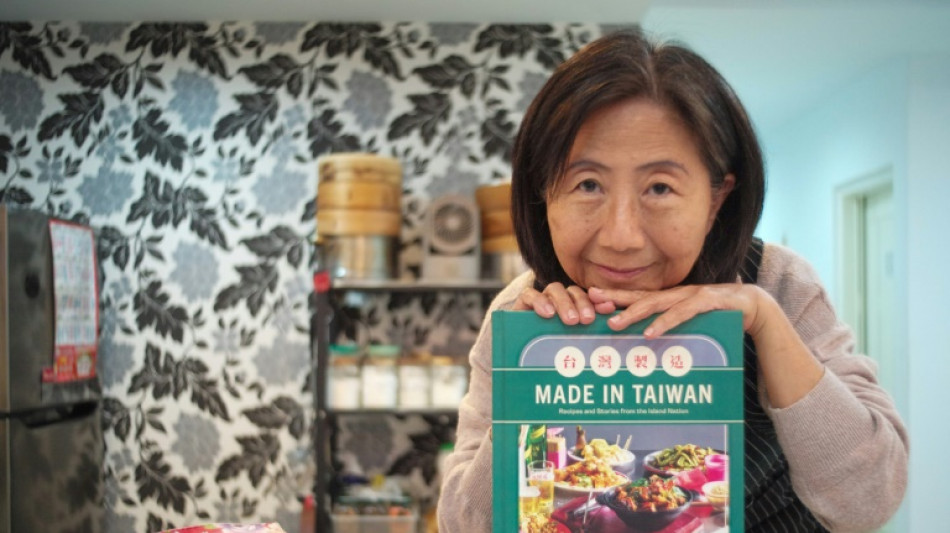
Wrapping bamboo leaves around a nugget of sticky rice, cooking instructor Ivy Chen tries to replicate the recipe of a Taiwanese-style dumpling -- a distinct cuisine integral to the democratic island's identity.
She has spent nearly a quarter-century championing Taiwan's cuisine and teaching recipes to tourists and sometimes locals, explaining how a dish that originated from across the strait in China has transformed into a Taiwanese staple.
The idea of a distinctly Taiwanese identity is looming large in the minds of some voters as the island prepares to go to the polls on Saturday to elect a new president and choose the path of relations with Beijing over the next four years.
"I am made in Taiwan -- I was born here, I grew up here, I know all the authentic flavours, I know the traditions," Chen, 66, told AFP from her Taipei kitchen.
Her latest cookbook "Made in Taiwan" seeks to show that "Taiwanese cuisine stands on its own", detailing recipes ubiquitous across the island such as the pork-belly buns and stinky tofu sold in Taipei's night markets.
"(The) very act of being Taiwanese is a constant fight against unrelenting Chinese state attempts to obliterate our identity," Chen's co-author Clarissa Wei wrote in the book's introduction.
"Our food isn't a subset of Chinese food because Taiwan isn't a part of China."
Their staunch declaration of Taiwanese identity is in line with how the majority of the island feels -- a clear separation from China, even as it claims Taiwan as part of its territory.
After the Communist Party gained control in China in 1949, the nationalists fled to Taiwan, leading to a political standoff.
But as the island moved from autocracy to democracy by the 1990s, sentiments of the population -- which had initially been educated under a Chinese-first curriculum -- began shifting within a more Taiwan-centric environment.
Taiwan's older generations see the "unification of China as inevitable", said Liu Wen, an expert on history and ethnology at Academia Sinica.
"They respond to China's encroachment and the military exercises in a passive way because they believe that eventually... Taiwan and China will be united."
- 'Second-class' food -
This mindset is fading among younger generations.
In 1992, around a quarter of the population identified as Chinese.
But less than three percent now feel that way, according to polling from Taiwan's National Chengchi University for the past three years.
Comedian Kylie Wang, who runs a popular news podcast, described herself as "without question" Taiwanese.
"I'm born here and I love my country so I'm Taiwanese. My identity is Taiwanese," the 38-year-old said.
Cookbook author Chen, who was born in 1957 -- during the authoritarian nationalist-led regime -- said this was not always the case.
"Taiwanese food was considered second-grade food and the nationalistic government boosted Chinese food as the proper, high-quality food."
This coincided with a push for people to speak only Mandarin Chinese in public.
The move subverted other languages on the island -- home to Taiwan's indigenous peoples and descendants of Dutch and Japanese colonial rule and not just newer immigrants from China.
A shift to greater pride in Taiwanese identity came after martial law was lifted and the island moved towards democracy.
By the time Chen Shui-bian became the island's second democratically elected leader in 2000 -- ending decades of single-party rule -- his national banquets included Taiwanese food.
He told the world "Taiwanese food is beautiful, delicious", Chen says.
"When the policies changed, the food changed too."
- A 'more respected' Taiwan -
Today, the island of 23 million people is a vocal proponent of its democracy, declaring values of speech and media freedom -- especially when faced with Chinese military pressures and threats of "unification".
Local and legislative elections dot its busy political calendar, while it also stands out in Asia as being one of the few territories that has legalised same-sex marriage.
"This is Taiwan -- we are so used to having elections, so used to having politics in our daily lives," says Wang, whose podcast "The KK Show" has about 400,000 listeners.
Her comedy has shifted over the years to making more targeted barbs at the Chinese Communist Party, differentiating Beijing's leadership from ordinary Chinese.
"For me, there's no problem as a Taiwanese to say this kind of stuff, and then... I got so many private messages from Chinese audiences, saying how much they appreciate our show," Wang says.
Besides, "everyone agrees that China is a threat... it's not funny anymore".
X.M.Francisco--PC