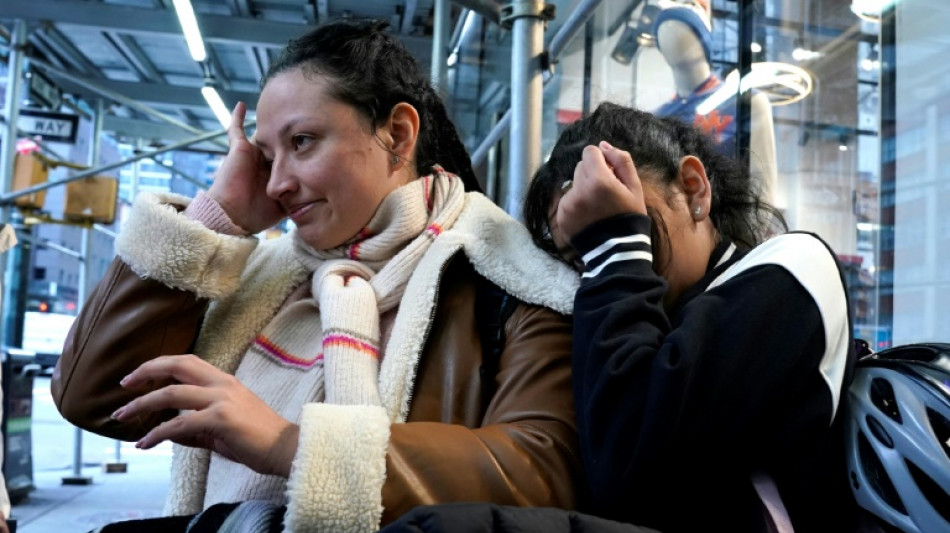
Life is tough and errant for asylum seekers in New York / Photo: TIMOTHY A. CLARY - AFP

 Fave or flop? A guide to gauging video game success

 Williams-Alcaraz fall in US Open mixed quarter-finals

 Mark Carney, the former central banker who said 'no' to Trump

 Segner out of South Africa tour as New Zealand injuries pile up

 Meta knew teen safety tools were ineffective, witnesses testify

 Williams and Alcaraz win opener at US Open mixed doubles

 Man Utd's Fernandes crowned PFA player of the year

 Dolly Parton: quotes on life, love and music

 Brazil fines TikTok $30 mn in 'powerful signal' over child safety

 Cameroon's Baleba joins as Man Utd boost midfield options
 US country music legend Dolly Parton dies at 80

 Kolisi fit to captain South Africa against New Zealand

 Volkswagen workers boo boss during speech on job cuts

 Djokovic, Sabalenka tumble out of US Open mixed doubles

 CIA director Ratcliffe visits Moscow: US media

 Trump threatens to rename Lake Ontario as 'Lake America'

 'Here to win': Xavi vows to restore pride to Dutch football

 Canada unveils counter tariffs of 15% to 50% on US goods

 Spain moves to speed up return of migrants stranded in Ceuta

 At least a quarter of NFL players may get brain disease: study

 Iranians queue for petrol after US announces new sanctions

 Blockchain Infrastructure Firm tZERO Integrates with Sui for Institutional-Grade Digital Asset Securities

 Oil down as traders weigh US sanctions threat against Iran

 Canada to unveil response to Trump's steep tariffs
 Curling attracts curious Romans under Colosseum's shadow

Sally Hernandez, age 12, sobbed Wednesday as the New York hotel where she and her immigrant family were sheltering expelled them before she could say goodbye to the Girl Scout troop she belonged to at her makeshift home.
Such painful departures are more and more common as the city applies new housing rules for a flood of migrants, while border control and people like Sally who lack residency papers take center stage ahead of the November general election.
New York's city hall, overwhelmed by the crisis, is implementing a new rule under which migrants cannot spend more than 60 days in any one shelter. Some people have been living in the same place for up to two years.
They also cannot apply for a new place until the day they leave the old one. So, when their time is up, asylum seekers like Sally and her family have to start from scratch and apply that day for a spot in a different shelter, competing with new people arriving every day, mainly from Latin America.
Sally and her Colombian family -- mother Karol Hernandez, father Sebastian Arango and an 18-month-old baby -- had to lug heavy suitcases a few blocks away to a hotel serving as a processing center for migrants like them.
And all this messy coming and going is happening amid frigid, rainy winter weather. On Tuesday night, 2,000 people living in tents in Brooklyn had to be relocated because of torrential rains.
"Sixty days is not much time ... the legal paperwork takes much longer, to get a work permit or Temporary Protected Status," said Angelo Chirino, a 22-year-old Venezuelan, who arrived in New York in November with his wife and infant son.
More than 160,000 people have come to New York since this immigration crisis started almost two years ago, often in buses chartered by governors in Republican-led border states to protest what they label President Joe Biden's lax border policies.
Struggling to cope with the sea of humanity, last week Mayor Eric Adams sued bus companies that have brought migrants to the city, seeking $700 million in damages to offset the cost of housing them.
The mayor is also asking for federal assistance money and wants it to be easier for such people to get work permits.
Historically Democratic and liberal New York City by law has to provide housing to anyone who requests it, and is the only city in America to offer this kind of help.
- Changing schools -
A 35-year-old Central American woman named Blanca faced the same dilemma as Sally on Wednesday: her time was up at the hotel where she was staying and she had to move on.
Blanca cried as she told AFP her 14-year-old daughter did not go to school this day because she feared that when classes ended she would not know where to find her mother.
Young people will be hit by the new housing rules because changing shelters can mean changing school and longer commute times, critics of the new policy say.
Blanca, who declined to give her last name, also has a baby not yet a year old. She said no one is helping her with all the paperwork involved in seeking housing and asylum, and she cannot afford a lawyer because she is not working.
"With work I know I can support my daughters," she said.
It was unclear where she and her daughters would sleep that frigid night -- possibly huddled together in a camp bed somewhere in the hotel that had just evicted her, or on a chair in the administrative center.
- Vicious cycle -
Her dilemma illustrates the dire straits that many single parent asylum-seekers are stuck in: they have no money, do not speak English and cannot work because they have no one to leave their kids with.
Sandra Gomez of Nicaragua has been more fortunate. After living in a hotel for more than six months she obtained a work permit and is moving with her husband and 17-year-old daughter into a rental house in New Jersey, sharing it with four other families.
"Now I have to go out and find work," Gomez said with a smile.
P.Queiroz--PC