IMF risks losing legitimacy over Argentina loan: minister

 Germans vote in elections threatening fresh blow to Merz

 US fears rapid escalation in Mideast after Houthis attack Riyadh

 Japan triathlete Hojo wins first gold of Asian Games

 IOC president impressed by 'beautiful' Asian Games wooden huts

 First Asian Games gold goes to Japan as China's 13-year-old Yu lights up pool

 Data centre command hub keeps AI up and running

 Pope Leo in France: the issues on the table

 Packing for a pope: behind the scenes on foreign trips

 Republicans find transgender issues a powerful political weapon in midterm campaigning

 German state elections threaten new shock waves for Merz

 Chile's Bachelet quits race to be next UN chief

 Raphinha treble fires perfect Barca to win at Sevilla

 Thiam makes winning heptathlon return at Decastar meet

 Czechs beat USA to qualify for Davis Cup finals

 Dortmund sink Stuttgart to climb to Bundesliga summit

 Trump says will not tolerate attempts to slow AI growth

 'It has to stop': runners protest women's murders in S.Africa district

 Fire erupts near Riyadh airport as Houthis claim strikes

 Cuba works to restore power after another blackout

 England thrash Sri Lanka again to return to top of T20 rankings

 Arsenal thrashed by Brighton, sorry Spurs lose again

 South Korea, Austria qualify for Davis Cup finals

 Seare shocks Ingebrigtsen to win world 5km gold

 Brigitte Bardot widower slams sale of star's belongings

 Aston Villa compound Tottenham's misery despite late rally

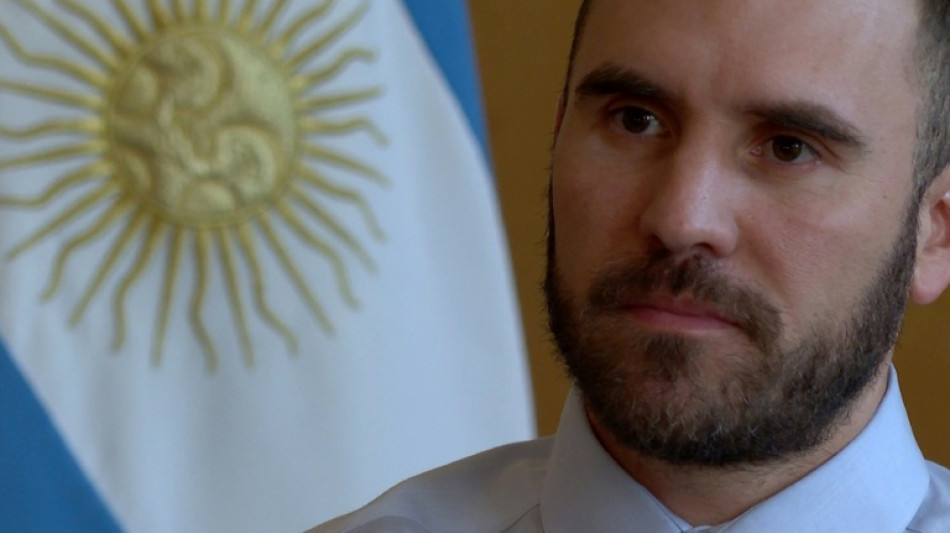
Argentina's economy minister, renegotiating a massive loan with the International Monetary Fund, warned the lender risked losing credibility if it "pushes" the country "into a destabilizing situation."
Argentina has received $44 billion of a $57 billion loan the lender itself said last month had failed to achieve its objectives of restoring confidence in the country's fiscal viability and fostering economic growth.
Latin America's third-largest economy has been in recession since 2018 and is seeking to renegotiate its down payment plan, with amounts of $19 billion and $20 billion due in 2022 and 2023.
The country registered GDP growth of 10 percent in 2021 after a drop of 9.9 percent the previous year largely due to the coronavirus pandemic.
Guzman, in an interview with AFP, said the repayment calendar was "unsustainable" for a country battling a poverty rate of some 40 percent and one of the highest inflation rates in the world at 50 percent.
The government of center-left President Alberto Fernandez, who refused to accept the last $13 billion of the IMF's biggest-ever loan arranged in 2018 under his conservative predecessor Mauricio Macri, is seeking a deal that will reduce Argentina's fiscal deficit through economic growth, not reduced public spending.
Here is what the minister said:
Q: How do you see 2022 unfolding? Is there a risk of a default?
A: Argentina has a very high trade surplus, which is at the highest levels we have achieved. It was over $15 billion in 2021. What is the balance of payments problem facing Argentina in 2022? It is precisely the debt with the IMF. And that is why it is important to refinance it.
It is important for the country and also for the IMF.
If the IMF pushes Argentina into a destabilizing situation, it will also have less legitimacy in the future when other countries require multilateralism in order to solve their problems with the international community.
If we want to protect each other and protect the workings of multilateralism, it is important to agree on something that is credible. And credible means implementable.
We have a set of economic and social objectives, and of course we want to deliver on our commitments, but we need time. We need to be able to refinance these debts.
We need not, for that time, to be burdened with a conditionality that stops recovery and inhibits Argentina's capacity for development in the medium and long term.
Q: Are you expecting support from the United States as the IMF's biggest shareholder? What do you make of the call by Democratic lawmakers to US Treasury Secretary Janet Yellen to back a review of IMF surcharges on larger, outstanding loans, especially at a time that countries need additional resources to fight the pandemic?
A: That was an important request to the Secretary of the Treasury of the United States to support in the IMF board a review of this policy, which harms countries in crisis that have what is called "exceptional access to the International Monetary Fund."
They are charged more when the situation is worse. That... does not help to fulfil the Fund's mission of ensuring global financial stability. Countries with these interest surcharges lose resources with which to carry out the investments needed to improve repayment capacity.
Q: Where does the disagreement lie?
A: There is nearly agreement on where to converge; what is the primary fiscal outcome (before the payment of interest).
The disagreement lies in the speed (of repayment) and this has to do with differing objectives.
In 2021, with an economy growing at 10 percent, the primary fiscal deficit fell by 3.5 percent of GDP. The fiscal deficit in 2021 was between 2.9 percent and 3.0 percent of GDP -- the figure will be known on January 20. It is a strong decline. Good fiscal consolidation is taking place.
What the IMF has put forward is that there must be faster fiscal consolidation.
But there are two problems: the first is that how they propose it be done would halt economic recovery in the short term. The second is that... it would focus on a smaller expansion of investment in public infrastructure. For us this is critical, because that investment is what Argentina needs most, from a productive point of view. That is where the tension lies.
Q: You have made reference to the difference between a perfect agreement and an acceptable one. Are you getting closer to an acceptable deal?
A: There is no perfect agreement...
What we are looking for is to move forward rather than backward. I'd say we are a little better than we were a week ago, but there is a long road ahead. The frequency (of contacts with the IMF) is not only daily, but several times a day.
P.Cavaco--PC