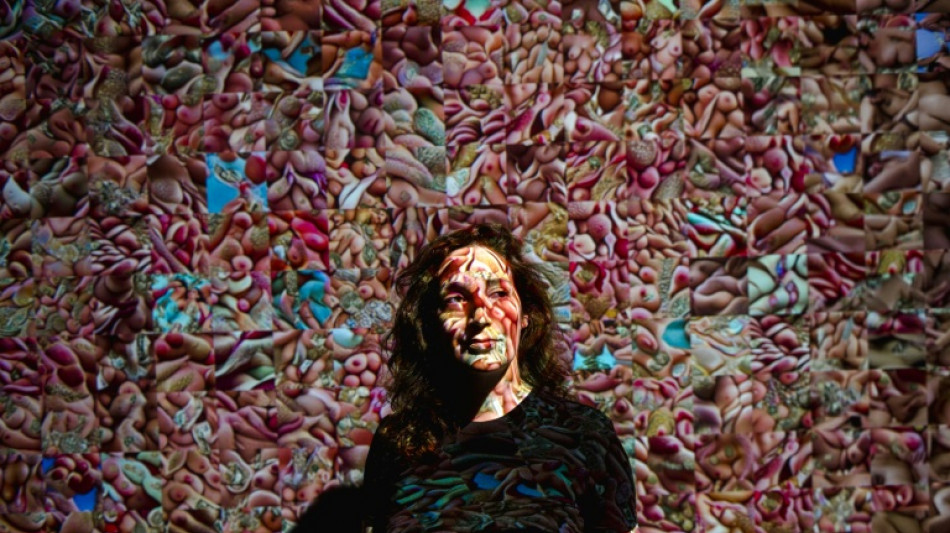
Beyond algorithms: Sandra Rodriguez hacks AI tools for art / Photo: ANDREJ IVANOV - AFP

 Man Utd's Fernandes crowned PFA player of the year

 Dolly Parton: quotes on life, love and music

 Brazil fines TikTok $30 mn in 'powerful signal' over child safety

 Cameroon's Baleba joins as Man Utd boost midfield options

 US country music legend Dolly Parton dies at 80

 Kolisi fit to captain South Africa against New Zealand

 Volkswagen workers boo boss during speech on job cuts

 Djokovic, Sabalenka tumble out of US Open mixed doubles

 CIA director Ratcliffe visits Moscow: US media

 Trump threatens to rename Lake Ontario as 'Lake America'

 'Here to win': Xavi vows to restore pride to Dutch football

 Canada unveils counter tariffs of 15% to 50% on US goods

 Spain moves to speed up return of migrants stranded in Ceuta

 At least a quarter of NFL players may get brain disease: study
 Iranians queue for petrol after US announces new sanctions

 Blockchain Infrastructure Firm tZERO Integrates with Sui for Institutional-Grade Digital Asset Securities

 Oil down as traders weigh US sanctions threat against Iran

 Canada to unveil response to Trump's steep tariffs

 Curling attracts curious Romans under Colosseum's shadow

 World must rein in autonomous weapons: UN, Red Cross

 'Wartime situation': tornado ravages French village

 Germany's Merz addresses critics with climate action pledge

 Stocks rise, oil down as traders weigh Iran sanctions threat

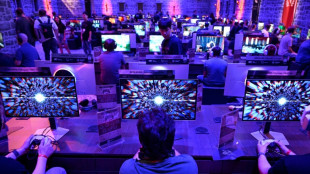 Europe's gaming bash kicks off as industry eyes 'Grand Theft' boost

 Welsh rugby league great Boston dies, aged 92

Canadian artist and academic Sandra Rodriguez, by hacking artificial intelligence, hopes to demystify the novel technology topping the news of late, while showcasing its power and potential to brighten but also disrupt our lives.
In a dimly lit Montreal art space, visitors interact with her exhibit -- an AI trained on millions of online searches for erotica that generates a mosaic of pornographic videos that eventually mesh into a soup of abstract shapes.
Skin is shown as "uniformly light" and "smooth," reflecting "what the AI sees most in current pornographic videos," explains Rodriguez, who used several generative algorithms to create the images that highlight "the social biases which exist in mass pornography."
A few months earlier, she had unveiled a conversational bot inspired by American linguist Noam Chomsky whose objective was to "demystify the secrets of AI" by chatting with the public, all in a virtual world.
"It is necessary today to create works of art that speak to the public about issues that will affect them tomorrow," Rodriguez tells AFP, adding she aims to dispel fears, as well as the "somewhat unrealistic craze," surrounding AI.
"Sandra is a bit of a hacker in a certain way," says Gauthier Gidel, who has collaborated on several of her projects and is a researcher at Mila, the artificial intelligence institute of Quebec.
"She will take the tools, try to change up their use and show the world that this twisted use is almost better than the initial reason for which they were created," he explains.
For her next project, the 40-something Rodriguez plans to mix artificial intelligence with dance, a passion she has had since her childhood in Montreal where she learned salsa at neighborhood parties.
- From documentaries to AI art -
Born to a Spanish humanitarian aid worker and a Quebec teacher, Rodriguez grew up in an immigrant neighborhood in Montreal before spending part of her youth abroad.
Attending secondary school in Spain, university in Canada and then in Belgium, "it was important for our parents that we be exposed to other ways of thinking, other cultures," says the artist whose older sister lives in Madrid.
Initially trained in documentary cinema, she quickly used emerging digital media to find "new ways of telling human stories."
At the same time, she developed a course of research on ways in which the public can reappropriate new tech tools and the resulting social impacts.
For seven years, she split her time between Montreal and the Massachusetts Institute of Technology in Cambridge, where she taught the first course devoted to the production of immersive media.
Today, several of her works embody this duality and have earned award nods at festivals including Sundance and Ars Electronica in Linz, Austria.
- 'A real danger' -
Rodriguez has a strong "desire to break the limits (of these technologies) and to go beyond them, but in an intelligent way, to bring value," says Eliane Achcar of Studio Normal.
For the artist, looking at technology through different lenses helps to reveal its flaws.
By relying only on content collected on the internet and on their own creations, generative AIs like Midjourney or Stable Diffusion that turn text prompts into images reduce "little by little creativity and the way of thinking differently," says Rodriguez.
Added to this is the question of plagiarism of the works on which these systems are based -- an issue raised by several artists before the courts.
"We need to take breaks in the development of AI," says Rodriguez, who has denounced the massive collection of data for several years. "Not so much because the systems are moving too fast, but because we don't know who is using them, what data they are using."
In 2015 Rodriguez was recognized for her work highlighting abuses by technology companies in the "DoNotTrack" project, a documentary series produced by international media.
"There is a real danger for us as citizens," she warns.
C.Amaral--PC