Economic outlook keeps investors wary on Nigeria / Photo: PIUS UTOMI EKPEI - AFP/File

 Man Utd's Fernandes crowned PFA player of the year

 Dolly Parton: quotes on life, love and music

 Brazil fines TikTok $30 mn in 'powerful signal' over child safety

 Cameroon's Baleba joins as Man Utd boost midfield options

 US country music legend Dolly Parton dies at 80

 Kolisi fit to captain South Africa against New Zealand

 Volkswagen workers boo boss during speech on job cuts

 Djokovic, Sabalenka tumble out of US Open mixed doubles

 CIA director Ratcliffe visits Moscow: US media

 Trump threatens to rename Lake Ontario as 'Lake America'

 'Here to win': Xavi vows to restore pride to Dutch football
 Canada unveils counter tariffs of 15% to 50% on US goods

 Spain moves to speed up return of migrants stranded in Ceuta

 At least a quarter of NFL players may get brain disease: study

 Iranians queue for petrol after US announces new sanctions

 Blockchain Infrastructure Firm tZERO Integrates with Sui for Institutional-Grade Digital Asset Securities

 Oil down as traders weigh US sanctions threat against Iran

 Canada to unveil response to Trump's steep tariffs
 Curling attracts curious Romans under Colosseum's shadow

 World must rein in autonomous weapons: UN, Red Cross

 'Wartime situation': tornado ravages French village

 Germany's Merz addresses critics with climate action pledge

 Stocks rise, oil down as traders weigh Iran sanctions threat

 Europe's gaming bash kicks off as industry eyes 'Grand Theft' boost
 Welsh rugby league great Boston dies, aged 92
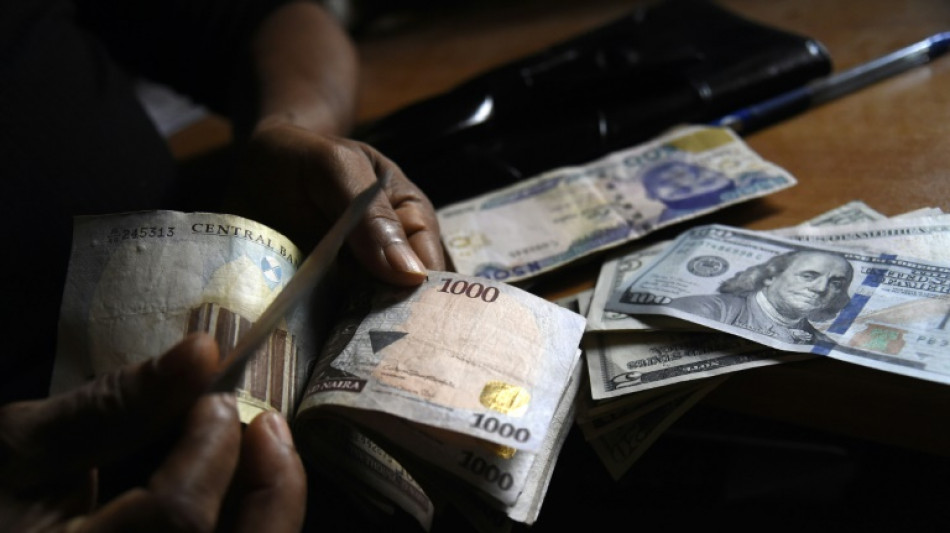
Record inflation, a sliding naira currency and weak financial structure are keeping investors wary of Nigeria, Africa's largest economy, with some companies even stepping away despite economic reforms under recently-elected President Bola Ahmed Tinubu.
Tinubu, who took office last May, has repeatedly called for patience to allow his reforms to take effect after ending a fuel subsidy and freeing up the naira currency -- policies the government says will bring more foreign investment despite the short-term austerity they cause.
Tinubu's moves have been praised by investors. But they have also led to a sharp fall in the naira's value against the dollar, and access to foreign currency in Nigeria remains a major problem for foreign companies.
For some companies the situation remains too uncertain.
South African supermarket chain Shoprite last week said it was closing its store in Kano, Nigeria's second largest city and capital of the Muslim north, "after careful evaluation of the financial situation of the store and the current business climate".
It was the latest announcement from a foreign company about a reduction in presence in Nigeria despite the potential of a consumer market of more than 200 million people in Africa's most populous nation.
In December, the US multinational Procter & Gamble announced that it would halt production in Nigeria after three decades in the country.
The manufacturer of Pampers, Ariel washing powder and Oral B toothpaste would now import and the company's factory in the southwestern city of Ibadan would close down, and let go of its 1,800 direct and indirect employees.
"When you think about places like Nigeria, when you think about places like Argentina, it's very difficult for us as a US dollar-denominated company to create value," Andre Schulten, P&Gs chief financial officer said at the Morgan Stanley Global Consumer & Retail Conference in New York in December.
"It's also difficult to operate because of the macroeconomic environment."
In August, the British pharmaceutical giant GSK also announced it would end its operations in Nigeria, after more than 50 years working in the country.
"In common with many companies operating in Nigeria, the significant challenge in accessing foreign currency in recent years impacted our local operations and has affected our ability to maintain consistent supply of medicines and vaccines in the market," a GSK spokesman told AFP.
GSK's pharmaceutical products will now be distributed by a third-party company.
- Restructuring -
In more muted ways, other international companies have begun a restructuring of their activities in Nigeria, such as PZ Cussons, a British manufacturer of consumer goods including detergents, soaps, household appliances.
In Nigeria since 1899, the company announced in September its plan to "delist from the Nigerian stock exchange" in order to "simplify" its activities in the country.
"We are focused on mitigating the challenges experienced in the region and we are making progress," the company said.
"It represents an investment in Nigeria and will allow us to simplify and strengthen our business here, putting in place a sustainable structure and platform to maximise long-term growth and value."
In its 2023 annual report, the company noted the fall in the value of the naira affecting its 2024 profits and significantly reduced the value of its liquidity.
For its part, the Dutch-British company Unilever announced in March "changes to its business model" to adapt to market conditions. It said it would abandon two segments -- household products and skin products.
Soon after taking office, Tinubu simultaneously initiated his two major reforms intended to restore public finances and attract foreign investment: the end of fuel subsidies that kept petrol prices artificially low and the liberalisation of the naira.
These measures had immediate effects on the country's economy, including a tripling of fuel prices and an explosion in inflation.
Since May, the naira has lost 41 percent of its value against the dollar on the official currency market and 30 percent on the parallel market, and the price of food has increased by more than 31 percent, according to the World Bank.
Elected on the promise of a programme called "Renewed Hope", Tinubu has repeatedly called for "patience" from Nigerians as those reforms take root.
The reforms were "essential" and were going in the "right direction", according to a World Bank report published in December which stressed that it was time to put in place fiscal and monetary measures in the short and medium term in order to obtain results.
According to the Nigerian Bureau of Statistics (NBS), foreign direct investment (FDI) fell from $1.15 billion in the third quarter of 2022 to $654 million in the third quarter of 2023, representing a decline of about 44 percent.
According to the auditing firm KPMG in an analysis published in January, the departures and restructuring of international companies in Nigeria have "dampened" interest from foreign investors.
But foreign companies are "making a mistake" by leaving the country because Nigeria "has more opportunities than many African countries", Jonathan Aremu, an economist at Covenant University in Lagos, told AFP.
"The government is trying all it can and it is going in the right direction in implementing these new policies," he said.
"Nigeria is a huge economy and there are still more opportunities than in many other African countries."
E.Paulino--PC