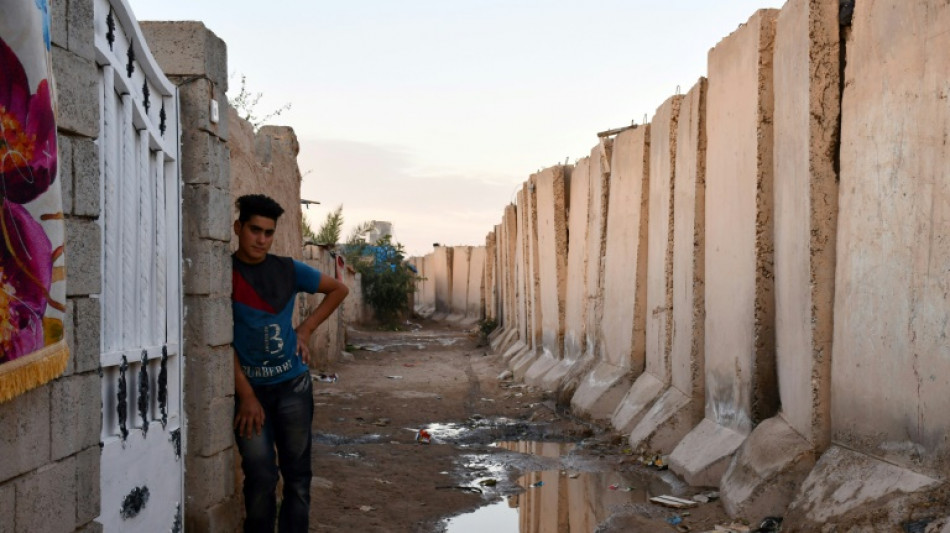
Years after civil war, security wall holds back Iraqi city / Photo: Abdelkhaleq SAMARRAI - AFP

 Man Utd's Fernandes crowned PFA player of the year

 Dolly Parton: quotes on life, love and music

 Brazil fines TikTok $30 mn in 'powerful signal' over child safety

 Cameroon's Baleba joins as Man Utd boost midfield options
 US country music legend Dolly Parton dies at 80

 Kolisi fit to captain South Africa against New Zealand

 Volkswagen workers boo boss during speech on job cuts

 Djokovic, Sabalenka tumble out of US Open mixed doubles

 CIA director Ratcliffe visits Moscow: US media

 Trump threatens to rename Lake Ontario as 'Lake America'
 'Here to win': Xavi vows to restore pride to Dutch football

 Canada unveils counter tariffs of 15% to 50% on US goods

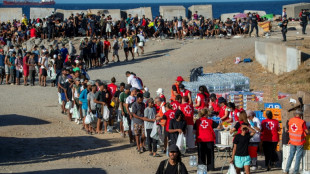 Spain moves to speed up return of migrants stranded in Ceuta

 At least a quarter of NFL players may get brain disease: study
 Iranians queue for petrol after US announces new sanctions

 Blockchain Infrastructure Firm tZERO Integrates with Sui for Institutional-Grade Digital Asset Securities

 Oil down as traders weigh US sanctions threat against Iran

 Canada to unveil response to Trump's steep tariffs
 Curling attracts curious Romans under Colosseum's shadow

 World must rein in autonomous weapons: UN, Red Cross
 'Wartime situation': tornado ravages French village

 Germany's Merz addresses critics with climate action pledge

 Stocks rise, oil down as traders weigh Iran sanctions threat

 Europe's gaming bash kicks off as industry eyes 'Grand Theft' boost
 Welsh rugby league great Boston dies, aged 92

Khaled Ibrahim dreams of a home on the outskirts of Samarra, but a concrete wall built to protect the Iraqi city is stopping him and hampering sorely-needed urban expansion.
Built more than a decade ago at the height of Iraq's civil war which tore apart the multi-faith, multi-ethnic country, authorities say the wall must remain to prevent the threat of jihadist violence, even as security has gradually improved across the country.
Samarra is home to the Al-Askari shrine, one of Shiite Islam's holiest sites and famed for its golden dome, but sits in the predominantly Sunni province of Salahaddin.
An attack by Sunni militant group Al-Qaeda in 2006 destroyed the dome, and set off a brutal sectarian conflict in which tens of thousands of people were killed. A year later, a second attack destroyed the two minarets at the site.
Today the wall around Samarra has also become a burden on daily life in the city that has expanded from 300,000 to 400,000 residents since 2008, pushing up property and land costs.
"It's a nightmare, worse than a prison," said Ibrahim.
The 52-year-old and his two sons, who all work as day labourers, currently rent accommodation in Samarra for around $180 a month, which for them is a small fortune.
Ibrahim has a plot of land just outside the city walls where he would like to build a house, but he is becoming increasingly frustrated that the fortified barrier makes this impossible.
"The security forces do not allow us to approach the wall," he said.
"And then there are no services, no water, no electricity. Building beyond the wall is like living in exile."
In the Iraqi capital of Baghdad, 110 kilometres (70 miles) to the south, many of the blast walls that once surrounded key streets, embassies and government offices are being taken down.
But in Samarra, small, unfinished cinderblock houses languish just inside the city's wall. On the other side, abandoned plots stretch as far as the eye can see.
- 'Sleeper cells' remain a threat -
There are three tightly controlled checkpoints in the barriers allowing access into Samarra, which is home to the remains of what was the capital of the Abassid caliphate in the ninth century, now a UNESCO heritage site.
Aware of residents' frustrations, authorities intend to overhaul the wall, with work to start within a month.
They plan to extend its perimeter by three to seven kilometres, increase the number of entry points to six, and add watchtowers and surveillance cameras.
"We would have liked to remove it, but there are obligations and security plans which mandated its presence," Riyad al-Tayyas, the deputy governor of Salahaddin, told AFP.
Tayyas said that building outside the wall was not officially banned, but he acknowledged that the barrier's presence was hindering urban expansion.
Residents opt not to build on the other side, fearing "they will find themselves cut off from the rest of the city", Tayyas said.
Nevertheless, he insisted lingering worries over security meant the barrier must stay.
This is to ensure there was no "repeat of the catastrophe of 2006, which led to a sectarian war", he told AFP.
"Even though the security situation has improved, there are still sleeper cells" of the Islamic State group (IS), he said.
A UN report in 2023 noted a drop in the frequency of IS attacks in urban centres but also warned that the group has maintained a presence in its strongholds, including around Salahaddin.
Tayyas's position chimes with the concerns of some Samarra residents such as 64-year-old retiree Laith Ibrahim, who said he was in favour of extending the wall's perimeter.
"In Samarra, inside the city, the security situation is excellent... Outside, it's exposed," he said.
But there is also "a shortage of land, housing," he said. "Real estate (prices) are soaring day after day."
A.F.Rosado--PC