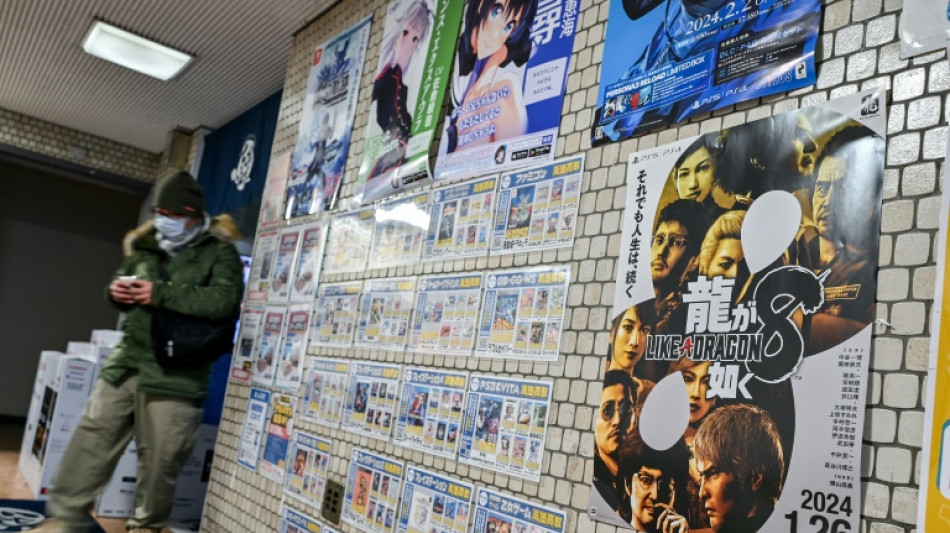
From Japan to the world: how to translate a game / Photo: Richard A. Brooks - AFP

 Dolly Parton: Country music's dolled up but deserving queen

 US robotaxi firm Waymo plans to launch in Germany

 'Here to win': Xavi vows to restore pride in Dutch football

 Cameroon's Baleba joins as Man United boost midfield options

 'Shocking' book about Putin's private life wins French literary prize

 Pogacar storms to Vuelta a Espana stage four solo triumph

 Canada unveils counter-tariffs of 15-50% on US goods

 Volkswagen boss braces German workers for more job cuts

 Olympic champion Brignone to undergo new knee operation

 The summer climate change became scorching reality for Europe

 Root angered by England's off-field 'stupid mistakes'

 Welsh rugby league 'giant' Boston dies, aged 92

 Root annoyed by England's off-field 'stupid mistakes'

 One million Afghan children suffer 'life-threatening' malnutrition: UN

 Sri Lanka trail India by 238 runs in second Test

 West Bank settlers attack AFP journalists

 MEXC Kicks Off MOVE Carnival With 0-Fee Trading and 1M USDT in Rewards

 Human rights in Myanmar hitting a 'new low': UN

 Son of Luxottica founder quits after succession row
 One million Afghan children suffering 'life-threatening' malnutrition: UN

 Real Madrid's Mourinho happy with squad despite losing out on Rodri

 Sri Lanka slump to 216-7 at tea in second India Test

 US delays Lockerbie bombing trial over new evidence

 Rohingya refugees protest dire conditions in Bangladesh camps

 Lego net profit up 32% in first half, 'stronger than expected': CEO to AFP

Behind the global success of Japanese video games lies a delicate task: appealing to overseas players whose expectations on issues such as sexism are increasingly influencing the content of major titles.
With the majority of sales for big games now outside Japan, everything from slang words to characters' costumes must be carefully considered for a global audience.
It is a complex process that has come a long way since the "Wild West" of the 1980s and 90s, one high-profile "localisation" team told AFP.
"There were no rules, no 'industry standards', and the quality of localisation could vary greatly from one title to the next," said the SEGA of America team who worked on "Like a Dragon: Infinite Wealth" -- the latest title in the hit "Yakuza" series, releasing on Friday.
Back then, translators faced constraints including too-small text boxes, and sometimes game developers did the job themselves in less-than-perfect English.
It also meant that many games from the era, especially dialogue-heavy ones, never made it out of Japan.
"Thankfully, the industry -- and perhaps more importantly consumers -- have changed a lot since those days, and we are now able to be more faithful to the cultural and emotional content of Japanese games than ever," the SEGA team said.
Localisation is now integral to the design process, with international gamers in mind from the start.
One key example is "how Japanese game developers dress their heroines" as the #MeToo movement changes mindsets, said Franck Genty, senior localisation manager at Japanese game giant Bandai Namco.
"We tell them that the cleavage is a bit too exposed, or the skirt is a bit too short," he told AFP.
"Before, they weren't very flexible, but they've become more proactive on such subjects."
- 'Puck Man' -
The puzzle of game localisation affected the 1980 arcade sensation "Pac-Man", with the direct translation "Puck Man" deemed too risky because it could be vandalised.
Some top-selling games including Mario, Final Fantasy and Pokemon involve fantasy worlds that are not overtly Japanese, offering some flexibility for their adaptation.
But the task becomes trickier for series such as "Yakuza", which are set in real-life locations and use slang from Japan's underworld.
Getting it right is important: around 70 percent of revenue from recent titles in the "Yakuza" series is from overseas.
But in recent years, booming interest in manga comics, anime cartoons and wider Japanese culture has made the job easier.
"People know what ramen is now... we don't need to say 'noodles' any more," Genty said.
His team at the European headquarters of Bandai Namco has adapted games including the "Tekken" fighting series and the smash-hit role-playing game "Elden Ring" into a dozen languages.
The job is as much a cultural challenge as a linguistic one, said Pierre Froget, localisation project manager at Bandai.
"The player, whichever country they're from, should understand and feel the same thing as someone playing in the original language," he said.
- 'No longer acceptable' -
A better understanding of Japanese culture among players means adaptations can be more subtle -- the "Yakuza" series is now called "Like a Dragon", closer to the original Japanese.
LGBTQ caricatures and sexist cliches have also been axed.
"Many representations which were normal in Japan in the first 'Like a Dragon' games are no longer acceptable today," Masayoshi Yokoyama, the series' executive producer, told AFP.
"We ask our teams in the United States and Europe to read the game's script, and they tell us if they see things that wouldn't be acceptable in their country," he said.
Changes often focus on "alcohol, politics or religion", Froget said, while cultural reference points also differ.
"When there are people dressed in black boots and big leather coats, in Europe that could bring to mind a Nazi uniform," he said.
With global release dates now the norm, these decisions must be made under tighter deadlines than before.
And despite improved communication between developers and localisation teams, challenges remain -- especially when translating a game into languages other than English.
"Efforts have been made to understand the needs of the English-speaking world," Froget said.
But for German, which has longer sentences and other linguistic quirks, localisation is sometimes "seen as an extra difficulty" by design teams.
Even so, Froget believes in his mission: "To create connections to Japanese culture and help Europeans discover its depth, while respecting both the game and the player."
L.Carrico--PC