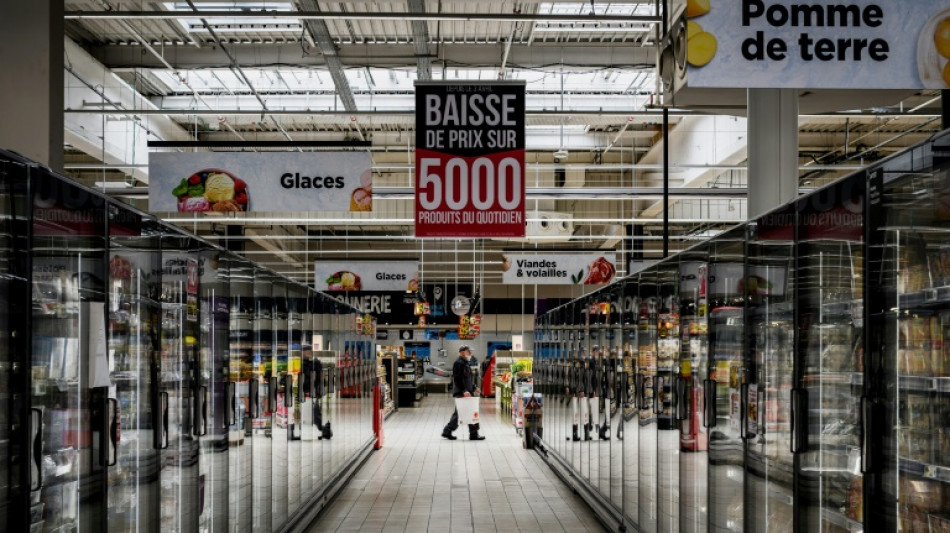
Eurozone inflation slows to 2.8% in January / Photo: JEFF PACHOUD - AFP/File

 Olympic champion Brignone to undergo new knee operation

 The summer climate change became scorching reality for Europe

 Root angered by England's off-field 'stupid mistakes'

 Welsh rugby league 'giant' Boston dies, aged 92

 Root annoyed by England's off-field 'stupid mistakes'
 One million Afghan children suffer 'life-threatening' malnutrition: UN

 Sri Lanka trail India by 238 runs in second Test
 West Bank settlers attack AFP journalists

 MEXC Kicks Off MOVE Carnival With 0-Fee Trading and 1M USDT in Rewards
 Human rights in Myanmar hitting a 'new low': UN
 Son of Luxottica founder quits after succession row

 One million Afghan children suffering 'life-threatening' malnutrition: UN

 Real Madrid's Mourinho happy with squad despite losing out on Rodri

 Sri Lanka slump to 216-7 at tea in second India Test

 US delays Lockerbie bombing trial over new evidence

 Rohingya refugees protest dire conditions in Bangladesh camps
 Lego net profit up 32% in first half, 'stronger than expected': CEO to AFP

 German GDP growth revised upwards, defying Iran war turmoil

 STARTRADER Adds 30 U.S. Stock and ETF CFDs as 2026 Product Expansion Accelerates

 Trees 'giving up': climnate change hammers historic English gardens

 Namibia paves way for phosphate mining in the Atlantic Ocean
 Six months into Iran war, Hormuz traffic way down, sailors stranded
 Netanyahu got his Iran war, but maybe not his desired result

 Hyundai reaches tentative deal with workers after strikes

 Once its saviour, US puts Kuwait in Iran's crosshairs

Eurozone inflation fell in January due to a slowdown in food price increases, official data showed Thursday, but the drop was more modest than expected by analysts.
Consumer prices slowed to 2.8 percent in January, from 2.9 percent in December, the EU's statistics agency said.
Analysts surveyed by Bloomberg and FactSet had forecast inflation to slow to 2.7 percent.
Inflation remains above the European Central Bank's two-percent target, but well below the peak of 10.6 percent recorded in October 2022 after Russia's invasion of Ukraine sent energy prices soaring.
"It's too soon to declare victory in the inflation battle," said Peter Vanden Houte, ING bank's chief Belgium, Luxembourg and eurozone economist.
The data will offer comfort to the ECB that its cautious approach is the right one and that there should not be a rush to cut interest rates, after it paused its unprecedented streak of hikes to combat inflation.
But it will also fuel hopes among some investors that the ECB could cut rates sooner than the summer.
The rise in food and drink prices reached 5.7 percent in January, compared with 6.1 percent in December, according to Eurostat.
Energy prices in the eurozone recorded a smaller drop in January of 6.3 percent, after falling 6.7 percent the previous month.
Core inflation, which strips out volatile energy, food, alcohol and tobacco prices, and is the key inflation indicator for the ECB, also slowed in January to 3.3 percent from 3.4 percent in October. But analysts had expected it to drop to 3.2 percent.
This will likely worry some in the ECB that risks persist.
"The European Central Bank is especially attentive to the evolution of core inflation. In that regard, the increase in transport prices on the back of the geopolitical tensions in the Middle East remains an inflation risk," ING's Vanden Houte said.
- Reining in inflation -
ECB chief Christine Lagarde warned last week that tensions in the Middle East posed an "upside risk" to inflation and has repeatedly pushed back against rising expectations of an early rate cut.
There is a growing belief among officials, however, that inflation is being reined in.
Lagarde told CNN International on Tuesday that Europe was now "on a disinflationary trend" and said the next change in rates would be a cut.
Some economists expect a cut as early as April, while others suggest June, as the ECB weighs inflation concerns against squeezing demand so much it crashes the economy.
"A first cut in June will probably be limited to 25 basis points," Vanden Houte said.
The US Federal Reserve also kept its key rate at a 23-year high on Wednesday, with chairman Jerome Powell disappointing the markets by dousing hopes of a cut as early as March.
The eurozone economy narrowly dodged a technical recession -- two consecutive quarters of contraction -- in the second half of 2023 but stagnated in the final three months of the year, Eurostat said on Tuesday.
Across the EU, Finland recorded the lowest inflation rate after consumer prices reached 0.7 percent in January, according to Eurostat figures.
The inflation rate also dropped in Germany, Europe's biggest economy, to 3.1 percent in January from 3.8 percent in December, the agency's data showed.
M.A.Vaz--PC