'Suspense' of slowest horse race wins new fans in Japan / Photo: Philip FONG - AFP

 West Bank settlers attack AFP journalists
 MEXC Kicks Off MOVE Carnival With 0-Fee Trading and 1M USDT in Rewards

 Human rights in Myanmar hitting a 'new low': UN

 Son of Luxottica founder quits after succession row
 One million Afghan children suffering 'life-threatening' malnutrition: UN

 Real Madrid's Mourinho happy with squad despite losing out on Rodri
 Sri Lanka slump to 216-7 at tea in second India Test

 US delays Lockerbie bombing trial over new evidence

 Rohingya refugees protest dire conditions in Bangladesh camps

 Lego net profit up 32% in first half, 'stronger than expected': CEO to AFP

 German GDP growth revised upwards, defying Iran war turmoil

 STARTRADER Adds 30 U.S. Stock and ETF CFDs as 2026 Product Expansion Accelerates
 Trees 'giving up': climnate change hammers historic English gardens
 Namibia paves way for phosphate mining in the Atlantic Ocean

 Six months into Iran war, Hormuz traffic way down, sailors stranded

 Netanyahu got his Iran war, but maybe not his desired result
 Hyundai reaches tentative deal with workers after strikes

 Once its saviour, US puts Kuwait in Iran's crosshairs
 Australia's top music charts ban AI songs
 Polaris Renewable Energy Announces Renewal of Normal Course Issuer Bid

 LiberNovo Support Week Goes Live: Up to 44% Off on Maxis, Omni SE and Omni Pro Ergonomic Chair Series

 Despair and anger erupt after deadly Guinea landfill collapse
 Tornado tears through French village, dozens injured

 Federer looks forward to brief return to Arthur Ashe stadium

 US removes Syria from state sponsor of terrorism list

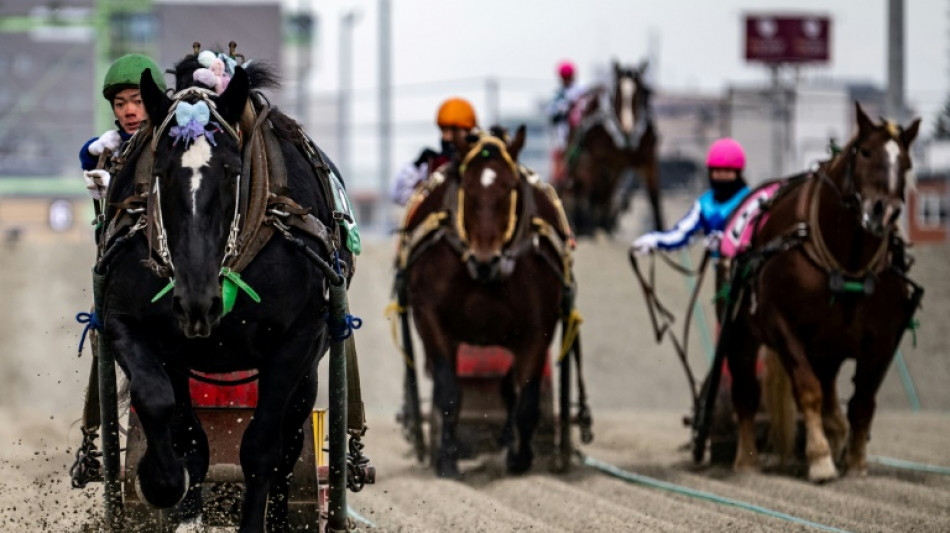
Speed isn't everything at one racecourse in Japan, where the unpredictable stop-and-start drama of the world's slowest horse race has drawn new fans eager to bet on their sturdy favourite.
A fanfare plays, the gates flip open and they're off -- but at a plod rather than a gallop, pulling heavy sleighs in a tradition that harks back more than a century.
The Banei Keiba races are held in Obihiro, a city in northern Japan's Hokkaido, where spectators cheer on the muscular workhorses moving at the pace of a brisk human walk.
Eight equine competitors kicked up dust on a recent afternoon as they powered over the first of two mounds on the 200-metre (220-yard) track.
But they soon began to halt, taking the first of several breaks to catch their breath, which billowed in the winter air.
The slow progress "builds a little bit of suspense", 24-year-old Australian tourist Esther McCourt told AFP, marvelling at the horses' size.
"No matter how good people or horses look in the beginning, the crucial part is the last 50 metres, so it can change at any time," she said.
The popularity of Banei Keiba had dwindled until renewed marketing efforts coincided with a surge of interest during the pandemic, when people began to watch the races and place bets online.
Those casual gamblers along with dedicated fans have boosted the event's annual sales to 55.5 billion yen ($375 million) -- a fivefold increase from their low point in 2011.
- 'Dynamic' races -
Banei Keiba developed when Japanese settlers migrated to Hokkaido, a sparsely populated island with long, bitter winters.
They relied on horses known as "banba" to clear fields, transport goods and operate mines, and would pit them against each other in tug-of-war games and other contests at local festivals.
Banba are twice as heavy as racing thoroughbreds, and the sleighs they tug weigh more than 600 kilograms (1,300 pounds).
Jockeys standing on the sleighs shout and whip the horses with long reins to keep them going.
Trainers like Yoshiyuki Hattori deny any accusations of cruelty, saying the strong creatures are treated with care and are not forced to pull loads above their capacity.
"If thoroughbreds were born to run, banba were bred to haul things," said Hattori, whose horses have won many race trophies.
"They worked in fields. They worked for us. We want to continue this history."
For Hattori, Banei races are "more dynamic" than the "visual experience" of regular horse racing.
"This moves you physically as you cheer," he said.
- 'Can't help but cheer' -
Three other cities in the region used to host similar races, but they all stopped under mountains of debt in 2006.
The long-stagnant Japanese economy had hit Banei Keiba hard, and the regular punters who kept it going were getting older.
Obihiro Racecourse, now the tradition's sole custodian, made efforts to attract more young families and tourists by cleaning up the facility and making it smoke-free.
They set up a mini-zoo and launched marketing campaigns including tie-ups with popular smartphone games to rejuvenate the attraction.
Now there are around 750 horses taking part in the races, kept by 28 trainers, 150 caretakers and 21 jockeys.
One of the caretakers, 21-year-old Yuno Goto, was busy affixing pale pink and blue fluffy bows and ribbons on a banba's mane ahead of the race.
She said she dreams of becoming a jockey one day, and called the event "a great opportunity to expose people to this culture, and to provide a different experience from other horse races".
Spectator Taichi Yamada, 27, who moved to the region last year, also said knowing the race's origins adds to its appeal.
"This is a form of interaction between humans and animals. I hope it will continue as a piece of history," he told AFP.
"It must be tough for horses to pull this much weight. You can't help but cheer for them."
L.Carrico--PC