'Missing' girls: selective abortion in Albania fuels gender gap
/ Photo: Adnan Beci - AFP

 West Bank settlers attack AFP journalists
 MEXC Kicks Off MOVE Carnival With 0-Fee Trading and 1M USDT in Rewards
 Human rights in Myanmar hitting a 'new low': UN

 Son of Luxottica founder quits after succession row

 One million Afghan children suffering 'life-threatening' malnutrition: UN
 Real Madrid's Mourinho happy with squad despite losing out on Rodri
 Sri Lanka slump to 216-7 at tea in second India Test
 US delays Lockerbie bombing trial over new evidence

 Rohingya refugees protest dire conditions in Bangladesh camps

 Lego net profit up 32% in first half, 'stronger than expected': CEO to AFP
 German GDP growth revised upwards, defying Iran war turmoil
 STARTRADER Adds 30 U.S. Stock and ETF CFDs as 2026 Product Expansion Accelerates
 Trees 'giving up': climnate change hammers historic English gardens
 Namibia paves way for phosphate mining in the Atlantic Ocean
 Six months into Iran war, Hormuz traffic way down, sailors stranded

 Netanyahu got his Iran war, but maybe not his desired result
 Hyundai reaches tentative deal with workers after strikes

 Once its saviour, US puts Kuwait in Iran's crosshairs
 Australia's top music charts ban AI songs
 Polaris Renewable Energy Announces Renewal of Normal Course Issuer Bid

 LiberNovo Support Week Goes Live: Up to 44% Off on Maxis, Omni SE and Omni Pro Ergonomic Chair Series
 Despair and anger erupt after deadly Guinea landfill collapse

 Tornado tears through French village, dozens injured

 Federer looks forward to brief return to Arthur Ashe stadium

 US removes Syria from state sponsor of terrorism list

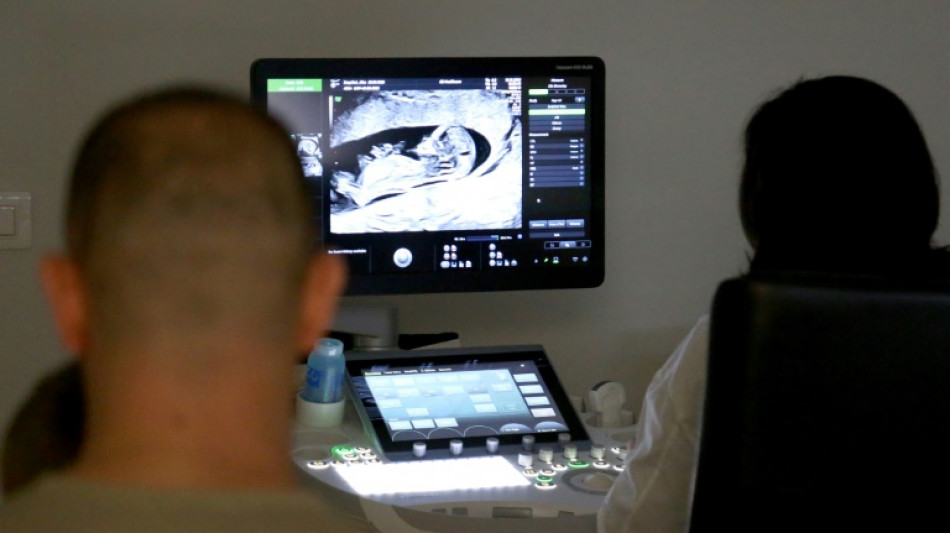
When Lina discovered she was pregnant with another girl, she decided to terminate the pregnancy, after her husband grew increasingly violent over the prospect of having a fourth daughter instead of a boy.
The decision was one that has become relatively common in her native Albania and across the Balkans, where a dominant patriarchal culture has pushed many families to pin their hopes on a son.
"When my husband learned that our fourth baby would still be a girl and that I would not be able to give him a boy, he became so violent he almost killed me," Lina, who used a pseudonym to hide her identity, told AFP through tears.
"I was ready to risk my life not to give birth to this baby," the 40-year-old added.
She said she continues to suffer from genital lesions caused by the procedure, administered in unhygienic conditions three years ago.
By even the most modest estimates Albania is "missing" thousands of girls, following years of sex-selective abortions that led to the termination of pregnancies by families hoping for male children.
"When parents learn that the foetus is a girl, they choose, for various reasons, to abort rather than keep it," Manuela Bello, the United Nations Population Fund (UNFPA) representative in Albania, told AFP.
"Over the past ten years 21,000 girls have been missing in Albania."
For families that already have a daughter, roughly a quarter said they would choose to have an abortion rather than have another girl in the household, according to research compiled by the UN.
- 'Social imbalance' -
Between 2000 and 2020, Albania ranked fourth in the world for the size of its difference between births of girls and boys -- with an average of 111 males born for every 100 girls, UN figures show.
An uptick in education has helped reduce the margin slightly in the past four years, including an awareness campaign by the UNFPA office in Albania.
Figures remain "higher than the biological average which is around 105 boy births for every 100 girls," explained Arjan Gjonca, a professor specialising in demography at the London School of Economics and Political Science.
"But if the phenomenon persists and if there are no rapid legal measures... the consequences in the near future could lead to social imbalance," warned Gjonca.
Abortion is legal in Albania until the 12th week of pregnancy, with special permission from doctors needed for later-term terminations.
Terminations linked to prenatal gender screenings are illegal.
But the growing availability of a blood test which makes it easier to know the sex of a foetus much earlier means it is harder to stop the practice.
"It is increasingly difficult to prove that the pregnancy was interrupted because the foetus was a girl," said Tirana-based gynaecologist Rubena Mosiu.
Women in Albania are increasingly turning to the simple test, which is available during the seventh week of pregnancy and can tell the baby's gender with more than 90 percent accuracy.
Permission from a doctor is not required for the screening.
- 'Bitter family history'-
Despite a rise in awareness, deep-seated values can be hard to overturn.
Across large swaths of the Balkans, a male child is believed to be "the pillar of the family", while girls are seen as a "burden or a weaker sex in an aggressive society", said Anila Hoxha, an investigative journalist and women rights activists from Tirana.
In neighbouring Montenegro, sex-selective abortions remain a perennial issue, despite recent improvement to the country's demographic imbalance.
"There is a direct correlation between patriarchal social norms and the preference of sons over daughters," said Maja Raicevic, who heads the Women's Rights Center in the capital Podgorica.
Women's subordinate role in the family, along with their economic dependence on men because many do not inherit property, only fuels greater levels of inequality.
In 2017, the centre launched a campaign called "#Unwanted".
The programme aims to dispel basic patriarchal notions by calling on Montenegrins "to ask themselves what values are taught that makes one sex desirable, while another does not even have the right to be born", explained Raicevic.
Often the biggest challenges come from tensions within the family.
Back in Albania, Maria -- who spoke on condition of anonymity -- said she confronted enormous pressure from her mother-in-law and brother-in-law after finding out she was pregnant with a baby girl.
"They were very unhappy," she said during an interview with the UNFPA.
"My mother-in-law even offered to take me to have an abortion at the home of someone she knew who performs abortions in the old, risky ways," she added.
But in the end, Maria refused to give into their pressure.
"I decided to keep the baby," said Maria. "But I won't tell my daughter about our bitter family history."
Nogueira--PC