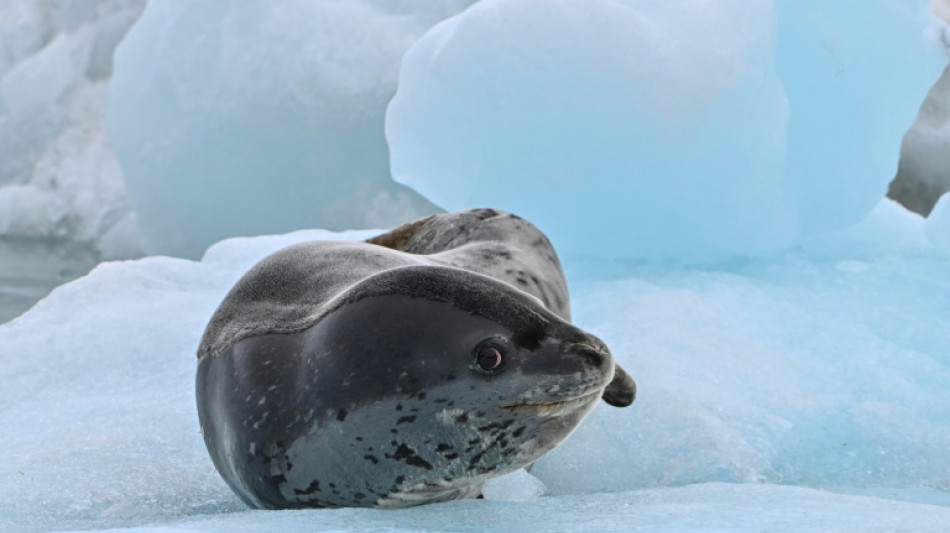
Scientists study levels of toxic mercury in Antarctic seals, whales / Photo: JUAN BARRETO - AFP

 West Bank settlers attack AFP journalists
 MEXC Kicks Off MOVE Carnival With 0-Fee Trading and 1M USDT in Rewards

 Human rights in Myanmar hitting a 'new low': UN

 Son of Luxottica founder quits after succession row

 One million Afghan children suffering 'life-threatening' malnutrition: UN

 Real Madrid's Mourinho happy with squad despite losing out on Rodri

 Sri Lanka slump to 216-7 at tea in second India Test

 US delays Lockerbie bombing trial over new evidence

 Rohingya refugees protest dire conditions in Bangladesh camps

 Lego net profit up 32% in first half, 'stronger than expected': CEO to AFP

 German GDP growth revised upwards, defying Iran war turmoil

 STARTRADER Adds 30 U.S. Stock and ETF CFDs as 2026 Product Expansion Accelerates

 Trees 'giving up': climnate change hammers historic English gardens

 Namibia paves way for phosphate mining in the Atlantic Ocean

 Six months into Iran war, Hormuz traffic way down, sailors stranded

 Netanyahu got his Iran war, but maybe not his desired result

 Hyundai reaches tentative deal with workers after strikes

 Once its saviour, US puts Kuwait in Iran's crosshairs
 Australia's top music charts ban AI songs
 Polaris Renewable Energy Announces Renewal of Normal Course Issuer Bid

 LiberNovo Support Week Goes Live: Up to 44% Off on Maxis, Omni SE and Omni Pro Ergonomic Chair Series

 Despair and anger erupt after deadly Guinea landfill collapse
 Tornado tears through French village, dozens injured

 Federer looks forward to brief return to Arthur Ashe stadium

 US removes Syria from state sponsor of terrorism list

A gunshot interrupts the peaceful sleep of a leopard seal, lying nonchalantly on a small piece of ice floating in the shadow of an Antarctic glacier.
Researcher Diego Mojica lowers his rifle.
The mammal, one of the largest predators on the White Continent after the orca, flinches from the impact of the remote biopsy -- a small red pipette that bounces off its skin, taking with it a piece of flesh -- and swims away.
Mojica, a Colombian marine biologist, descends from his boat alongside Livingston Island, in the South Shetland archipelago, to retrieve his sample.
Excitedly, he explains to an AFP team accompanying him on a day of research amid the glaciers, how rare it is to get so close to a leopard seal -- a solitary and usually aggressive species that feeds on penguins.
Mojica is studying the impact of mercury, used in activities such as mining thousands of kilometers away, on Antarctica's large mammals.
The toxic heavy metal is believed to reach the ocean through rivers or rain, after it "evaporates into the air," said Mojica, who works for Colombia's Malpelo Foundation, which specializes in the study of marine fauna.
Scientists at Spain's University of Murcia have previously found mercury in the feathers of chinstrap penguins on King George Island, the closest point in Antarctica to the Americas.
The pollution appears to extend south to Livingston Island and the Gerlache Strait, a natural channel off Antarctica.
The United Nation's Global Mercury Partnership warns that marine mammals, because they are "at the top of the food chain, are particularly susceptible to contamination" by the metal.
Later on his voyage -- a Colombian scientific expedition to Antarctica -- Mojica finds himself surrounded by humpback whales.
When a tail or back pokes out of the rough waters, he carefully takes aim with his rifle.
This time, he retrieves his sample of skin and fat from the freezing waters using a net.
Humpback whales consume large quantities of krill, small crustaceans susceptible to mercury contamination.
Mojica will study the samples to determine if "mercury has been transmitted from one link to the next in the food chain."
According to UN environmental agency UNEP, if an animal consumes mercury, it may suffer "reproductive failure, behavioral changes and may even (die)."
In 2013, 140 countries signed the Minamata Convention to reduce the use of mercury, which can cause severe health problems.
Some 9,000 tons of the toxic substance are released into the atmosphere every year.
Artisanal mining is the main source of mercury emissions, where the element is used to collect gold by binding to it.
Coal combustion is another major source. But mercury is also present in many household products like batteries, some lightbulbs and even mascara.
"We want to do our part to be able, as much as possible, to propose credible measures for the conservation and protection of these emblematic mammals," said Mojica.
G.Machado--PC