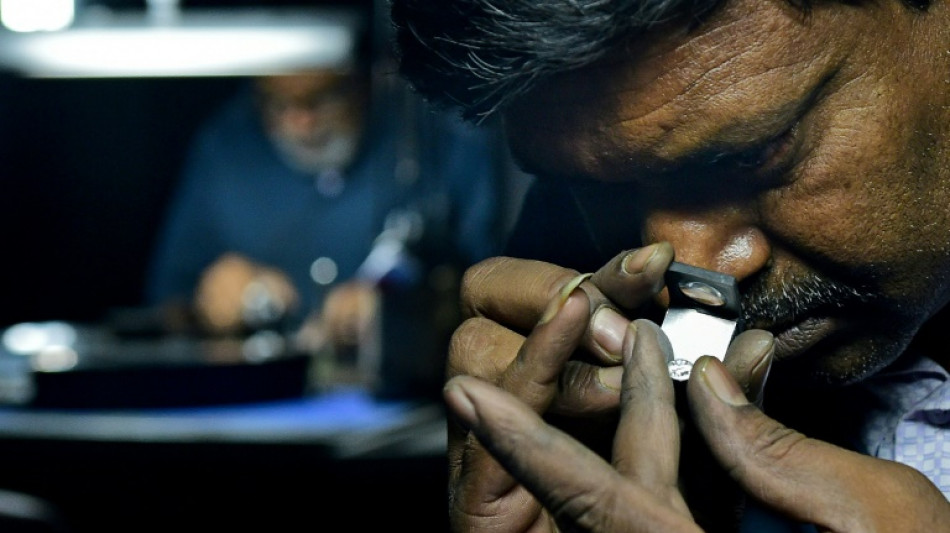
Lab-grown diamonds put natural gems under pressure / Photo: Sam PANTHAKY - AFP

 Hyundai reaches tentative deal with workers after strike

 Trees 'giving up': climate change hammers historic English gardens
 Malian songbird keeps age-old sounds alive at 88

 Canada to announce response to Trump's new tariffs

 Stocks stagger and oil rises as traders eye Iran threat, Nvidia results

 Families of detained Chinese Christians cling to faith in legal limbo

 Trump veers from boredom to denial after six months of Iran war

 Cool Japan: Human fridge chills workers in extreme heat

 Tens of thousands flee fire near US city of Reno

 Despair and anger erupt after deadly Guinea landfill collapse

 Tornado tears through French village, dozens injured

 Federer looks forward to brief return to Arthur Ashe stadium

 US removes Syria from state sponsor of terrorism list

 Facebook, TikTok promoted Colombian armed groups' content to recruit children: HRW

 Palmeiras agree to sell Allan to Manchester City: source

 US vows 'economic asphyxiation' of Iran with new sanctions

 French tourist dies after getting stuck in scorching Death Valley

 US proposes expanding UN Sudan arms embargo to entire country
 Ceasefire verification mission heads to east DR Congo

 Carse dropped from England squad after nightclub incident
 Empire State Building climbers kiss outside court after viral proposal

 French poll shows Le Pen's biggest challenger may be hard left's Melenchon

 Noosha Aubel: Πόση διοικητική αποτυχία μπορεί να αντέξει ακόμα το Πότσδαμ?

 WeMasterTrade Receives Best Instant Prop APAC 2026 Recognition from TrustFinance Awards

 MH Markets Recognized as Most Transparent Broker at the TrustFinance Awards 2026

The glittering diamonds sparkle the same but there are key differences: mined natural gems are more than a billion years old, while laboratory-made rocks are new and cost less than half the price.
Man-made gems are reshaping the $89 billion global diamond jewellery market, especially in the west Indian city of Surat where 90 percent of the world's diamonds are cut and polished.
In Smit Patel's gleaming lab, technicians drop crystal diamond "seed" slices into reactors mimicking the extreme pressure far underground.
"Once the customer sees it for herself, they are sold. I believe this is the future," said Patel, director of Greenlab Diamonds and the third generation of his family to deal in diamonds.
From seed to ring-ready jewels, his team takes less than eight weeks to produce a diamond virtually indistinguishable from a mined gem.
"It's the same product, it's the same chemical, the same optical properties," Patel said.
- Gas, heat, pressure -
Lab-grown diamond exports from India tripled in value between 2019 and 2022, while export volumes rose by 25 percent between April and October 2023, up from 15 percent in the same period a year earlier, according to the latest industry data.
"We've grown at 400 percent year on year in volume," Patel told AFP.
Reactors in labs such as Patel's are pumped full of carbon-containing gases such as methane and the crystal grows under heat and pressure.
Rough diamonds are then taken to another facility where hundreds of workers design, cut and polish the stones.
The global market share by value of lab-grown gems rocketed from 3.5 percent in 2018 to 18.5 percent in 2023, New York-based industry analyst Paul Zimnisky told AFP, and will likely exceed 20 percent this year.
That has heaped pressure on an industry already racked by geopolitical turmoil and slumping demand.
- 'Clean' stones -
Machine-made diamonds were first developed in the early 1950s but it took technological leaps to create a commercially viable process less than a decade ago.
Producers boast that their gems come at a lower carbon cost, although there are questions about whether the energy-intensive process is any better for the environment.
Patel said his lab uses solar energy from the local grid, although others suck up electricity from carbon-heavy sources.
And while mined gem sellers say "conflict diamonds" from war zones are kept off the market through the international Kimberley Process certification scheme, lab producers argue their facilities guarantee a clean record.
Such environmental and humanitarian claims have helped make lab-grown stones a popular choice for engagement rings.
In February 2023, 17 percent of diamond engagement rings sold in the United States -- the world's biggest consumer of natural stones -- used lab-grown gems, according to industry analyst Edahn Golan.
By Golan's assessment, it is now 36 percent.
This has partly been made possible by hundreds of companies in China and India, both among the largest producers of man-made stones.
- 'Perfect storm' -
Indian lab diamond makers exported 4.04 million carats between April and October 2023, a 42 percent year-on-year increase, according to India's Gem and Jewellery Export Promotion Council (GJEPC).
In contrast, natural diamond companies in India reported a more than 25 percent drop, to 11.3 million carats, over the same period.
While natural diamond sales during the Covid-19 pandemic surged as affluent shoppers sought to brighten lockdowns with luxury purchases, demand dropped when economies reopened.
Top companies were left holding expensive excess stock.
Ajesh Mehta from D.Navinchandra Exports, whose group is one of global diamond giant De Beers Group's authorised buyers, or "sightholders", said it was the worst slump in his 30-year career.
"This is a totally different kind of lack of demand," Mehta told AFP. "Everything came like a perfect storm."
Factors other than competition from lab-grown rivals included slowing economic growth in the all-important US and China markets, as well as oversupply and sanctions against Russian rough-cut diamonds.
India's natural diamond industry was forced into a rare voluntary import ban on rough diamonds in October.
"We had to press the reset button," Mehta said. "Otherwise people would panic."
At least five Indian sightholders told AFP that the De Beers Group had cut prices by between 10 and 25 percent for different categories of diamonds at the first sale of its year, when buyers restock after the US holiday season.
- 'No monopoly' -
The lab-grown industry has had its problems, too.
Supply has skyrocketed and prices have dropped drastically, with wholesale prices down by 58 percent in 2023 alone, according to Golan's analysis.
Retailers in Surat told AFP the price of a lower-quality one-carat polished stone had fallen from $2,400 in 2022 to a little over $1,000 in 2023.
WD Lab Grown Diamonds, the second-biggest US producer of the man-made stones, filed for bankruptcy in October.
But Patel argues that falling prices will spur demand.
"We knew that prices would come down, because there's no monopoly in this industry," he said.
Customers in a jewellery showroom in India's commercial capital Mumbai appeared to agree.
"A mined diamond would be five times more expensive," said 29-year-old Lekha Prabhakar.
"If you want something you want to wear daily... a lab-grown diamond works. I really like that."
T.Batista--PC