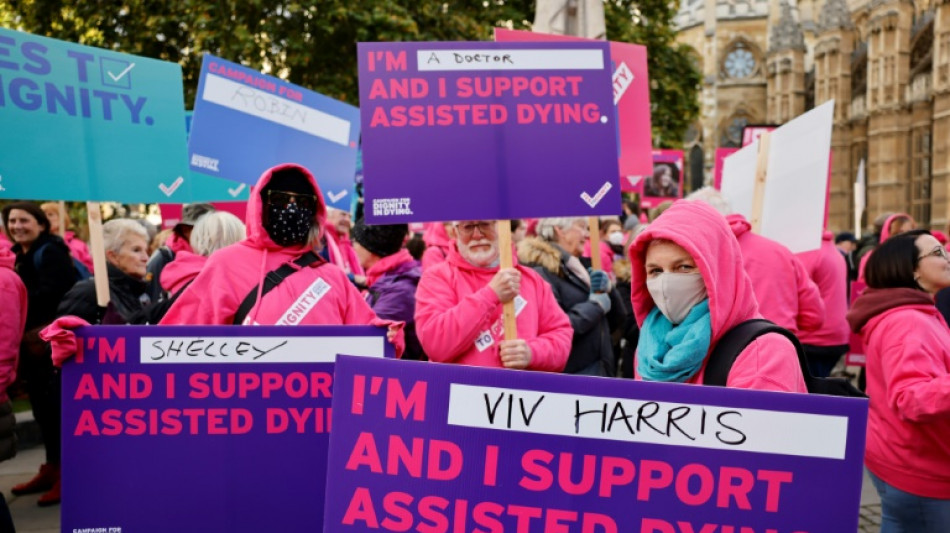
UK assisted dying bill hopes to end 'inhumane' suicides

 Germans vote in elections threatening fresh blow to Merz

 US fears rapid escalation in Mideast after Houthis attack Riyadh

 Japan triathlete Hojo wins first gold of Asian Games

 IOC president impressed by 'beautiful' Asian Games wooden huts

 First Asian Games gold goes to Japan as China's 13-year-old Yu lights up pool

 Data centre command hub keeps AI up and running

 Pope Leo in France: the issues on the table

 Packing for a pope: behind the scenes on foreign trips

 Republicans find transgender issues a powerful political weapon in midterm campaigning

 German state elections threaten new shock waves for Merz

 Chile's Bachelet quits race to be next UN chief

 Raphinha treble fires perfect Barca to win at Sevilla

 Thiam makes winning heptathlon return at Decastar meet

 Czechs beat USA to qualify for Davis Cup finals

 Dortmund sink Stuttgart to climb to Bundesliga summit

 Trump says will not tolerate attempts to slow AI growth

 'It has to stop': runners protest women's murders in S.Africa district

 Fire erupts near Riyadh airport as Houthis claim strikes

 Cuba works to restore power after another blackout

 England thrash Sri Lanka again to return to top of T20 rankings

 Arsenal thrashed by Brighton, sorry Spurs lose again

 South Korea, Austria qualify for Davis Cup finals

 Seare shocks Ingebrigtsen to win world 5km gold

 Brigitte Bardot widower slams sale of star's belongings

 Aston Villa compound Tottenham's misery despite late rally

Molly Meacher's voice quivers with emotion as she tells how her aunt took her own life after her liver cancer tumour grew to the size of a football.
"One night, she took a whole lot of pills and whisky, and her husband found her dead in the morning," said Meacher, a member of British parliament's upper House of Lords.
"It seemed to me terribly sad that somebody would end their life alone in the middle of the night without even their dear husband knowing that this was what they were doing," she told AFP.
Meacher, 81, has drafted a law to legalise assisted dying in England for the terminally ill with less than six months to live, an act currently punishable by up to 14 years in prison.
"It just was clear to me that this was just inhumane. You wouldn't treat a dog or a cat like that. But we treat our own people like that," said the former social worker.
The UK parliament examined the question of assisted dying in 2015 and decided against legalising it, but since then other countries have decided to approve what many see as an act of mercy.
"Things are moving in the right direction, there are a number of British Isles jurisdictions that are looking at changing the law," said Sarah Wootton, head of the Dignity in Dying campaign group.
- 'Discriminatory' -
Last September, the influential British Medical Association ended its opposition to "physician-assisted dying", taking the "historic step" of adopting a neutral position.
According to a poll by YouGov, 73 percent of Britons questioned in August said that doctors should be able to help terminally ill patients die.
By contrast, only 35 percent of MPs approved.
Campaigner Alex Pandolfo says the law "needs changing immediately (because) of the discriminatory practice that takes place in this country".
"It actually exists already for the privileged," says Pandolfo, in his 60s and terminally ill with Alzheimer's.
If you have £10,000 (about 12,000 euros, 13,500 dollars) for flights, hotels and food, you can go to a country such as Switzerland to die, he said.
Pandolfo has already booked his assisted death at a Swiss clinic and in recent years has accompanied around 100 Britons to die in Switzerland.
But he would rather die in England, to be near loved ones and allow them to have a more natural grieving process.
"I'm in no hurry," he jokes, saying he was given "a death sentence" in 2015.
"I am already dying of a condition that I've got no control over," he said.
"All I'm asking for is somebody to assist me with that death when it will be unbearable, to accelerate things. It's a rational act."
Sitting on his sofa in Lancaster, northwest England, the white-haired Pandolfo says his illness has already had a "massive impact" on his quality of life.
It affects his memory, movement, ability to speak and drive, and watch a football match.
As a result, he would never qualify for assisted dying under the terms of the draft law before parliament, which he says is "extremely restricted".
"By the time I've got six months to live, I won't have capacity to say that I want assisted dying," he said.
- 'Unacceptable pressure' -
Meacher said her bill's restrictions are "a political decision based on realities" in a "fairly conservative country", particularly where religious leaders and the faithful are involved.
"It's pretty hard to get a bill through parliament with these rather narrow limits," she said.
The Archbishop of Canterbury, Justin Welby, told parliament that euthanasia could expose the most vulnerable to unacceptable pressure to die from some "loved ones".
Welby, the most senior cleric in the worldwide Anglican communion, also told the BBC that "sadly people make mistakes in their diagnosis".
Meacher's bill "has done a great job at raising the issue," said Wootton.
While it will not necessarily become law a similar bill before the Scottish Parliament has much more chance of success "within a year-and-a-half", she said.
"It will be very difficult for medical regulators to have something lawful in one part of the country and not lawful in other parts of the country.
"I think that's an unsustainable situation in the long term."
Similar draft laws are being looked at in the self-governing Crown dependencies of Jersey and the Isle of Man.
Even strictly Roman Catholic neighbour Ireland is studying the possibility of euthanasia, giving people like Pandolfo a measure of hope.
Once he had his place booked in Switzerland, Pandolfo said: "I stopped worrying about dying and suffering and started focusing and concentrating on enjoying what life can."
F.Moura--PC