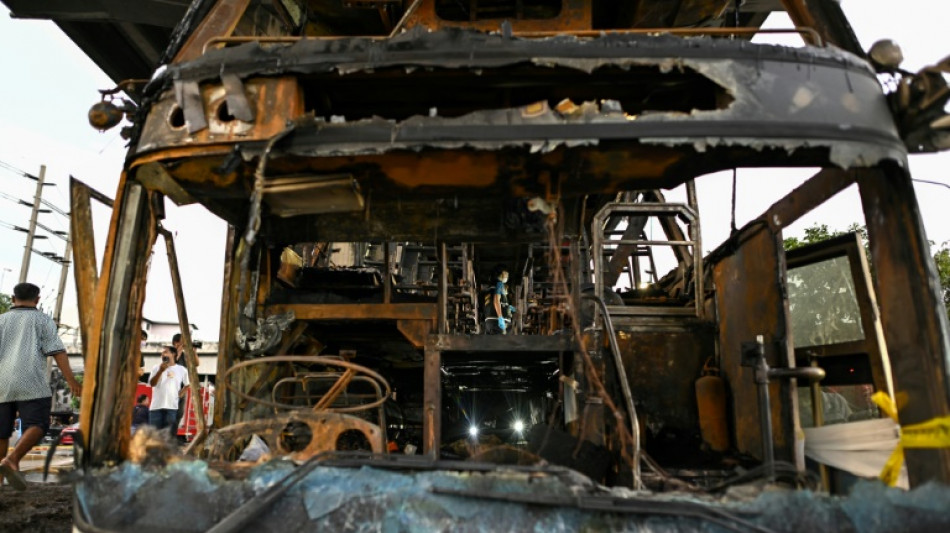
Why are Thailand's roads so deadly? / Photo: Manan VATSYAYANA - AFP

 William and Harry: Britain's warring royal brothers
 UN holds second informal poll for next leader
 In US mining hub, black lung rates soar

 Champions Arsenal embrace being 'hunted' as Premier League returns
 World No.2 Rybakina retires from Cincinnati clash with Swiatek

 'I heard you missed me': Melania Trump jokes about month out of spotlight

 Amazon Prime Video to invest $2 bn in Latin America productions

 Panama Canal to reduce shipping over El Nino-fueled drought
 Maradona trial on hold over possible medical evidence mix-up

 'Green dilemma': China's solar boom hurt birds, says study

 Pegula hangs on to dispatch Anisimova, reach Cincinnati semi-finals

 US charges woman with IS-inspired plot to blow up New York State Capitol

 What a record-breaking El Nino could mean for the world

 Duplantis edges Karalis to win Lausanne Diamond League pole vault

 Alcaraz to return for US Open title defence

 China's rapid solar expansion hurt bird diversity: study
 President Paul Biya back in Cameroon after 73 days away

 Newcastle boss Jaissle unfazed by lack of respect
 US Open purse to top $100 mn as Grand Slams form player council

 Hull aim to silence critics after unexpected promotion to Premier League

 Pakistan hit back against England after Cox and Root fifties

 Walmart reports mixed results as gas prices drag on US sales growth

 Wang downs Sindhu to break Indian hearts at badminton worlds

 As Europe's rivers recede, shippers scramble to limit damage

 Alonso won't confirm Fernandez will remain at Chelsea after Man City link
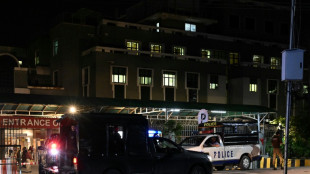
A horrifying fire on a Thai school bus this week that killed at least 23 people, most of them children, underscores how the kingdom's roads are some of the deadliest in the world.
AFP looks at the poor safety record, why there are so many deaths and what the Thai government is doing about it.
- How bad is it? -
Around 20,000 people are killed every year on Thailand's roads -- an average of more than 50 a day.
This means Thailand has the second-deadliest roads in Asia after Nepal, and ranks 16th in the world for traffic mortality, alongside Chad and Guinea-Bissau, according to the World Health Organization (WHO).
There were 25.7 deaths due to traffic injuries per 100,000 people in 2021 in Thailand, compared with a global average of 15.
Road safety watchdog Thai RSC says that already this year there have been more than 10,000 fatalities and 600,000 injuries on the country's roads.
More than four out of five deaths involve motorbikes, the RSC says, compared with a global average of one out of five.
Accident rates and deaths soar around major celebrations such as New Year and Songkran, the annual Thai water festival.
In 2021, the WHO said traffic-related incidents accounted for nearly a third of all deaths in Thailand. About three-quarters of those killed were male.
The economic losses caused by traffic deaths and injuries amounted to around $15.5 billion in 2022 the WHO says -- equivalent to more than three percent of the country's GDP.
- Why is it so bad? -
Speeding, drink driving, poor road design and unsafe vehicles all contribute to the problem.
Enforcement of safety rules has long been undermined by a culture of low-ranking traffic cops taking bribes to turn a blind eye to infractions such as speeding or motorcyclists not wearing helmets.
Vehicle safety checks have also been weakened by graft.
Last month, local media reported that two highway officials had been arrested on allegations of taking hundreds of thousands of dollars in bribes to allow unsafe overloaded trucks to pass checks to use the roads.
In Bangkok and other cities, motorbikes and mopeds weave in and out of heavy traffic, but helmet-wearing is lax.
While hospitals in Thailand are generally good, in rural areas they are spread out and often less well-equipped than city facilities.
Anyone involved in an accident on one of the countless narrow country roads snaking through steep jungle-clad hillsides could find themselves waiting a long time for emergency services to arrive.
- What is being done about it? -
The country has set a five-year National Master Plan on Road Safety which aims to slash the road mortality rate to 12 per 100,000 by 2027 -- which would equate to fewer than 8,500 deaths per year.
Police regularly mount drives to encourage helmet-wearing and to catch drink drivers, particularly around around major festivals.
Thai RSC oversees road safety and raises public awareness to reduce road accidents, including pushing for helmet use on motorbikes and mopeds.
There have been efforts to tackle poorly lit roads, with Bangkok Governor Chadchart Sittipunt last year vowing to make the capital's streets brighter by replacing streetlamp bulbs with newer LEDs.
And there has been some improvement -- Thailand's road mortality rate fell from 39 per 100,000 people in 2000, a relative decline of 17 percent, according to WHO data.
R.J.Fidalgo--PC