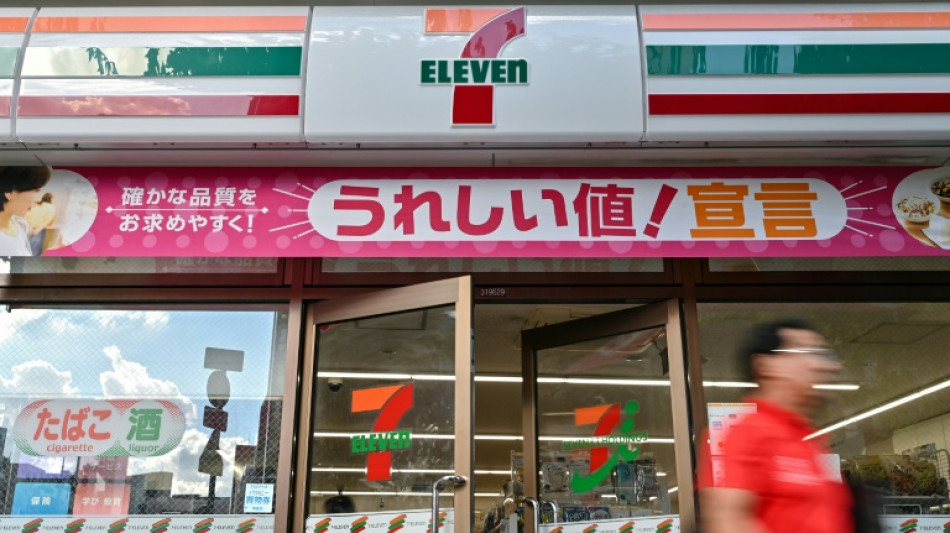
Your 'local everything': what 7-Eleven buyout battle means for Japan / Photo: Richard A. Brooks - AFP/File

 World No.2 Rybakina retires from Cincinnati clash with Swiatek

 'I heard you missed me': Melania Trump jokes about month out of spotlight

 Amazon Prime Video to invest $2 bn in Latin America productions

 Panama Canal to reduce shipping over El Nino-fueled drought

 Maradona trial on hold over possible medical evidence mix-up

 'Green dilemma': China's solar boom hurt birds, says study

 Pegula hangs on to dispatch Anisimova, reach Cincinnati semi-finals

 US charges woman with IS-inspired plot to blow up New York State Capitol

 What a record-breaking El Nino could mean for the world

 Duplantis edges Karalis to win Lausanne Diamond League pole vault
 Alcaraz to return for US Open title defence
 China's rapid solar expansion hurt bird diversity: study

 President Paul Biya back in Cameroon after 73 days away

 Newcastle boss Jaissle unfazed by lack of respect

 US Open purse to top $100 mn as Grand Slams form player council

 Hull aim to silence critics after unexpected promotion to Premier League

 Pakistan hit back against England after Cox and Root fifties

 Walmart reports mixed results as gas prices drag on US sales growth

 Wang downs Sindhu to break Indian hearts at badminton worlds

 As Europe's rivers recede, shippers scramble to limit damage
 Alonso won't confirm Fernandez will remain at Chelsea after Man City link

 Milky Way's fastest star discovered spinning around black hole

 Kanye West planned concerts trigger frenzy in Russia

 Hungary music festival basks in post-Orban freedom
 Vatican says 'serious concerns' over Israel-Lebanon deal implementation

In Japan more is at stake than money in the mammoth takeover battle for 7-Eleven, the world's biggest convenience chain, by Canadian retail giant Alimentation Couche-Tard.
It is a litmus test for government efforts to shake up corporate Japan, experts say, and one that may put more firms in the sights of foreign buyers.
The chain is a ubiquitous lifeline for an ageing population in Japan and a cherished one-stop shop for everything from egg sandwiches to concert tickets.
For tourists it's Instagram gold, sparking jokes about spending $1,000 on flights just to eat a $1 rice ball.
"It's part of the fabric of Japan, the infrastructure," Gavin H. Whitelaw, a researcher at Harvard who has worked at three Japanese convenience stores, told AFP.
"They've become a kind of global template for convenience retail" as "the equivalent of a 'local everything'", said Whitelaw, executive director of the Reischauer Institute of Japanese Studies.
As well as stocking up on fresh food, toiletries and snacks, 7-Eleven customers in Japan can pay bills, print photos and send suitcases across the country, or just use the ATM.
To operate smoothly, Japanese convenience stores have mastered a "byzantine-like distribution system" and crunch huge amounts of data on consumer behaviour, Whitelaw said.
"There's national pride to this," with the stores nicknamed "konbini" often acting as community hubs that contribute to local festivals and help in disasters, he added.
- Ito's idea -
7-Eleven began life in the United States but late billionaire Masatoshi Ito turned it into a Japanese empire with 85,000 stores worldwide, a quarter of them in Japan.
Last month its owner Seven & i -- Japan's biggest retailer -- rejected a $40-billion offer from ACT, saying it undervalued the company, while warning of regulatory hurdles.
But the Canadian group, which owns Circle K and runs nearly 17,000 outlets worldwide, has vowed to pursue what would be the biggest foreign takeover of a Japanese firm.
Seven & i shares surged on Wednesday after Bloomberg News reported that ACT had upgraded its offer to around $47 billion.
The group declined to comment, but Seven & i's CEO is due to speak on Thursday when second-quarter earnings are released.
"The timing of Couche-Tard's bid cannot be more perfect," said Kai Li, a professor and Canadian corporate governance expert at the UBC Sauder School of Business.
Japanese companies are "relatively cheap" thanks to the weak yen, she said, while the country also revised its merger and acquisition guidelines last year.
The new rules aim to make Japan's business world more competitive by discouraging companies from routinely dismissing foreign buyout offers.
- 'Core' industry -
In 2021, Couche-Tard dropped a takeover bid worth 16 billion euros ($17 billion today) for French supermarket Carrefour after Paris said it would veto the deal over food security concerns.
It's unclear if Japan's new government under Prime Minister Shigeru Ishiba would do the same, but last month, the finance ministry designated Seven & i a "core" industry.
The move gives authorities more power to block a takeover in certain cases.
Recent media reports have also said Seven & i wants to strengthen its hand by selling off other assets such as its banking unit.
Japanese companies were once famous for their huge global acquisitions -- but they have long spurned the idea of foreign buyouts the other way around.
"Traditionally speaking, companies were very stable" in Japan and considered mergers "a very, very foreign concept", said Nobuko Kobayashi from consulting firm EY.
"It's the end of your sort of business history if you sell out. So it had a bad connotation," she told AFP.
This is changing, however, as authorities and businesses try to drag Japan's economy out of stagnation, so the 7-Eleven buyout tussle is being closely watched -- with some saying it could unleash many similar deals.
The weak yen, Japanese companies being undervalued in the stock market, and China's economic woes and geopolitical risks making it less attractive to buyers mean "all eyes are on Japan", Kobayashi said.
However, prospective buyers should be wary that it can be difficult to enact a "transformation" within Japan's rigid management style, she said.
"You may need kind of a structural change in mindset to unlock the value of Japan."
Nogueira--PC