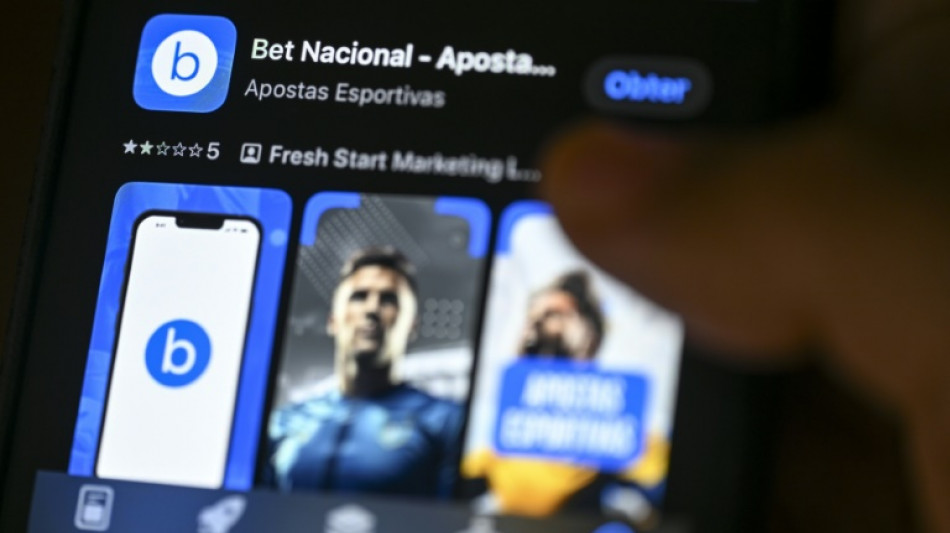
'A casino in every kitchen': Brazil's online gambling craze / Photo: Mauro PIMENTEL - AFP

 World No.2 Rybakina retires from Cincinnati clash with Swiatek
 'I heard you missed me': Melania Trump jokes about month out of spotlight

 Amazon Prime Video to invest $2 bn in Latin America productions
 Panama Canal to reduce shipping over El Nino-fueled drought

 Maradona trial on hold over possible medical evidence mix-up

 'Green dilemma': China's solar boom hurt birds, says study

 Pegula hangs on to dispatch Anisimova, reach Cincinnati semi-finals
 US charges woman with IS-inspired plot to blow up New York State Capitol

 What a record-breaking El Nino could mean for the world

 Duplantis edges Karalis to win Lausanne Diamond League pole vault
 Alcaraz to return for US Open title defence

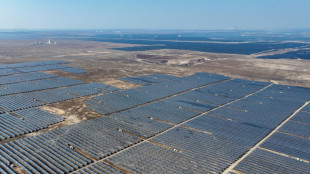 China's rapid solar expansion hurt bird diversity: study
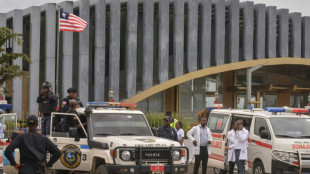
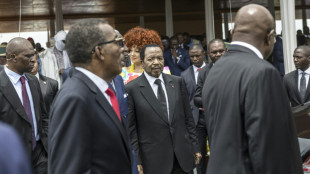 President Paul Biya back in Cameroon after 73 days away

 Newcastle boss Jaissle unfazed by lack of respect

 US Open purse to top $100 mn as Grand Slams form player council

 Hull aim to silence critics after unexpected promotion to Premier League

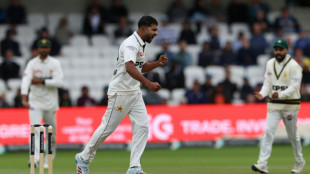 Pakistan hit back against England after Cox and Root fifties

 Walmart reports mixed results as gas prices drag on US sales growth

 Wang downs Sindhu to break Indian hearts at badminton worlds
 As Europe's rivers recede, shippers scramble to limit damage

 Alonso won't confirm Fernandez will remain at Chelsea after Man City link

 Milky Way's fastest star discovered spinning around black hole

 Kanye West planned concerts trigger frenzy in Russia

 Hungary music festival basks in post-Orban freedom

 Vatican says 'serious concerns' over Israel-Lebanon deal implementation
Fernanda, a cleaner from Rio de Janeiro, lists off the items she sold to feed her online gambling addiction, one of millions of Brazilians caught in a betting craze that has swept the nation.
"I lost everything," said the 34-year-old, whose name has been changed to protect her identity. "I sold my TV, my washing machine, everything in my home."
Six years after Brazil legalized online sports betting, Latin America's biggest economy is battling what Finance Minister Fernando Haddad has called a "pandemic," prompting the government to tighten the screws on the sector.
Brazil's central bank estimates that 24 million out of Brazil's 212 million inhabitants, roughly one in nine people, bet online on sporting events or on games like Aviator, Fernanda's favorite, where players gamble on the flight of a virtual airplane.
Online gambling "is going to empty Brazilians' fridges," warned Joao Pedro Nascimento, president of Brazil's securities regulator (CVM).
Sports betting sites now sponsor most of Brazil's major football clubs and flood TV channels and social networks with advertisements featuring stars like Real Madrid striker Vinicius Junior.
But in recent months they have come under growing scrutiny, with experts warning of the risk to users' mental health and finances, and reports emerging of money laundering by gambling sites.
- Poor families hooked -
In a recent bombshell report the central bank revealed that five million beneficiaries of the state's Bolsa Familia allowance for poor families -- one in four of all recipients -- had spent a total of three billion reais (around $540 million) on betting sites in August.
"Many poor people run into debt while trying to earn money with betting. We will have to regulate (the sector). Otherwise we will soon have a casino in every kitchen," President Luiz Inacio Lula da Silva said in late September.
Casinos and other gambling venues have been banned in Brazil since 1941.
The turning point came in 2018 when sports betting was allowed on the condition it was properly regulated and that the proceeds were taxed.
Six years later and the regulations, such as a ban on underage gambling have yet to go into effect, with the measures only set to be implemented in January.
Meanwhile, several hundred betting sites -- most of them based abroad -- operate in a sort of gambling wild west, imposing no rules and paying no taxes.
The Brazilian government recently published a list of around 200 betting sites that have been licensed to operate after agreeing to the new regulations.
Around 2,000 others sites will be blocked from Friday.
- World Cup explosion -
Hermano Tavares runs a treatment program for compulsive gamblers at Sao Paulo university hospital.
The number of patients he receives has risen sharply since 2018 but he said the real "explosion" in numbers took place after the 2022 football World Cup.
"It's one of the most dangerous addictions after crack cocaine," Andre Rolim, a 39-year-old recovering gambler told AFP.
Rolim, an engineer who grew up in a wealthy family in the northeastern city of Fortaleza, ran up huge debts from betting and found himself having suicidal thoughts before entering treatment.
The National Association of Games and Lotteries, which represents some of the big gambling sites, defended the sector in a statement to AFP, insisting that "only a small proportion of all players... around 1-1.5 percent" become hooked.
It admitted however that the addiction was "extremely harmful" to those concerned and their families, and said it was in discussions with NGOs about developing prevention strategies.
Fernanda's savior was her sister, who, she said, "grabbed my phone from my hands" and confiscated it to force her to stop betting.
"Without my family I would never have come through this," she acknowledged.
P.Queiroz--PC