Tariffs, tax cuts, energy: What is in Trump's economic plan? / Photo: Jim WATSON - AFP/File

 Jailed Pakistan ex-PM Khan moved to hospital on court order: party

 Pogacar eyes 'missing' piece ahead of Vuelta return
 US, Canada 'very close' to trade deal, Ottawa says, as details emerge

 Ronaldinho returns in search of 'beautiful' 300th goal

 US pushes allies, China to back Trump's economic war on Iran

 Former NBA MVP Harden reportedly set to return to Cavaliers

 Brook makes Pakistan pay for drop as England dominate first Test

 MemeCore Arrives on Nasdaq Through $1 Billion Landmark Treasury Transaction
 First US deportees land in Liberia
 US, Canada resume talks to finalize trade deal as details emerge

 Europe heatwaves scorch 80 million with 40 C heat: AFP analysis

 Carrick insists Man Utd will make more signings after quiet transfer window

 US warns allies, China to back economic war on Iran

 Manifesto defends Germany's iconic Bauhaus against 'populist attacks'

 Kenya's Kipyegon ends season with hamstring injury

 Nord Stream bomb suspect arrested while working on movie about attack: media

 German football fans plan widespread VAR protests

 Scorching summer triggers record rockfalls in Alps, scientist says

 Newly-crowned European champ Werro turns focus on 800m record

 Hamilton 'fittest ever' as he chases eighth F1 title

 Stocks retreat as bond yield fears persist, oil rises

 ARKBRIDGE’s David Mali Highlights AI-Driven Risk Management at the Finance Magnates London Summit

 Zuckerberg buys Gothic castle in Ireland: spokesman

 Belgium's fire of the century now 'under control'

 Evergrande's Xu Jiayin: from real-estate tycoon to life in prison

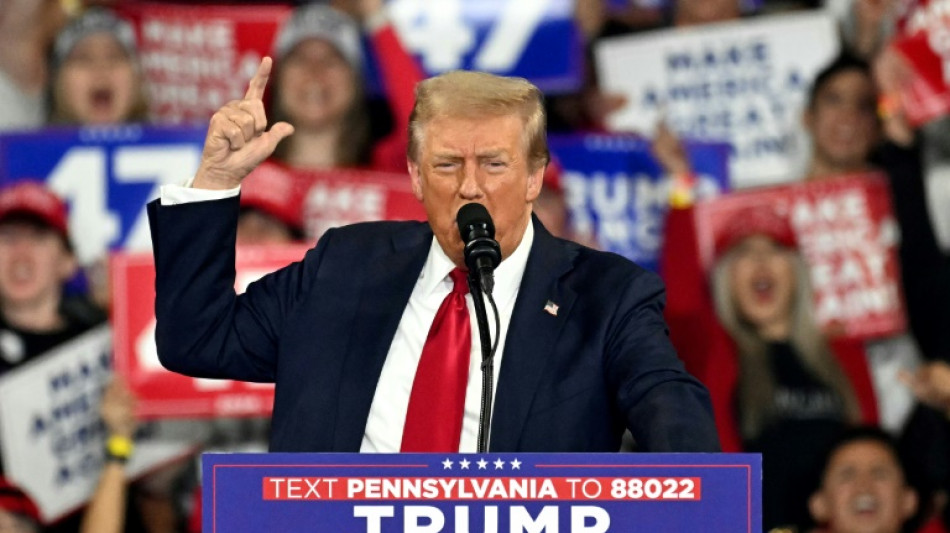
Republican presidential candidate Donald Trump wants to bring back US manufacturing and lower costs, relying on tariffs to boost US coffers and exert pressure on other countries -- but the reality is less straightforward.
Ahead of November's election, economists warn his policies could raise consumer prices and shake up global trade -- with unclear benefits to US production.
The pitch is for tariffs to add billions in revenue and take aim at countries like China which have been "ripping us off," while pushing businesses to bring production back on US shores.
"Other countries are going to finally, after 75 years, pay us back for all that we've done for the world," Trump said in his September debate with Democratic nominee Kamala Harris.
He told a rally in Michigan last week: "Tariffs, to me, are the most beautiful word."
The former president has vowed a 10 percent to 20 percent across-the-board tariff on imports and a 60 percent rate on Chinese goods -- more recently threatening a 200 percent levy on automobiles made in Mexico.
It is US businesses -- not foreign governments, as Trump often asserts -- that pay import taxes on overseas purchases when there are tariffs on such goods, and they can pass on the higher costs, which could add to inflation.
Alongside his tariff plans, Trump wants to extend expiring tax cuts and lower corporate income tax further.
But proposed tariffs could counteract the benefits from his tax policy "while falling short of offsetting the tax revenue losses," said the Tax Foundation think tank.
- Higher costs -
US inflation could rise 1.3 percentage points above baseline next year if Trump imposed a 10 percent universal tariff and other governments retaliate, said the Peterson Institute for International Economics (PIIE).
Sharp hikes on Chinese goods would also fuel inflation, the institute added.
Others, like Bernard Yaros of Oxford Economics, estimates a Trump presidency could raise inflation by 0.6 percentage points at its peak.
Previously, businesses bore the brunt as imported components got more expensive, said Kyle Handley, professor at UC San Diego.
But he noted: "If they do an across-the-board tariff of 10 percent to 20 percent, there's no way we're not going to see that on store shelves."
And it is unlikely that manufacturing can return to the United States in short order.
"We haven't made TVs in the US in decades," Handley said, adding that US factories are not producing at the scale needed to satisfy consumption either.
Trump claims earlier tariff hikes on China and others brought no inflation.
But Handley estimates the supply chain frictions exporters faced were equivalent to a two to four percent tariff hit -- and companies tell AFP they have had to pass on some costs.
A 2019 paper in the Journal of Economic Perspectives found that by end-2018, import tariffs were costing US consumers and importers an additional $3.2 billion per month in added tax costs.
- Rerouting trade -
Trump's tariff plans could also slash bilateral US-China trade by 70 percent, redirecting or eliminating hundreds of billions of dollars' worth of exchanges, said Oxford Economics.
US trade volumes could be cut by 10 percent, becoming more centered on North American and other free trade agreement partners, the advisory firm added.
While the added tariffs would raise some $500 billion in revenue annually, rerouted trade from China could slash this figure closer to $200 billion per year eventually, Yaros said.
Other proposals like revoking a status that shields China from various US levies -- "permanent normal trade relations" -- could also raise inflation by 0.4 percentage points in 2025, PIIE added.
Although Trump wants a "reciprocal trade act" where "countries that make us pay a tax to do business with them will be charged the same tax when they send their product into the United States," Yaros believes this is less likely as it requires bipartisan Congressional support.
- Food, energy -
Trump regularly promises to eliminate inflation, too -- a critical voter concern -- saying he would slash energy bills in half within a year.
Analysts expect that this refers to more deregulation in the domestic oil and gas sector.
But Yaros expressed skepticism that this would "unleash significantly greater production" given that it depends on major energy producers, who in turn have shareholders to answer to.
While Trump wants to lower food costs by allowing less foreign agricultural products into the country, economists have noted that import barriers could trigger retaliation.
This could harm US farmers who export significantly.
M.Carneiro--PC