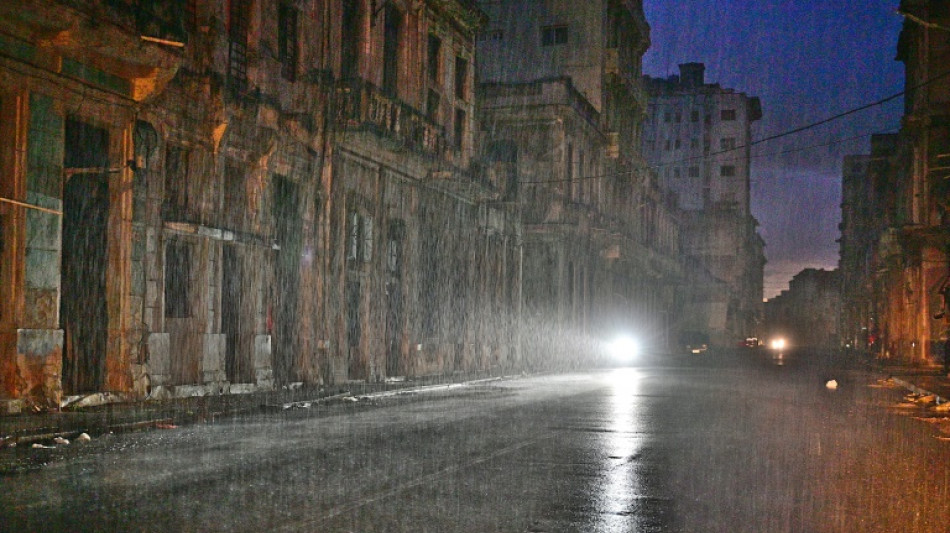
Hurricane set to hit Cuba amid national blackout / Photo: ADALBERTO ROQUE - AFP

 Alcaraz to return for US Open title defence

 China's rapid solar expansion hurt bird diversity: study
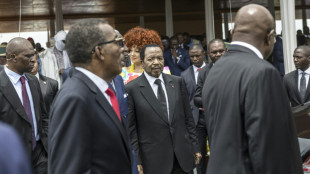 President Paul Biya back in Cameroon after 73 days away
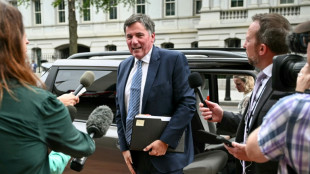
 Newcastle boss Jaissle unfazed by lack of respect
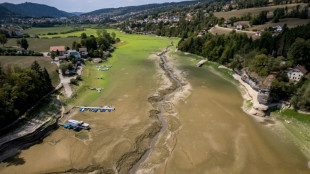
 US Open purse to top $100 mn as Grand Slams form player council
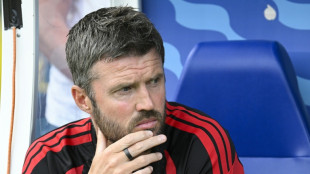
 Hull aim to silence critics after unexpected promotion to Premier League

 Pakistan hit back against England after Cox and Root fifties

 Walmart reports mixed results as gas prices drag on US sales growth

 Wang downs Sindhu to break Indian hearts at badminton worlds

 As Europe's rivers recede, shippers scramble to limit damage

 Alonso won't confirm Fernandez will remain at Chelsea after Man City link
 Milky Way's fastest star discovered spinning around black hole

 Kanye West planned concerts trigger frenzy in Russia

 Hungary music festival basks in post-Orban freedom
 Vatican says 'serious concerns' over Israel-Lebanon deal implementation

 Arteta confirms Arsenal want to sign defender after Konsa link

 What's behind the UAE's decision to cut Iran trade ties?
 Barca seal Cancelo return to bolster defence

 Germany reports record 14,000 heat-related deaths this summer

 Alvarez 'focused' says new Atletico team-mate Romero

 West Ham warn fans about 'offensive' Solomon chant
 Huge questions loom over Prince Harry's shock return to UK

 BYDFi Joins Coinfest Asia 2026, Connecting with Institutions, Builders and Traders in Bali

 Max Verstappen: Natural-born winner
 Van Dijk urges Liverpool to make amends for 'unacceptable' season
A hurricane was bearing down on Cuba Sunday as the island nation's authorities scrambled to restore power following a massive nationwide outage.
The expected arrival of Hurricane Oscar, just days after the failure of Cuba's largest power plant crippled the national grid, piles more pressure on a country already battling sky-high inflation and shortages of food, medicine, fuel and water.
President Miguel Diaz-Canel said Saturday in a post on social media that authorities in the east of the island were "working hard to protect the people and economic resources, given the imminent arrival of Hurricane Oscar".
Packing winds of 140 kilometers (85 miles) per hour, Oscar was forecast to reach eastern Cuba on Sunday, where heavy rains are expected, according to the US National Hurricane Center.
The Cuban presidency said in another social media post that progress had been made in restoring power, with 16 percent of consumers receiving electricity and around 500 megawatts being generated.
That was a fraction of the country's 3,300-megawatt demand on Thursday, the day before the grid collapsed and the government declared an "energy emergency" following weeks of extended outages.
The power grid failed in a chain reaction Friday due to the unexpected shutdown of the Antonio Guiteras power plant, the biggest of the island's eight decrepit coal-fired power plants, according to the head of electricity supply at the energy ministry, Lazaro Guerra.
National electric utility UNE said it had managed to generate a minimal amount of electricity to get power plants restarted on Friday night, but by Saturday morning it was experiencing what official news outlet Cubadebate called "a new, total disconnection of the electrical grid."
Most neighborhoods in Havana remained dark on Saturday, except for hotels and hospitals with emergency generators and the very few private homes with that kind of backup in the economically challenged nation.
"God knows when the power will come back on," said Rafael Carrillo, a 41-year-old mechanic, who had to walk almost five kilometers (three miles) due to the lack of public transportation amid the blackout.
Yaima Vallares, a 28-year-old dancer, told AFP that "everything is very difficult. For almost a day we have had this blackout that makes life so hard for us."
"I am trying to remain calm because there is too much stress over everything in this country," she said.
The blackout followed weeks of power outages, lasting up to 20 hours a day in some provinces.
Prime Minister Manuel Marrero on Thursday declared an "energy emergency," suspending non-essential public services in order to prioritize electricity supply to homes.
Schools across the country are now closed until Monday.
"This is crazy," Eloy Fon, an 80-year-old retiree living in central Havana, told AFP on Friday.
"It shows the fragility of our electricity system... We have no reserves, there is nothing to sustain the country, we are living day-to-day."
- Leaving Cuba -
President Diaz-Canel blamed the situation on Cuba's difficulties in acquiring fuel for its power plants, which he attributed to the tightening, during Donald Trump's presidency, of a six-decade-long US trade embargo.
Cuba is in the throes of its worst economic crisis since the collapse of key ally the Soviet Union in the early 1990s -- marked by soaring inflation and shortages of basic goods.
With no relief in sight, many Cubans have emigrated.
More than 700,000 entered the United States between January 2022 and August 2024, according to US officials.
While the authorities chiefly blame the US embargo, the island is also feeling the aftershocks of the Covid-19 pandemic battering its critical tourism sector, and of economic mismanagement.
To bolster its grid, Cuba has leased seven floating power plants from Turkish companies and also added many small diesel-powered generators.
In July 2021, blackouts sparked an unprecedented outpouring of public anger.
Thousands of Cubans took to the streets shouting, "We are hungry" and "Freedom!" in a rare challenge to the government.
One person was killed and dozens were injured in the protests. According to the Mexico-based human rights organization Justicia 11J, 600 people detained during the unrest remain in prison.
In 2022, the island also suffered months of daily hours-long power outages, capped by a nationwide blackout caused by Hurricane Ian.
M.Gameiro--PC