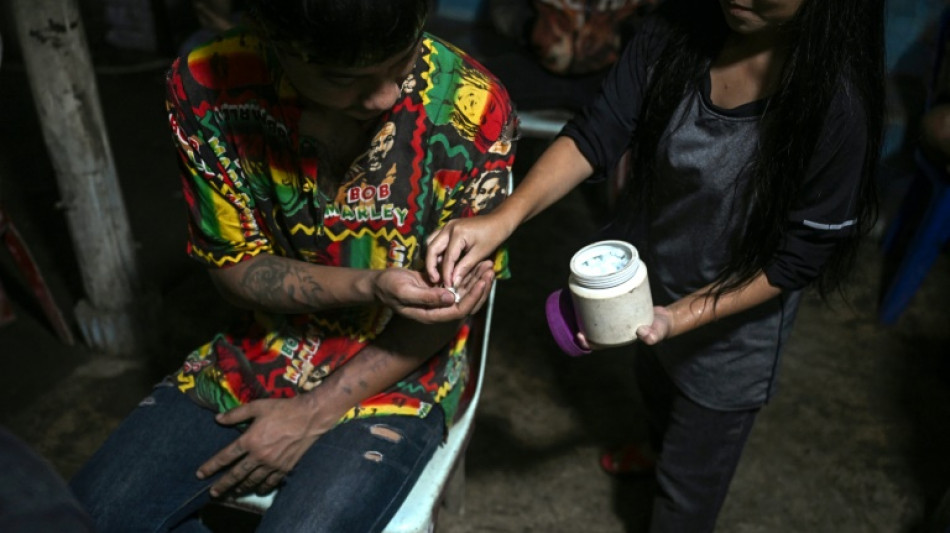
Myanmar's lost generation battles trauma, addiction at jungle rehab / Photo: Lillian SUWANRUMPHA - AFP

 Stocks retreat as bond yield fears persist, oil rises

 ARKBRIDGE’s David Mali Highlights AI-Driven Risk Management at the Finance Magnates London Summit

 Zuckerberg buys Gothic castle in Ireland: spokesman
 Belgium's fire of the century now 'under control'

 Evergrande's Xu Jiayin: from real-estate tycoon to life in prison

 Spurs eyeing move for Man City's Savinho and Marmoush - reports

 Springboks captain Kolisi to miss first All Blacks Test

 Japan to launch probe for Mars moons in October: space agency

 From beach to Bulls: relaxed Tsunoda savours rare F1 drive

 Prince Harry: key dates in life of returning UK royal

 North Korea launches missiles, Seoul says, after Trump floats Kim meet

 Oil jumps on Iran war tensions, offsetting bond yield fears

 Germany identifies far-right suspect in deadly 1970 antisemitic attack
 PrimeXBT Expands Swap-Free Trading to PXTrader 2.0
 Record number of locations in France top 40C over summer: AFP analysis
 Trump pledges 'economic warfare' on Iran, prompting Tehran derision
 'Girl with a Pearl Earring' in Japan, perhaps for the last time

 Russian strikes kill 13 in Kyiv, surrounding region
 'Simply lovely': Verstappen signs new Red Bull contract until 2030

 Australia coach Walters heading to St Helens after World Cup
 China jails founder, fines disgraced property giant Evergrande

 Russian strikes kill 12 in Kyiv, surrounding region
 US India ambassador's Kashmir remarks rile Pakistan; envoy summoned
 In Senegal's Saint-Louis, traces of slave-trading past fade away

 Russian strikes kill 9 in Kyiv, surrounding region
In a drug treatment centre in a wooden stilt house deep in the Thai jungle, young refugees from Myanmar wait patiently for the prick of an acupuncture needle.
They are among the thousands who have become addicted to methamphetamine and other synthetic drugs that have flooded camps housing those forced to flee their homes by Myanmar's civil war.
Myanmar's military ousted Aung San Suu Kyi's government in a February 2021 coup, igniting a conflict that has killed thousands, displaced nearly three million people and triggered a boom in drug production.
A rehabilitation programme across the border in Thailand, run by former addicts, is trying to help stem the rising tide of addiction among young people living in the camps.
"Youths from the camps are hopeless... they don't know what to do. They have no guarantee for jobs and no future," said Marip, a counsellor and former addict, using a pseudonym because of the stigma associated with addiction.
"They end up taking drugs. Drugs are easy to find in the camps," the 34-year-old told AFP at the camp in a remote forest location in Thailand's western province of Tak.
The Drug and Alcohol Recovery and Education (DARE) rehabilitation centre, funded by the UN and other aid agencies, uses acupuncture as part of its regimen along with massages to reduce drug cravings and yoga to help manage intense withdrawal pains.
The group operates in five refugee camps, as well as more than 40 villages in Myanmar's Karen state, and claims a 60 percent success rate for its 90-day treatment programme.
It did not allow AFP to speak to any of its patients or former cases, saying doing so would violate its treatment principles.
- 'Cheaper than beer' -
More than three years of conflict in Myanmar combined with the easy availability of drugs have created a "perfect storm", Edward Blakely, a director at DARE, told AFP.
"You have two large problems, trauma from people who fled their homes and saw their relatives killed and an abundant supply of drugs and a sense of hopelessness," he said.
The junta led by General Min Aung Hlaing is battling multiple armed groups opposed to its rule across the country.
As well as death and displacement, the conflict has also seen law enforcement wither, enabling drug gangs to ramp up production.
The "Golden Triangle" region where Myanmar, Thailand and Laos meet has long been a hub for the illegal drug trade.
But the UN Office on Drugs and Crime (UNODC) said in a report this year that methamphetamine production has "significantly increased", sending wholesale prices of the drug's crystal form crashing from over $10,000 a tonne in 2019 to $4,000 a tonne in 2023.
On the streets and in the camps, a tablet of "yaba" -- a potent mix of methamphetamine and caffeine -- can be bought for small change.
"They are so cheap at this point, it is really easy for people to buy drugs," Benedikt Hofmann, the UNODC's Southeast Asia and Pacific deputy representative, told AFP.
"Right now, in most parts of the Mekong, getting a tablet of yaba is cheaper than buying a beer."
- Drug-funded groups -
The displacement camps are in border regions of Myanmar mostly controlled by ethnic minority armed groups -- many of which fund their activities by making and trafficking drugs.
One senior anti-drugs police official in Myanmar told AFP that many new trafficking routes had opened up around the country due to the fighting.
"We face many difficulties in cracking down on the drug trade," the official who asked not to be named told AFP.
"The problem is severe, as many armed groups are involved."
The costs fall on those who have suffered most, and counsellor Marip told AFP: "There is no price that compares to the freedom from drugs."
P.Mira--PC