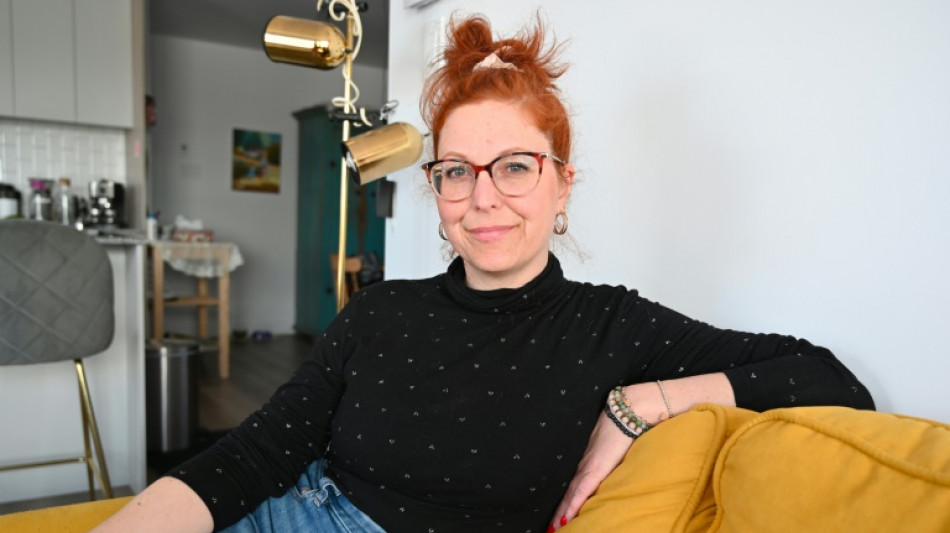
Alzheimer's patient 'relieved' at Quebec's assisted suicide policy shift / Photo: Anne-Sophie THILL - AFP

 Huge questions loom over Prince Harry's shock return to UK

 BYDFi Joins Coinfest Asia 2026, Connecting with Institutions, Builders and Traders in Bali

 Max Verstappen: Natural-born winner

 Van Dijk urges Liverpool to make amends for 'unacceptable' season

 All Blacks replace Tuipulotu with Holland for Springboks Test

 Rain delays start of second day's play in England-Pakistan opener

 Russian strikes kill 16 in Kyiv, surrounding region

 'It is tough': Indonesia battles wildfires, bracing for worse to come

 Seoul detects North Korean missile launches after Trump says to meet Kim

 Thai, Myanmar military chiefs meet as post-coup thaw progresses

 Asian stocks rally as US Treasury steps in to ease bond fears

 Verstappen signs new Red Bull contract until 2030: team

 What property giant Evergrande's sentence means for China's economy

 Australian prosecutors demand life in prison for mushroom killer

 Fallout far-reaching for Australian Rules after latest scandal

 Rafts on Rome's Tiber River cool down overheated tourists

 Top seeds Sabalenka, Zverev stunned in Cincinnati fourth round

 Australia says relations with Israel 'difficult' after aid worker death

 PSG start Ligue 1 defence with eye on Champions League hat-trick

 Arsenal can become world's best club: Arteta

 Japan's King Kazu, 59, scores twice from spot to make cup history

 Kyiv's desperate vendors persevere outside obliterated flea market

 Australia races to shield little penguins from H5N1 bird flu

 Messi scores first goal since father's death

 US national debt exceeds $40 trillion for first time

Sandra Demontigny was afraid of being a prisoner in her own body: a 45-year-old diagnosed with early-onset Alzheimer's, she worried about losing control of her life and burdening those she loves for years.
But the Quebec resident said she is now "relieved" after the Canadian province approved advanced requests for medical assistance in dying (MAID), its voluntary euthanasia program.
As of Wednesday, Quebec has expanded access to euthanasia for people with neurodegenerative diseases. They will now be able to fill out a form -- like a will -- in anticipation of the time when they can no longer consent to care.
"I feel like I finally have control over what's left of my life," said Demontigny, a mother and midwife who lives in Quebec City.
MAID has been offered to the terminally ill in Quebec since 2015, and is widely accepted in the French-speaking province. By authorizing advance requests, Quebec joins a handful of countries where this is also legal -- the Netherlands, Belgium, Luxembourg and Colombia.
"My condition is degenerating," Demontigny said.
"I would have been a prisoner of my body for years," added Demontigny, who remains shaken by her father's experience with Alzheimer's, an incurable disease.
Before dying at age 53, he "talked to himself in the mirror" thinking it was someone else, she said. He also walked "on all fours, banging his head on the wall," before falling to the floor in tears from exhaustion.
For her, it was inconceivable that she would experience such "atrocities" and make her loved ones suffer them. She has been campaigning for years for advance requests to be allowed.
- 'Very strict' criteria -
Polls have steadily shown support for MAID above 80 percent, but individual cases have attracted international headlines about whether the program is too permissive.
Particular scrutiny has focused on whether assisted suicide should be available to people solely suffering from mental illness, or those citing disability as a primary justification to end their life.
Before Wednesday's eligibility expansion, Quebec already had the highest proportion of deaths attributable to medically assisted suicide in the world: it was administered to 5,686 people in 2023, representing 7.3 percent of deaths in the province.
The majority were 70 years of age or older, had cancer, and a survival prognosis of one year or less.
Marie-Eve Bouthillier, medical professor at the Universite de Montreal, said criteria for advanced bookings are "very strict."
Two specialized doctors or nurse practitioners will have to, as prescribed by law, assess whether the patient is experiencing "persistent, unbearable physical or psychological suffering" that cannot be relieved -- which does not systematically happen in people with dementia, for example.
The patient will also have to clearly explain what clinical circumstances he or she considers intolerable -- for example, no longer recognizing their children, or incontinence -- to set a bar for when they should be provided an assisted death.
Federal Health Minister Mark Holland noted Monday that "it is still illegal in this country under the Criminal Code to enact advance requests" for MAID.
But, he added, "it is the responsibility of the provinces to pursue violations of the Criminal Code," and Ottawa will not challenge Quebec's new rules.
- An 'execution'? -
Criminality aside, doctors have voiced concern.
At the final stage, "what will be the most difficult will be to administer medical assistance in dying to someone who is not aware of it and who will not remember having asked for it," explained David Lussier, a member of the Commission on End-of-Life Care of Quebec.
If the patient makes a "gesture of refusal," the doctor must cancel the procedure. But if a patient "resists, and it is part of their illness, we can still give it" -- which could raise ethical questions for professionals, he added.
Claude Rivard, a doctor who has administered euthanasia hundreds of times over the past decade, fears that it will be necessary to use restraint measures to install intravenous lines.
"In the family's mind, it could appear as an execution," said Rivard, who has decided not to get involved in advance requests.
Laurent Boisvert, another doctor who has administered assisted deaths since 2015, downplayed these as "theoretical" fears and said he saw no issues with Quebec's new policy.
"The person who is in his right mind, who communicates with his loved ones and society, will be gone," he explained.
"If we take the human being as a whole, it is not the same person and I will respond to the wishes of the person who was fit, who had a life that he considers to be dignified and decent, and who is no longer here."
F.Cardoso--PC