-
 Rain delays start of second day's play in England-Pakistan opener
-
PrimeXBT Expands Swap-Free Trading to PXTrader 2.0

-
 Russian strikes kill 16 in Kyiv, surrounding region
-
Record number of locations in France top 40C over summer: AFP analysis
-
 'It is tough': Indonesia battles wildfires, bracing for worse to come
-
Trump pledges 'economic warfare' on Iran, prompting Tehran derision
-
 Seoul detects North Korean missile launches after Trump says to meet Kim
-
'Girl with a Pearl Earring' in Japan, perhaps for the last time

-
 Thai, Myanmar military chiefs meet as post-coup thaw progresses
-
Russian strikes kill 13 in Kyiv, surrounding region
-
 Asian stocks rally as US Treasury steps in to ease bond fears
-
'Simply lovely': Verstappen signs new Red Bull contract until 2030
-
 Verstappen signs new Red Bull contract until 2030: team
-
Australia coach Walters heading to St Helens after World Cup

-
 What property giant Evergrande's sentence means for China's economy
-
China jails founder, fines disgraced property giant Evergrande
-
 Australian prosecutors demand life in prison for mushroom killer
-
Russian strikes kill 12 in Kyiv, surrounding region
-
 Fallout far-reaching for Australian Rules after latest scandal
-
US India ambassador's Kashmir remarks rile Pakistan; envoy summoned
-
 Rafts on Rome's Tiber River cool down overheated tourists
-
In Senegal's Saint-Louis, traces of slave-trading past fade away

-
 Top seeds Sabalenka, Zverev stunned in Cincinnati fourth round
-
Russian strikes kill 9 in Kyiv, surrounding region

-
 Australia says relations with Israel 'difficult' after aid worker death
-
Messi scores first goal since father's death in Miami draw

-
 PSG start Ligue 1 defence with eye on Champions League hat-trick
-
Mercedes and Max: What to watch as F1 returns for Dutch GP

-
 Arsenal can become world's best club: Arteta
-
'People, not robots': Ukraine's soldiers justify human role amid drone revolution
-
 Japan's King Kazu, 59, scores twice from spot to make cup history
-
North Sea drilling tests UK govt climate pledge

-
 Kyiv's desperate vendors persevere outside obliterated flea market
-
'Ray of hope': Gaza seed bank rebuilds after wartime destruction
-
 Australia races to shield little penguins from H5N1 bird flu
-
Mourinho begins second Real Madrid reign with Barca in his sights
-
 Messi scores first goal since father's death
-
'More confrontational': Iran's new hardline security leadership
-
 US national debt exceeds $40 trillion for first time
-
UK summons Israeli envoy over West Bank settlement project

-
 Brazilian narco violence spills over into tranquil Bolivia
-
Trump vows 'tremendous' economic costs on Iran partners
-
 Trump's devoted 'human printer' in media glare
-
Germany, France, UN condemn far-right Israeli minister's 'inhumane' Gaza remarks

-
 Top seed Zverev bundled out by Paul in rain-hit Cincinnati upset
-
Prince Harry and Meghan moving back to UK: British press
-
 WADA pledges vigilance on Russian athletes ahead of 2028 Olympics
-
Lee, Baena guide Atletico to opening Liga win over Malaga

-
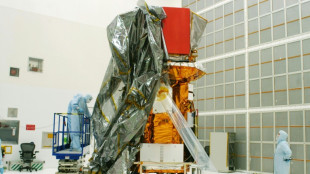 NASA satellite rescue mission fails
-
Ecuador intel chief, five Americans killed in Kenya helicopter crash

Germany dodges recession but inflation rises sharply
Germany dodged a technical recession after posting surprise growth in the third quarter, official data showed Wednesday, but the rare good news for Europe's largest economy was tempered by a sharp uptick in inflation.
German gross domestic product expanded 0.2 percent quarter-on-quarter, federal statistics office Destatis said in preliminary data, thanks to higher government spending and household consumption.
The figure defied expectations, and the government of Chancellor Olaf Scholz had braced for another slight drop in GDP after output already fell in the second quarter.
Economy Minister Robert Habeck said the quarter-on-quarter expansion was a "ray of hope" for the German economy, which has been battered in recent years by high energy costs, cooling exports and increased Chinese competition.
"The economy is proving more robust than previously forecast and the technical recession expected by many has not materialised," Habeck was quoted as saying by German media.
A technical recession is defined as two consecutive quarters of contraction.
Germany's performance helped lift the wider eurozone economy, which on Wednesday reported forecast-beating growth of 0.4 percent over the July-September period.
LBBW analyst Elmar Voelker said although it was "too early to speak of a positive trend reversal" for Germany, it was "encouraging that private consumption is showing the first signs of recovery".
The news for Germany wasn't all good however as Destatis revised downwards its figure for the second quarter, saying GDP shrank by 0.3 percent instead of the previous estimate of a 0.1-percent decline.
German inflation also sprang a negative surprise, climbing back up to two percent in October after falling to a more than three-year-low of 1.6 percent in September.
The uptick "shows that inflationary pressure in Germany is still very much alive and kicking," said ING economist Carsten Brzeski.
- Manufacturing slump -
The headwinds plaguing the German economy, particularly surging energy costs due to Russia's war in Ukraine, have taken a heavy toll on the country's crucial industrial sector.
Nowhere has the manufacturing downturn been more visible than in Germany's flagship auto sector.
Europe's biggest carmaker Volkswagen reported a sharp fall in third-quarter net profits Wednesday and warned of an "urgent need" to cut costs to boost its competitiveness.
Volkswagen is considering closing at least three German plants and slashing tens of thousands of jobs, labour leaders told employees this week, as the company confronts stiff Chinese competition especially in electric vehicles.
Volkswagen, BMW and Mercedes-Benz all lowered their annual outlook in September, citing falling Chinese demand.
- Government under pressure -
Long-standing structural challenges have deepened Germany's woes, including complex bureaucracy, under-investment in infrastructure, an ageing workforce and a costly green energy transition.
Pressure has mounted on Scholz to take action, but his fragile three-party coalition is at odds over how best to turn the economic tide.
Habeck, from the Greens party, last week proposed a multi-billion-euro investment bonanza to help German business, but the idea was shot down by hawkish Finance Minister Christian Lindner from the liberal FDP.
Lindner is a staunch defender of Germany's constitutionally enshrined debt limits and has resisted calls from other coalition members to loosen the rules.
The International Monetary Fund has waded into the debate, with its European head Alfred Kammer on Tuesday saying Germany needed structural reforms as well as public infrastructure investments.
To achieve this, he told the Sueddeutsche newspaper, "the debt brake can be relaxed".
Germany was the only major advanced economy to shrink in 2023 and the government has previously said it expects another mild contraction in 2024.
But it now sees a recovery starting in 2025, when easing inflation and higher wages are expected to further bolster consumption.
T.Batista--PC