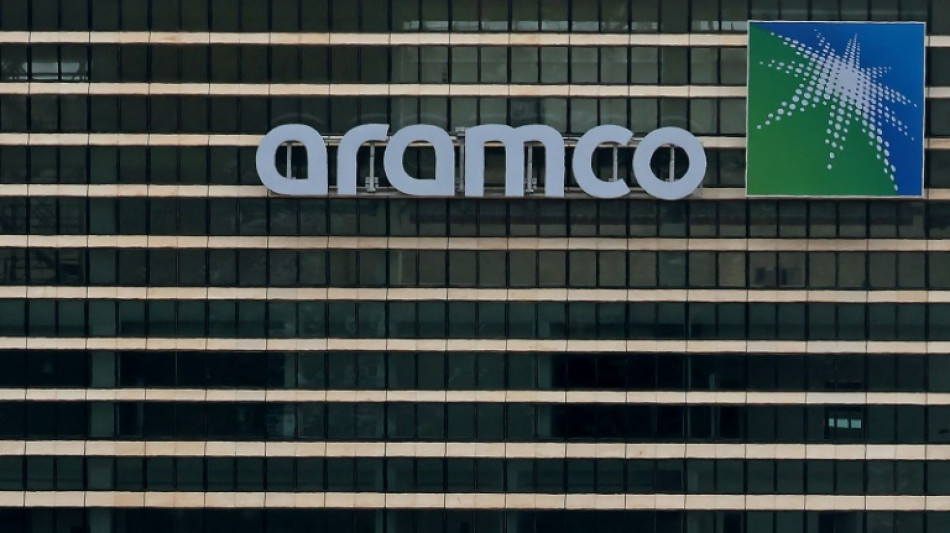
Saudi Aramco's quarterly profit drops 15% on low oil prices / Photo: Fayez Nureldine - AFP/File

 Thai, Myanmar military chiefs meet as post-coup thaw progresses

 Asian stocks rally as US Treasury steps in to ease bond fears

 Verstappen signs new Red Bull contract until 2030: team

 What property giant Evergrande's sentence means for China's economy

 Australian prosecutors demand life in prison for mushroom killer

 Fallout far-reaching for Australian Rules after latest scandal
 Rafts on Rome's Tiber River cool down overheated tourists

 Top seeds Sabalenka, Zverev stunned in Cincinnati fourth round

 Australia says relations with Israel 'difficult' after aid worker death

 PSG start Ligue 1 defence with eye on Champions League hat-trick

 Arsenal can become world's best club: Arteta
 Japan's King Kazu, 59, scores twice from spot to make cup history

 Kyiv's desperate vendors persevere outside obliterated flea market
 Australia races to shield little penguins from H5N1 bird flu

 Messi scores first goal since father's death
 US national debt exceeds $40 trillion for first time
 Brazilian narco violence spills over into tranquil Bolivia
 Trump's devoted 'human printer' in media glare

 Top seed Zverev bundled out by Paul in rain-hit Cincinnati upset

 WADA pledges vigilance on Russian athletes ahead of 2028 Olympics

 NASA satellite rescue mission fails
 Cobolli halts Jodar to reach Cincinnati quarter-finals

 As election looms, Netanyahu puts Turkey in Israel's crosshairs

 McIlroy questions LIV stars 'value' as talk of PGA return builds
 'Breakthrough' mRNA cancer drug curbs melanoma in large trial

Energy giant Saudi Aramco reported a 15 percent year-on-year drop in third quarter profit on Tuesday, citing prices which have stayed low despite production cuts and war in the Middle East.
The fall in net income to $27.56 billion from $32.58 billion in 2023 is the seventh consecutive quarterly drop for Aramco, one of the world's biggest companies by market capitalisation.
Aramco is the chief source of revenue for Crown Prince Mohammed bin Salman's Vision 2030 reform agenda, which aims to remodel the Gulf kingdom's crude-reliant economy.
The lower third quarter profit "was mainly due to the impact of lower crude oil prices and weakening refining margins", Aramco said in a statement to the Saudi stock exchange.
Following a series of output cuts since October 2022, the world's biggest crude oil exporter is currently producing roughly nine million barrels per day (bpd), well below its capacity of 12 million bpd.
Yet despite lower production, as well as widening conflict in the Middle East, prices have remained low because of concerns about market oversupply.
Brent crude was priced at around $75 per barrel on Tuesday -- much cheaper than Saudi Arabia's estimated fiscal break-even mark.
"Aramco delivered robust net income and generated strong free cash flow during the third quarter, despite a lower oil price environment," chief executive Amin Nasser said in a statement.
The firm will maintain its $10.8 billion performance-based dividend for another quarter alongside its $20.3 billion base dividend, the statement said.
- 'No supply disruptions' -
Soaring energy prices following Russia's invasion of Ukraine allowed Aramco to post record profits in 2022, before they dipped by 25 percent last year.
Profits were down 14.5 percent in the first quarter of 2024 and 3.4 percent in the second quarter.
Israel's war against Hamas has drawn in Iran-backed groups from across the region and led to direct strikes between Israel and Iran, spurring fears about oil supply.
Yet while Brent rose above $80 per barrel in early October, it has not approached $96.2 -- the mark the International Monetary Fund has identified as break-even for the Saudi budget at current production levels.
"The markets appear to be dismissing geopolitical risk in the Middle East, so anything short of an actual supply disruption" will be unlikely to exert upward pressure on prices, said Amena Bakr, senior research analyst at Energy Intelligence.
"So far there have been no supply disruptions."
The year-on-year drop in profits "isn't coming as a surprise to the government which has already revised down revenue expectations for this year based on weakening oil markets", said Jamie Ingram, senior editor at the Middle East Economic Survey.
- 'Maximising prices' -
On Sunday, Saudi Arabia and seven other members of the OPEC+ group of oil-producing nations said they were extending a 2.2 million-barrel reduction announced in November 2023 by another month, until the end of December.
"When it comes to oil production policy, they'll be trying to assess what will ultimately bring in the most revenue," Ingram said.
"Is it maximising volumes or maximising prices? For now, the strategy remains the latter."
The government's stake in Aramco is around 81.5 percent, while the Saudi sovereign wealth fund, the Public Investment Fund, holds 16 percent.
Aramco is pushing to diversify from its core business, "investing big-time in renewable and hydrogen and carbon capture and storage" while also "making sure that we are growing our oil and gas activities and petrochemicals", Nasser told an investor forum in Riyadh last week.
The company's initial public offering in 2019, the biggest flotation in history, raised $29.4 billion, and a secondary offering this year of nearly 1.7 billion shares fetched $12.35 billion.
Aramco's profits help finance flagship projects including NEOM, the planned futuristic mega-city being built in the desert, a giant airport in Riyadh and major tourism and leisure developments.
The Saudi finance ministry has acknowledged that spending will outstrip revenue in the short term, and in September it projected a budget deficit of 2.3 percent of GDP in 2025 and for deficits to continue through 2027.
A.Magalhes--PC