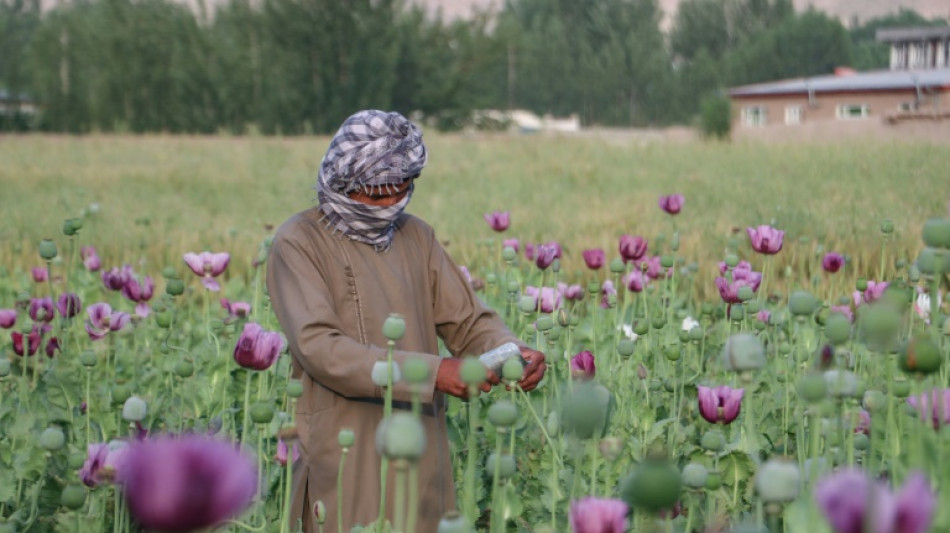
Afghanistan poppy cultivation grows 19 percent despite ban: UN / Photo: OMER ABRAR - AFP/File

 Thai, Myanmar military chiefs meet as post-coup thaw progresses
 Asian stocks rally as US Treasury steps in to ease bond fears

 Verstappen signs new Red Bull contract until 2030: team

 What property giant Evergrande's sentence means for China's economy

 Australian prosecutors demand life in prison for mushroom killer
 Fallout far-reaching for Australian Rules after latest scandal
 Rafts on Rome's Tiber River cool down overheated tourists
 Top seeds Sabalenka, Zverev stunned in Cincinnati fourth round

 Australia says relations with Israel 'difficult' after aid worker death

 PSG start Ligue 1 defence with eye on Champions League hat-trick

 Arsenal can become world's best club: Arteta
 Japan's King Kazu, 59, scores twice from spot to make cup history

 Kyiv's desperate vendors persevere outside obliterated flea market
 Australia races to shield little penguins from H5N1 bird flu

 Messi scores first goal since father's death
 US national debt exceeds $40 trillion for first time
 Brazilian narco violence spills over into tranquil Bolivia
 Trump's devoted 'human printer' in media glare

 Top seed Zverev bundled out by Paul in rain-hit Cincinnati upset

 WADA pledges vigilance on Russian athletes ahead of 2028 Olympics

 NASA satellite rescue mission fails
 Cobolli halts Jodar to reach Cincinnati quarter-finals

 As election looms, Netanyahu puts Turkey in Israel's crosshairs

 McIlroy questions LIV stars 'value' as talk of PGA return builds
 'Breakthrough' mRNA cancer drug curbs melanoma in large trial

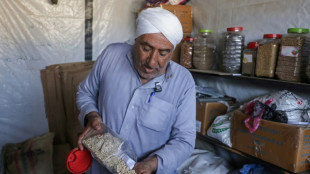
Opium cultivation rose by 19 percent in Afghanistan this year, the UN reported Wednesday, despite a Taliban government ban that almost eradicated the crop.
Currently, 12,800 hectares of poppies are cultivated in Afghanistan -- where up to 80 percent of the population depends on agriculture -- a new survey by the United Nations Office on Drugs and Crime (UNODC) shows, the agency said in a statement.
The 19 percent increase year-on-year remains far below the 232,000 hectares cultivated when Taliban supreme leader Hibatullah Akhundzada banned the crop in April 2022, nearly a year after the Taliban returned to power, UNODC added.
The centre of poppy cultivation has also shifted, the agency noted, and is now concentrated in northeastern provinces instead of in the Taliban strongholds of southern Afghanistan.
In May, clashes between farmers and brigades sent to destroy their poppy fields resulted in several deaths in northeastern Badakhshan.
Following the poppy ban, prices soared for the resin from which opium and heroin are made.
During the first half of 2024, prices stabilised around $730 per kilogram, (two pounds) according to the UNODC, compared to about $100 per kg before 2022.
For years Afghanistan was the world's biggest supplier of opium and heroin.
Many farmers in Afghanistan, one of the poorest countries in the world, were hit hard financially by the ban and have not been able to reap the same profits from alternative crops.
Even legal crops are only a short-term solution, according to the International Crisis Group (ICG), "so the focus should be on job creation in non-farm industries".
The UNODC and the UN Assistance Mission in Afghanistan (UNAMA) called for international support for farmers to transition to alternative crops and livelihoods, something the Taliban government has requested.
"With opium cultivation remaining at a low level in Afghanistan, we have the opportunity and responsibility to support Afghan farmers to develop sustainable sources of income free from illicit markets," said UNODC Executive Director Ghada Waly in the statement.
G.Machado--PC