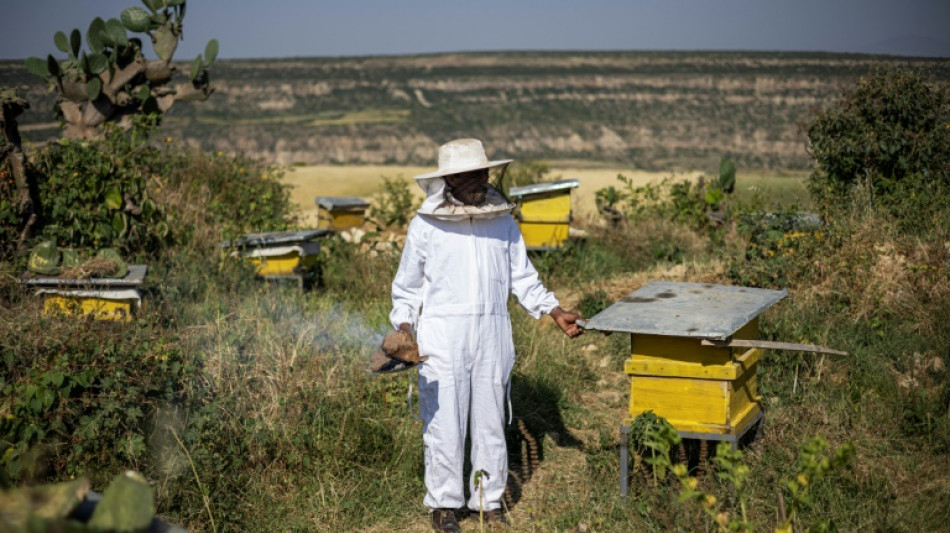
Ethiopia's famed honeybees make slow recovery from war / Photo: Michele Spatari - AFP

 Thai, Myanmar military chiefs meet as post-coup thaw progresses

 Asian stocks rally as US Treasury steps in to ease bond fears

 Verstappen signs new Red Bull contract until 2030: team

 What property giant Evergrande's sentence means for China's economy

 Australian prosecutors demand life in prison for mushroom killer

 Fallout far-reaching for Australian Rules after latest scandal

 Rafts on Rome's Tiber River cool down overheated tourists
 Top seeds Sabalenka, Zverev stunned in Cincinnati fourth round

 Australia says relations with Israel 'difficult' after aid worker death

 PSG start Ligue 1 defence with eye on Champions League hat-trick

 Arsenal can become world's best club: Arteta

 Japan's King Kazu, 59, scores twice from spot to make cup history

 Kyiv's desperate vendors persevere outside obliterated flea market
 Australia races to shield little penguins from H5N1 bird flu

 Messi scores first goal since father's death

 US national debt exceeds $40 trillion for first time
 Brazilian narco violence spills over into tranquil Bolivia

 Trump's devoted 'human printer' in media glare

 Top seed Zverev bundled out by Paul in rain-hit Cincinnati upset

 WADA pledges vigilance on Russian athletes ahead of 2028 Olympics

 NASA satellite rescue mission fails

 Cobolli halts Jodar to reach Cincinnati quarter-finals

 As election looms, Netanyahu puts Turkey in Israel's crosshairs

 McIlroy questions LIV stars 'value' as talk of PGA return builds
 'Breakthrough' mRNA cancer drug curbs melanoma in large trial

In his stone house perched on a hill in northern Ethiopia, Amanuel Hiluf puts on his protective suit, carefully adjusting the hood and gloves.
"We have to hurry up, it starts to be hot, and the bees will be upset," he says.
In his garden in Hawidela, a village about an hour from Mekele, capital of the Tigray region, the beekeeper has about 40 hives from which clouds of bees are soon escaping.
For nearly 20 years, his hives have produced white honey, a creamy, highly prized variety for which the northernmost region of Ethiopia is famous.
Amanuel, 42, remembers a time when they produced "in abundance".
But that was before the war in Tigray between federal government troops and Tigrayan rebels that raged from 2020 to 2022, which forced him to flee with his wife and children.
"In this region, there was a lot of damage," he says, pointing to a hill from which shells were fired.
When he returned a few months later, all his hives -- and his livelihood -- had been destroyed.
Before the war, he could produce about 600 kilos (1,300 pounds) of white honey each year and earn some 900,000 birr (about $7,500 at today's rates).
That is a considerable sum in a country where more than a third of the population lives below the poverty line, according to the World Bank.
When he resumed production, Amanuel said he had lost 95 percent of his earnings. He has gradually rebuilt the hives, but still only produces 100 kilos.
- 'Sound of misery' -
The situation is replicated across Tigray.
Goshu Welealeabzgi, a specialist for the Tigray authorities' Bureau of Agriculture and Natural Resources, says 40 to 60 percent of hives were destroyed by the war.
Before the conflict, he estimates there were 500,000 colonies in Tigray, with 200,000 people directly dependent on beekeeping, in a region of around six million inhabitants.
Bees were also victim to the environmental damage caused by the conflict, especially as desperate locals were forced to cut down trees, particularly the acacias that covered the hills, to sell or use for firewood.
"If trees are lost and flowers are lost, production will decrease," says Amanuel.
"The conflict harmed everybody," he adds. "The sound of bullets has stopped, but there is still the sound of misery."
His hives are home to Apis mellifera monticola bees, a particularly productive species that can survive the region's high altitudes. Mekele sits at more than 2,200 metres above sea level.
Ethiopia, an East African country with a population of around 120 million, is the continent's largest producer of honey.
Nectar is particularly important in Ethiopian culture, with yellow honey used to produce tej, a popular local mead.
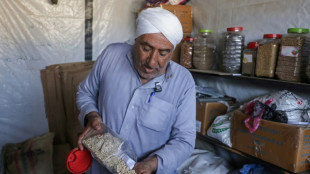
Amanuel regularly sells his honey to Birhanu Araya, who runs a small shop in Mekele where dozens of cans containing the precious nectar are piled up.
"There are only very few (bees) due to the war and drought," says 61-year-old Birhanu, who has been running his business for 25 years.
"The amount that's entering now is small and the price is very high," he adds.
Goshu says he remains optimistic.
"If resources are allocated and the community gets onboard, maybe it could recover in three to five years," he says.
"We have to look forward."
P.Queiroz--PC