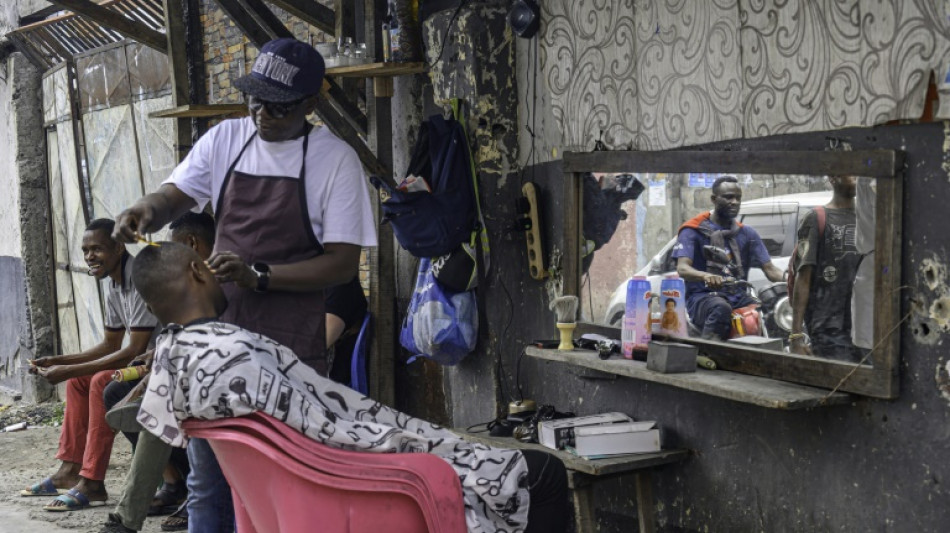
On Kinshasa's streets hairdressers make a quick buck / Photo: Hardy BOPE - AFP

 Thai, Myanmar military chiefs meet as post-coup thaw progresses
 Asian stocks rally as US Treasury steps in to ease bond fears

 Verstappen signs new Red Bull contract until 2030: team

 What property giant Evergrande's sentence means for China's economy

 Australian prosecutors demand life in prison for mushroom killer
 Fallout far-reaching for Australian Rules after latest scandal
 Rafts on Rome's Tiber River cool down overheated tourists
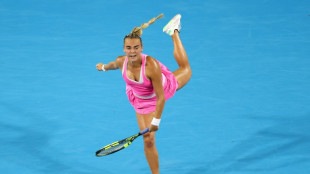 Top seeds Sabalenka, Zverev stunned in Cincinnati fourth round
 Australia says relations with Israel 'difficult' after aid worker death

 PSG start Ligue 1 defence with eye on Champions League hat-trick
 Arsenal can become world's best club: Arteta
 Japan's King Kazu, 59, scores twice from spot to make cup history
 Kyiv's desperate vendors persevere outside obliterated flea market
 Australia races to shield little penguins from H5N1 bird flu
 Messi scores first goal since father's death
 US national debt exceeds $40 trillion for first time
 Brazilian narco violence spills over into tranquil Bolivia
 Trump's devoted 'human printer' in media glare

 Top seed Zverev bundled out by Paul in rain-hit Cincinnati upset

 WADA pledges vigilance on Russian athletes ahead of 2028 Olympics

 NASA satellite rescue mission fails
 Cobolli halts Jodar to reach Cincinnati quarter-finals

 As election looms, Netanyahu puts Turkey in Israel's crosshairs
 McIlroy questions LIV stars 'value' as talk of PGA return builds
 'Breakthrough' mRNA cancer drug curbs melanoma in large trial
Standing in a makeshift salon on the side of a dusty backstreet in Democratic Republic of Congo capital Kinshasa Papy Kalume pulled a fresh razor out of his bag.
The 47-year-old barber placed the "Gillette" -- as it is commonly called by street hairdressers in the city -- against the back of a customer's head and began to shave.
Kalume is one of thousands trying to make ends meet with an off-the-books job in a country which, according to official figures, has nearly 50 percent unemployment.
It only took him a few minutes for him to finish.
But Kalume, like many street barbers, has spent years perfecting his technique on neighbourhood children and relatives.
"You have to master the blade to style hair well," Kalume told AFP.
"The Gillette can easily injure (someone)," he added.
Brushing any stray hairs from around the customer's neck and shoulders he finished the cut.
Clients are then treated to a spray of disinfectant on the back of the head and neck to treat any accidental cuts, then a slap of talcum powder.
Dozens of men come into Kalume's makeshift salon every day, sitting on an office chair so dilapidated only the seat and metal frame remain, in front of a cracked mirror.
The haircut costs the equivalent of 70 cents (US $0.70, 2,000 Congolese francs).
"We earn the bread that God gives us," said Kalume.
In a hair salon a few blocks away it cost almost 30 times more for a haircut.
But that salon is often deserted.
- A 'pirate market' -
Kalume is just one of thousands of Congolese people with an unofficial job.
In the same neighbourhood of Kinshasa where he works, teenage shoe-shiners can be heard tapping their wooden brushes to attract customers.
Coffee sellers push carts topped with flasks through bumpy streets. Men weave through cars on busy roads selling water to thirsty drivers.
Nearly half of the population is unemployed in DRC, according to the planning ministry.
And among those who are employed "only four percent are employed in the formal economy, 72% work in the informal economy," according to a 2021 report from the International Labour Organization
The country is one of the five poorest nations in the world. In 2023, almost three quarters of the population lived on less than$2.15 a day, according to the World Bank.
The informal sector accounted for an estimated 41.8 percent of DRC's GDP in 2022, said a study from the South Africa-based Institute for Security Studies (ISS) published in May.
This was the third highest in Africa after Zimbabwe and Tanzania, whose informal sectors made up 54.5 percent and 45.6 percent of GDP in 2022 respectively.
Kalume did work "officially" for a few years in a regular salon.
But he found it would be more profitable to set up his own business, even if it does come with some disadvantages.
"In the street we are exposed to bad weather, rain," said Kalume, whose salon is open from 6:00 am to 5:00 pm, Monday to Saturday.
He is also has to pay off the police for so-called infringements: these "tips" -- often referred to as "hassles" or "tracasseries" in French -- are commonplace.
He also has to pay a few bucks to avoid being evicted from the sidewalk where he works.
"It's a pirate market," he said with a sigh.
A.Seabra--PC